Facts
The State of Haryana acquired 3.14 acres of land in Village Jhopra, District Sirsa, along with land in four other villages, for construction of the Sirsa bypass road pursuant to notifications under Sections 4 and 6 of the Land Acquisition Act, 1894, dated 12 September 2008 and 15 June 2009, respectively.
Source reference: paras. 1, 3The Land Acquisition Collector assessed the market value at ₹12,00,000 per acre by award dated 29 June 2011.
Source reference: paras. 1, 4On reference under Section 18, the Reference Court enhanced the market value to ₹21,00,000 per acre and granted severance charges at 60% where less than two acres were acquired and 40% where more than two acres were acquired.
Source reference: paras. 1, 5Both the landowners and the State preferred appeals/cross-objections. The landowners relied principally on an award concerning Village Meerpur, where compensation had been assessed at ₹50,00,000 per acre, while the State relied on sale deeds indicating lower values.
Source reference: paras. 6–7Issues
Whether the market value of the acquired land in Village Jhopra should be enhanced by relying on the award concerning Village Meerpur or the valuation relating to Village Nezadela.
Source reference: paras. 12–17Whether the Reference Court correctly awarded severance charges at fixed rates of 60% or 40% of the compensation without determining the actual effect of severance on the remaining land.
Source reference: paras. 18–20Whether statutory benefits under Sections 23(1A) and 23(2) of the Land Acquisition Act, 1894, could be granted on severance charges.
Source reference: para. 19Law Applied
Appeals under Section 54 of the Land Acquisition Act, 1894, permit reconsideration of the compensation determined by the Reference Court.
Source reference: para. 1Market value should ordinarily be determined on the basis of reliable and comparable exemplar sale deeds; previous awards are relevant evidence but are not binding and cannot be followed mechanically.
Source reference: paras. 15–16The court relied on Manoj Kumar v. State of Haryana, 2018 (13) SCC 96, which held that previous awards must be examined with reference to the nature, location, similarity and evidentiary basis of the land, and on Ram Krishan (Since Deceased) v. State of Haryana, 2025 SCC OnLine SC 715, which clarified that previous awards may be considered as a piece of evidence.
Source reference: paras. 15–16Section 25 of the 1894 Act and the principles discussed in Lal Chand v. Union of India, (2009) 15 SCC 769, were also considered in relation to valuation evidence.
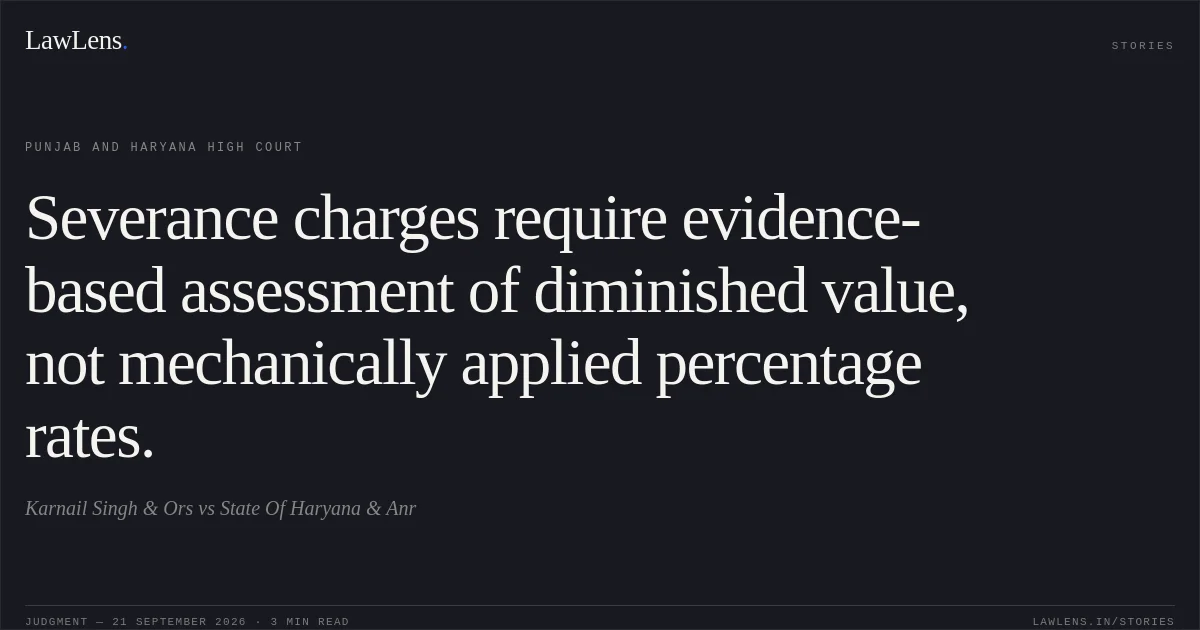
Source reference: para. 13Severance compensation must reflect the actual diminution in value or utility of the remaining land and cannot be awarded mechanically by applying a uniform percentage.
Source reference: paras. 18–20Benefits under Sections 23(1A) and 23(2) are payable on the market value and not on severance charges.
Source reference: para. 19Reasoning
The Court rejected reliance on the Meerpur award because Meerpur possessed locational advantages that were not available to Village Jhopra, although the two areas were in proximity and were acquired under the same notification.
Source reference: paras. 13, 16The State’s sale deeds were not accepted as determinative because they disclosed values below even the Collector’s assessment and did not represent the true market value in the prevailing circumstances.
Source reference: para. 13Since the Reference Court had assessed the value of the adjoining Village Nezadela at ₹21,50,000 per acre, and this Court had independently revised that valuation to ₹26,01,500 per acre, the same revised rate was considered appropriate for the acquired land in Village Jhopra.
Source reference: para. 16On severance, the Court found that the Reference Court had applied the 60%/40% formula without examining the size and location of the severed portion, the area and possession of the remaining land, its use before and after acquisition, and the possible increase in its value due to construction of the bypass.
Source reference: paras. 18–20Such factual determination was necessary before awarding severance compensation. The Reference Court had also incorrectly extended statutory benefits to severance charges.
Source reference: para. 19Holding
The market value of the acquired land was enhanced and fixed at ₹26,01,500 per acre.
The award of severance charges at the uniform rates of 60% or 40% was set aside for reconsideration.
Source reference: paras. 19–20The matter was remanded to the Reference Court, limited to determining severance charges after permitting both parties to lead or address evidence regarding the bifurcation and diminution, if any, of the unacquired land; statutory benefits under Sections 23(1A) and 23(2) were not to be calculated on severance charges.
Source reference: paras. 19–20Any delay in the connected appeals was condoned, but the appellants were held disentitled to interest for the delayed period.
Source reference: para. 10Pending applications were disposed of.
Source reference: para. 21Acts & Sections Cited
6 provisions across 1 statute referred to in this judgment. Linked provisions open on LawLens.
Land Acquisition Act, 18946
Original Court PDF
Karnail Singh & OrsvsState Of Haryana & Anr
Click to open original judgment
Original judgment, available to read, download and summarize on LawLens.in