Facts
Ram Avtar Pandey was allegedly travelling from Ghaziabad to Khurja by a MEMU/passenger train on 13.12.2014 with a valid second-class ordinary ticket.
Source reference: p.3The appellants’ case was that, due to heavy rush and a jerk inside the moving train, he accidentally fell between Ghaziabad and Maripat Railway Stations near Chipiyana Bujurg and sustained fatal injuries; the ticket was allegedly lost at the spot.
Source reference: p.3The Railway Claims Tribunal dismissed the claim application, holding that the deceased was neither a bona fide passenger nor the victim of an “untoward incident” under the Railways Act, 1989.
Source reference: p.3The appellants challenged that decision under Section 23 of the Railway Claims Tribunal Act, 1987.
Source reference: p.3The High Court first condoned the 855-day delay in filing the appeal, considering the appellants’ economic circumstances and the beneficial nature of the legislation.
Source reference: pp.1–2Issues
1. Whether the deceased was a bona fide passenger despite the non-recovery of the journey ticket.
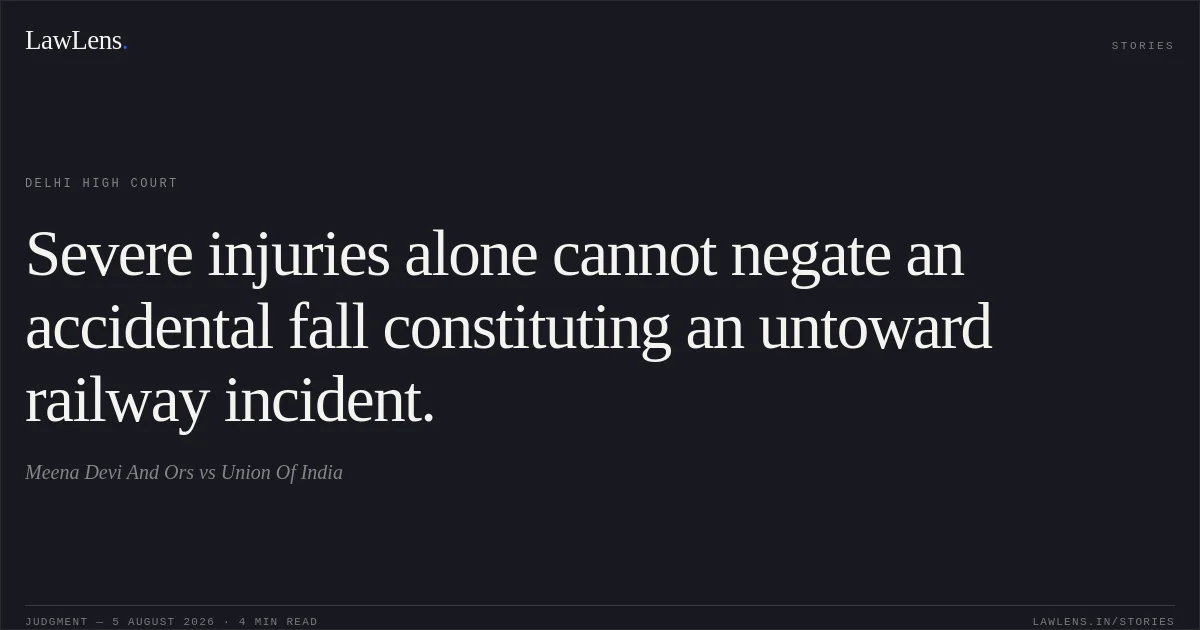
Source reference: p.4; para. 72. Whether the deceased’s death resulted from an “untoward incident” under the Railways Act, 1989, rather than from trespassing and being run over by an unknown train.
Source reference: p.4; para. 7Law Applied
The Court applied Section 23 of the Railway Claims Tribunal Act, 1987, governing appeals against orders of the Railway Claims Tribunal, and Section 124A of the Railways Act, 1989, which imposes strict liability on the Railways for death or injury resulting from an untoward incident.
Source reference: no citationUnder Union of India v. Rina Devi, (2019) 3 SCC 572, non-recovery of a journey ticket is not conclusive proof that the deceased was not a bona fide passenger; the claimant may discharge the initial burden through relevant facts, including affidavit evidence, after which the burden shifts to the Railway Administration to rebut the claim with cogent evidence.
Source reference: p.4; para. 8The Court also relied on Lata v. Union of India, 2026 SCC OnLine SC 1350, reaffirming that an affidavit and surrounding circumstances may establish bona fide travel even where the ticket is not recovered.
Source reference: pp.5–6; para. 9Under Rajpati v. Union of India, 2014 SCC OnLine Del 2540, the physical condition of a body, including cut or crush injuries, cannot by itself establish that the deceased was run over rather than having fallen from a train.
Source reference: pp.6–7; para. 11The beneficial and social-welfare character of the Railways Act requires a liberal interpretation, and contributory negligence is not a defence to liability under Section 124A, as held in Union of India v. Prabhakaran Vijaya Kumar, (2008) 9 SCC 527.
Source reference: p.7; para. 14Reasoning
The Court held that the appellants discharged the initial burden of proving bona fide travel through the affidavit and testimony of AW-2, who stated that he had accompanied the deceased to Ghaziabad Railway Station and witnessed him purchase the ticket.
Source reference: pp.5–6; para. 9The witness’s statement that the deceased might also have possessed a duty pass did not contradict his categorical evidence regarding the purchase of the journey ticket; it merely reflected uncertainty about an additional travel document.
Source reference: no citationThe Railway Administration relied principally on the non-recovery of the ticket and the alleged discrepancy in AW-2’s testimony, but led no cogent rebuttal evidence.
Source reference: p.6; para. 9On the second issue, the Tribunal had inferred trespassing and a run-over accident solely from the crush injuries, fractures and amputation of both legs.
Source reference: pp.6–7; paras. 10–13The High Court found that this inference was speculative because such injuries could also result where a passenger first falls from a moving train and becomes entangled with its wheels or steps.
Source reference: pp.6–7; paras. 10–13The panchnama only recorded recovery of the body near the railway track, and no loco pilot, guard or railway official was examined to prove trespassing or a run-over incident independent of an accidental fall.
Source reference: p.7; para. 13In the absence of direct or cogent evidence establishing an exclusionary cause, the beneficial and strict-liability scheme of Section 124A favoured treating the incident as an untoward incident.
Source reference: no citationHolding
The High Court answered both issues in favour of the appellants.
It held that the deceased’s bona fide passenger status was sufficiently established despite the missing ticket, and that the Tribunal erred in rejecting the accidental-fall theory solely on the basis of the nature of the injuries.
Source reference: pp.5–7; paras. 9–13The impugned judgment was set aside, and the matter was remanded to the Tribunal to assess the compensation payable in accordance with law and direct its disbursement within two months of receiving the order.
Source reference: p.8; para. 15The appeal was accordingly allowed and disposed of, with the matter directed to be listed before the Tribunal on 21.08.2026.
Source reference: p.8; paras. 15–17Original Court PDF
Meena Devi And OrsvsUnion Of India
Click to open original judgment
Original judgment, available to read, download and summarize on LawLens.in