Facts
On 12 February 2015, the claimant was riding his motorcycle when a Maximo Light Goods Tempo, allegedly attempting to overtake him, lost control and collided with the motorcycle, causing the claimant grievous head injuries.
Source reference: p.6, para.4He underwent brain surgery and remained hospitalised from 12 February to 14 March 2015, followed by repeated treatment; he remained semi-conscious, unable to walk or perform daily activities, and dependent on others.
Source reference: pp.25–27, para.14.1The claimant filed a petition under Section 166 of the Motor Vehicles Act, 1988, through his wife and guardian.
Source reference: no citationThe Tribunal awarded ₹14,56,030 with interest at 6% per annum, but held the owner and insurer jointly and severally liable, observing that the driver lacked a valid endorsement to drive the transport vehicle.
Source reference: pp.10–11, paras.6.4–6.6The Insurance Company challenged liability and quantum, while the claimant filed cross-objections seeking enhancement.
Source reference: p.13, para.9Issues
Whether the driver’s Light Motor Vehicle licence, without a separate endorsement for a transport vehicle, constituted a breach of the insurance policy so as to absolve the Insurance Company from liability?
Source reference: pp.13–24, paras.10–13Whether the Tribunal correctly assessed the claimant’s functional disability and the compensation payable for loss of future earning capacity and other heads?
Source reference: pp.13, 24–36, paras.10, 14–20Law Applied
The Court applied Sections 149(2)(a)(ii), 166 and 173(1) of the Motor Vehicles Act, 1988.
Source reference: no citationUnder Mukund Dewangan v. Oriental Insurance Co. Ltd., (2017) 14 SCC 663, a holder of a Light Motor Vehicle licence may drive a transport vehicle whose gross vehicle weight does not exceed 7,500 kg, without a separate transport endorsement.
Source reference: pp.14–16, para.11.1Under National Insurance Co. Ltd. v. Swaran Singh, (2004) 3 SCC 297, the insurer must prove not merely the absence or invalidity of a licence but also a wilful and fundamental breach by the insured; a breach must be shown to have contributed to the accident before liability can be avoided.
Source reference: pp.16–20, paras.12–12.1Shamanna v. Divisional Manager, Oriental Insurance Co. Ltd., (2018) 9 SCC 650, permits a “pay and recover” direction in third-party claims even where a breach relating to the driver’s licence is established.
Source reference: pp.20–23, para.12.2For compensation, Raj Kumar v. Ajay Kumar, (2011) 1 SCC 343, requires the Tribunal to assess the effect of permanent disability on actual earning capacity, rather than mechanically equating medical disability with economic loss.
Source reference: pp.31–34, para.17Reasoning
The Insurance Company failed to produce evidence establishing that the alleged licensing breach was wilful, fundamental, or causally connected with the accident.
Source reference: p.24, para.13Further, the driver’s licence was for a Light Motor Vehicle and the offending vehicle fell within that class; therefore, under Mukund Dewangan, a separate transport endorsement was not necessary.
Source reference: pp.14–16, para.11.1In any event, the third-party claimant could not be deprived of compensation, and the insurer’s remedy, if a breach were established, would be to pay the award and recover it from the owner.
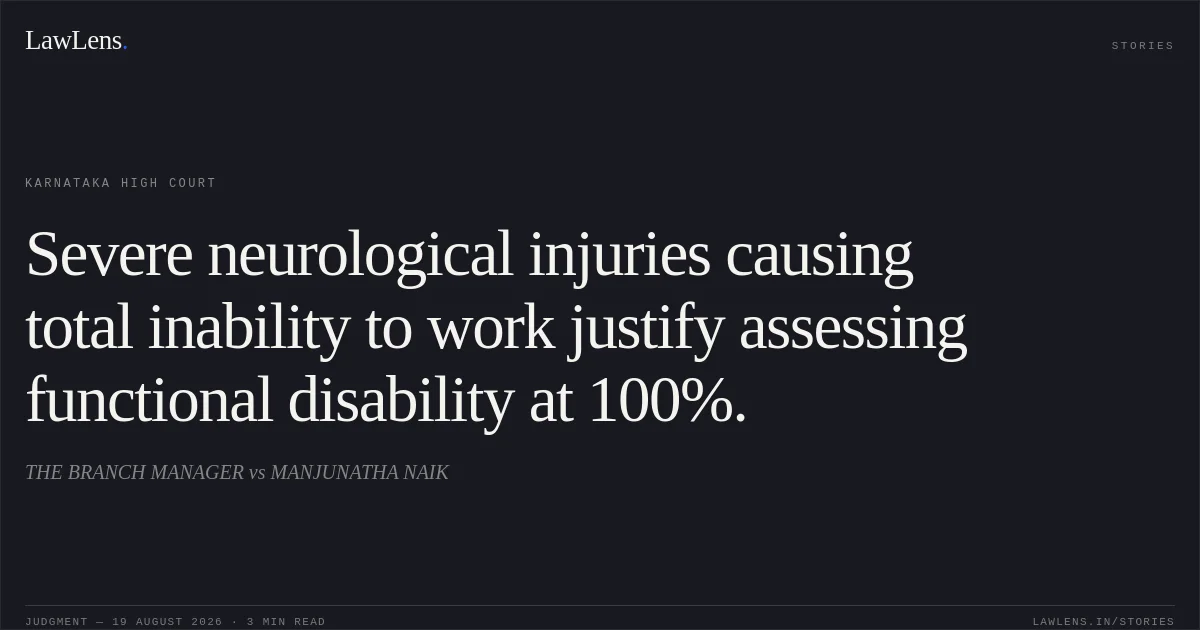
Source reference: pp.20–24, para.12.2On quantum, the medical evidence showed 85% neurological disability, inability to walk without support, impaired speech and memory, inability to care for himself, and a lifelong requirement for an attendant.
Source reference: pp.26–30, paras.14.1, 15–16Applying Raj Kumar, the Court held that the claimant’s functional loss of earning capacity was 100%, since he was incapable of performing his restaurant work or any other labour.
Source reference: pp.28–35, paras.15–19The Court adopted the 2015 notional income of ₹9,000 per month, added 25% future prospects, applied the multiplier of 14, and recalculated the loss of future earnings at ₹18,90,000.
Source reference: p.35, para.19It also enhanced compensation for pain and suffering, nourishment, conveyance, attendant charges, loss of amenities and future medical expenses.
Source reference: pp.35–36, paras.18–20Holding
The Insurance Company’s challenge was rejected, and the claimant’s cross-objection was allowed in part.
The total compensation was enhanced from ₹14,56,030 to ₹35,55,030, with interest at 6% per annum from the date of the petition until realisation.
Source reference: pp.35–37, paras.20–21The insurer was directed to deposit the enhanced compensation within eight weeks and, consistently with the applicable third-party liability principle, to pay the claimant and recover the amount from the owner if entitled to do so.
Source reference: pp.24, 37–38, paras.13, 22No interest was payable on the enhanced amount for the delayed period of 759 days.
Source reference: p.38, para.22(vi)Acts & Sections Cited
9 provisions across 1 statute referred to in this judgment. Each provision opens on LawLens.
Motor Vehicles Act, 1988
Original Court PDF
THE BRANCH MANAGERvsMANJUNATHA NAIK
Click to open original judgment
Original judgment, available to read, download and summarize on LawLens.in