Facts
Respondent No. 1 instituted Regular Summary Suit No. 13 of 2023 against the petitioners.
Source reference: no citationAn earlier decree in the summary suit was set aside by the High Court in First Appeal No. 292 of 2024 because the summons for judgment served on the petitioners did not comply with Order XXXVII Rule 3(4) of the Code of Civil Procedure, 1908 (“CPC”).
Source reference: para. 6; p. 5After remand, fresh summons for judgment were filed on 01 August 2025 and served on the petitioners on 11 August 2025.
Source reference: para. 6; p. 6The petitioners filed their leave to defend application on 05 September 2025, involving a delay of approximately 18 days, and thereafter filed an application for condonation of delay on 09 September 2025.
Source reference: para. 6; p. 6The Trial Court rejected the delay application on the grounds that the petitioners ought to have remained more vigilant after remand and had failed to establish sufficient cause.
Source reference: para. 7; p. 6The petitioners challenged that order under Article 226 of the Constitution.
Source reference: no citationIssues
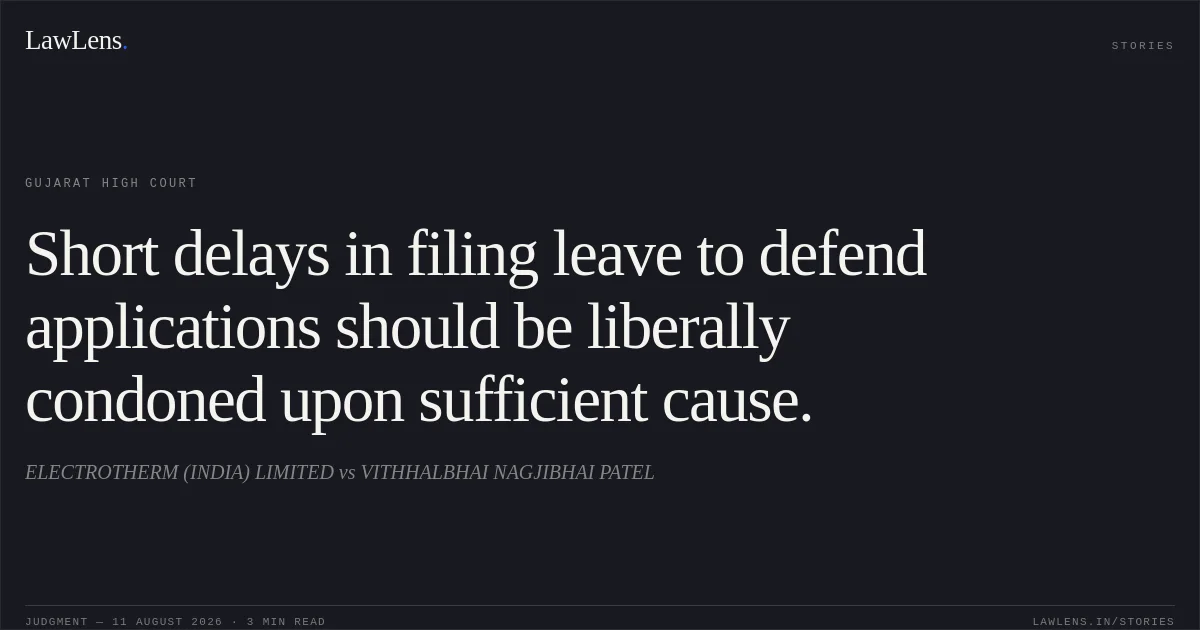
Whether the petitioners had shown sufficient cause for condoning the 18-day delay in filing the application for leave to defend under Order XXXVII Rule 3(5) CPC.
Source reference: paras. 6–11; pp. 6–9Whether the Trial Court was justified in refusing to condone the delay, thereby potentially foreclosing the petitioners’ right to defend the summary suit on merits.
Source reference: paras. 8–10; pp. 7–9Whether the delay could be condoned subject to payment of costs and appropriate directions for expeditious disposal of the summons for judgment and leave to defend application.
Source reference: paras. 12–16; pp. 9–11Law Applied
The Court applied Order XXXVII Rule 3(4) CPC, which governs the form and service of summons for judgment, and Order XXXVII Rule 3(5) CPC, under which a defendant may seek leave to defend and the Court may condone delay upon sufficient cause being shown.
Source reference: paras. 6, 10; pp. 5–9The Court held that Order XXXVII Rule 3(5) is akin to Section 5 of the Limitation Act, 1963, and that “sufficient cause” must ordinarily be construed liberally rather than pedantically, with the objective of advancing substantial justice rather than shutting out a defence on merits.
Source reference: para. 10; p. 9At the same time, a defendant who is deliberately or grossly negligent cannot claim condonation as a matter of course.
Source reference: para. 8; p. 7Leave to defend was treated as a vital procedural right because refusal to receive the application may result in an automatic decree against the defendant.
Source reference: para. 8; p. 7Reasoning
The Court found that the delay was neither deliberate nor mala fide.
Source reference: para. 9; p. 8The prior decree had been set aside specifically because the original summons for judgment was legally defective; therefore, the petitioners could not reasonably anticipate the contents of the fresh summons until it was properly served.
Source reference: para. 9; p. 8The Court also accepted that petitioner No. 1, being a company, required time to collect and verify its records and complete the necessary administrative process before preparing the leave to defend application.
Source reference: para. 9; p. 8Since the delay was only 18 days, was not gross or inordinate, and there was no material demonstrating negligence in pursuing the remedy, sufficient cause was established.
Source reference: paras. 9–11; pp. 8–9The prejudice to the respondent could adequately be addressed by imposing costs, whereas refusing condonation would deprive the petitioners of an opportunity to defend the summary suit on merits.
Source reference: paras. 8, 10, 12; pp. 7–10Holding
The High Court allowed the petition and quashed the Trial Court’s order dated 03 July 2026 rejecting the delay application.
The 18-day delay in filing the leave to defend application was condoned, subject to the petitioners paying Rs. 20,000 to respondent No. 1 within 10 days of receiving the judgment; respondent No. 1 was directed to issue a receipt for the payment.
Source reference: para. 14; p. 10Upon compliance, the Trial Court was directed to take the leave to defend application on record.
Source reference: para. 15; p. 10The Trial Court was further requested to decide the summons for judgment and leave to defend application on their merits, preferably by 07 November 2026, without being influenced by the observations in the earlier orders or the High Court’s judgment.
Source reference: para. 16; p. 11Acts & Sections Cited
1 provisions across 1 statute referred to in this judgment. Each provision opens on LawLens.
Limitation Act, 19631
Original Court PDF
ELECTROTHERM (INDIA) LIMITEDvsVITHHALBHAI NAGJIBHAI PATEL
Click to open original judgment
Original judgment, available to read, download and summarize on LawLens.in