Facts
The appellant (plaintiff) filed a civil suit seeking a declaration that respondent No. 1 (defendant No. 1) was not his legally wedded wife and that no marriage had been solemnized as per custom.
Source reference: para 2The plaintiff further sought a permanent prohibitory injunction to restrain the respondents from claiming such a marital status or visiting his house.
Source reference: para 2Defendant No. 1 contended that the parties entered a "love marriage" on 04.05.2005 according to local agricultural customs (Riwaj-e-Aam) of District Kullu, involving the placement of a Thipu (dupatta) on her head before a deity and a community feast.
Source reference: para 3She alleged she was turned out of the house in January 2006 and relied on a compromise undertaking (Ext. DW3/A) executed by the plaintiff before the Gram Panchayat.
Source reference: para 3Both the Trial Court and the First Appellate Court dismissed the plaintiff’s suit, holding that cohabitation and the compromise document established a valid marriage.
Source reference: paras 7–8Issues
1. Whether the lower courts erred in holding that a marriage existed under customary law without the custom being specifically pleaded and proved by instances.
Source reference: para 92. Whether the learned courts below erred in relying on the compromise/undertaking (Ext. DW3/A) as an agreement of marriage.
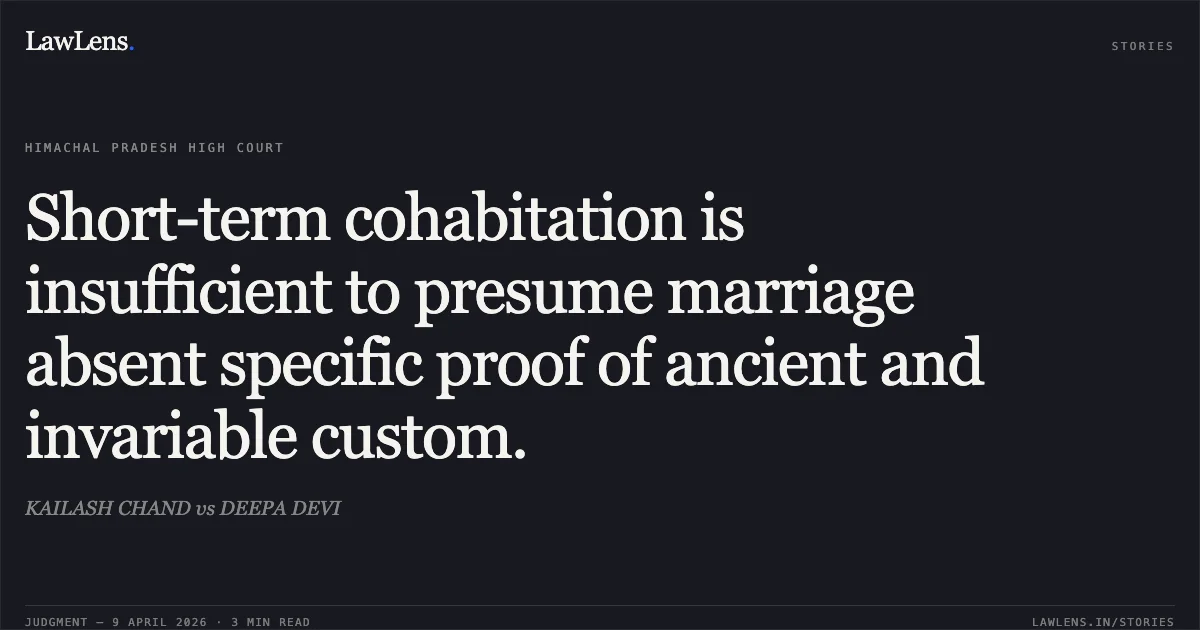
Source reference: para 93. Whether the presumption of a valid marriage can be drawn from a short period of cohabitation (7–8 months).
Source reference: paras 21–234. Whether the findings of the lower courts were based on a misappreciation of oral and documentary evidence.
Source reference: para 9Law Applied
a custom, to have the force of law, must be ancient, certain, reasonable, and not opposed to public policy; it must be specifically pleaded and proved by clear, unambiguous evidence or cited instances.
Source reference: paras 14–17custom cannot be extended by analogy.
Source reference: paras 15, 17a strong presumption of wedlock arises only where partners have lived together for a "long spell" or "prolonged and continuous cohabitation".
Source reference: para 21Reasoning
The High Court found that the respondents failed to prove the alleged custom. While Defendant No. 1 pleaded a custom involving a Thipu, the Appellate Court erroneously relied on a different custom involving Ganesh Pooja which was neither pleaded nor supported by evidence of a priest's presence.
Source reference: paras 18–20The Court observed that the lower courts misapplied the "presumption of marriage." Law requires a "long spell" of cohabitation to presume marriage; however, the defendant’s own case admitted a cohabitation of only 7–8 months, which the Court deemed insufficient to raise such a presumption.
Source reference: paras 21–23evidence regarding cohabitation was contradictory and lacked the "continuous" nature required by law.
Source reference: para 24Regarding Ext. DW3/A, the Court held it was merely an undertaking following a dispute and not a deed of marriage; an admission of a relationship cannot override the failure to prove the legal solemnization of marriage under the pleaded custom.
Source reference: paras 29–30Holding
The Court held that the respondents failed to prove the existence of a customary marriage and that the period of cohabitation was too brief to warrant a legal presumption of marriage.
The High Court allowed the appeal and set aside the judgments of the Trial and Appellate Courts. The suit was decreed in favor of the plaintiff, declaring that Defendant No. 1 is not his legally wedded wife and granting a permanent prohibitory injunction against the defendants.
Source reference: para 33Acts & Sections Cited
2 provisions across 2 statutes referred to in this judgment. Linked provisions open on LawLens.
Code of Civil Procedure, 19081
Indian Evidence Act, 18721
Original Court PDF
KAILASH CHANDvsDEEPA DEVI
Click to open original judgment
Original judgment, available to read, download and summarize on LawLens.in