Facts
The respondent filed a complaint under Section 138 of the Negotiable Instruments Act against the petitioner regarding the dishonor of three cheques worth Rs. 1.00 lakh each.
Source reference: p. 1-2After the defense evidence concluded, the petitioner moved an application before the Judicial Magistrate 1st Class, Sumbal, seeking forensic examination of the handwriting on the cheques.
Source reference: p. 2The petitioner claimed he signed the cheques under coercion while in police custody and that a Sub-Inspector filled in the blanks.
Source reference: p. 2-3The trial court rejected the application on 14.02.2025.
Source reference: p. 1-3The petitioner challenged this rejection, asserting that forensic examination was necessary for a fair trial.
Source reference: p. 3Issues
1. Whether the forensic examination of handwriting on the body of a signed cheque is necessary to rebut the presumption under the Negotiable Instruments Act.
Source reference: p. 4 / para. 82. Whether the trial court’s rejection of the application for forensic examination was legally sound.
Source reference: p. 5 / para. 9Law Applied
Section 139 of the Negotiable Instruments Act, which mandates a presumption in favor of the holder that a cheque was issued for the discharge of a debt or liability.
Source reference: p. 3-4Oriental Bank of Commerce v. Prabodh Kumar Tewari (2022 LiveLaw (SC) 714), which established that once signatures on a cheque are admitted, it is immaterial who filled in the remaining details.
Source reference: p. 4Under this doctrine, a handwriting expert's report cannot rebut the statutory presumption if the drawer has signed the instrument.
Source reference: p. 4Reasoning
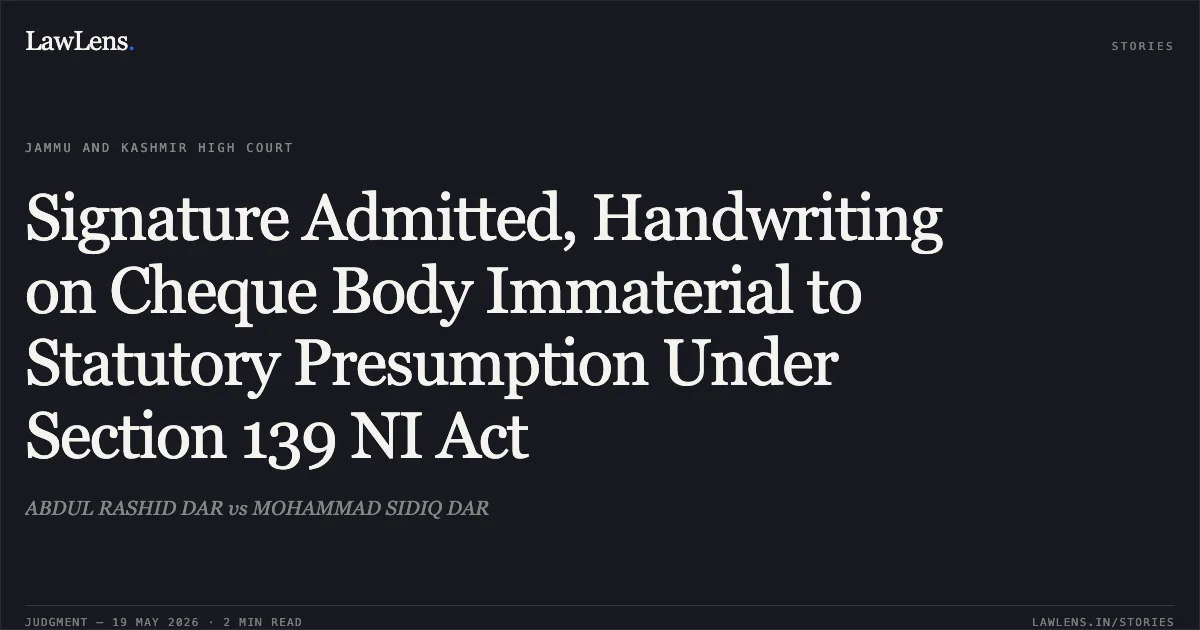
The court reasoned that since the petitioner admitted to signing the cheques, the legal presumption under Section 139 was immediately triggered.
Source reference: p. 3-4Following the Supreme Court's mandate in Oriental Bank of Commerce, the court held that the identity of the person who filled the "blanks" in the cheque is legally "superfluous".
Source reference: p. 4-5The petitioner's defense—that the cheques were obtained via coercion in police custody—is a factual plea that must be established through witness testimony and cogent evidence rather than forensic analysis of handwriting.
Source reference: p. 5The court concluded that allowing forensic examination would serve no legal purpose and would only result in an unnecessary delay of the trial.
Source reference: p. 4-5Holding
The High Court answered both issues in the negative, holding that forensic examination is unnecessary when signatures are admitted.
The court upheld the trial court's order, dismissed the petition for lacking merit, and vacated the interim stay order dated 26.08.2025. The trial magistrate was directed to proceed with the case.
Source reference: p. 5Acts & Sections Cited
2 provisions across 1 statute referred to in this judgment. Each provision opens on LawLens.
Negotiable Instruments Act, 18812
Original Court PDF
ABDUL RASHID DARvsMOHAMMAD SIDIQ DAR
Click to open original judgment
Original judgment, available to read, download and summarize on LawLens.in