Facts
The appellant filed a claim seeking compensation for injuries sustained on 25.03.2015.
Source reference: p. 1-2, para. 2He alleged that while traveling from Sonipat to Jhansi on the Malwa Express (Train No. 12920) with a valid second-class ticket, he fell from the train due to a heavy rush between Sonipat and New Delhi Railway Stations.
Source reference: p. 1-2, para. 2The fall resulted in the amputation of both hands below the elbow.
Source reference: p. 2, para. 2The Railway Claims Tribunal dismissed the claim on 03.01.2018, finding that the appellant was not a bona fide passenger and that the event did not constitute an "untoward incident".
Source reference: p. 2, para. 3The appellant challenged this, citing Union of India v. Rina Devi to argue that the loss of a ticket during an accident does not negate bona fide passenger status.
Source reference: p. 2, para. 3Issues
1. Whether the appellant was a bona fide passenger at the time of the incident?
Source reference: p. 3, para. 62. Whether the injuries sustained by the appellant were the result of an “untoward incident” as defined under the Railways Act, 1989?
Source reference: p. 3, para. 6Law Applied
The court applied Section 23 of the Railway Claims Tribunal Act, 1987, regarding the right to appeal, and the definitions provided under the Railways Act, 1989, specifically concerning "untoward incidents".
Source reference: p. 1, 3, para. 1, 6It also considered the legal principle established in Union of India v. Rina Devi (2019) 3 SCC 572, which holds that the mere non-recovery of a journey ticket from the body of a victim or at the site of an accident is not conclusive proof that the person was not a bona fide passenger.
Source reference: p. 2, para. 3Reasoning
The Court found significant contradictions that undermined the appellant’s version of events.
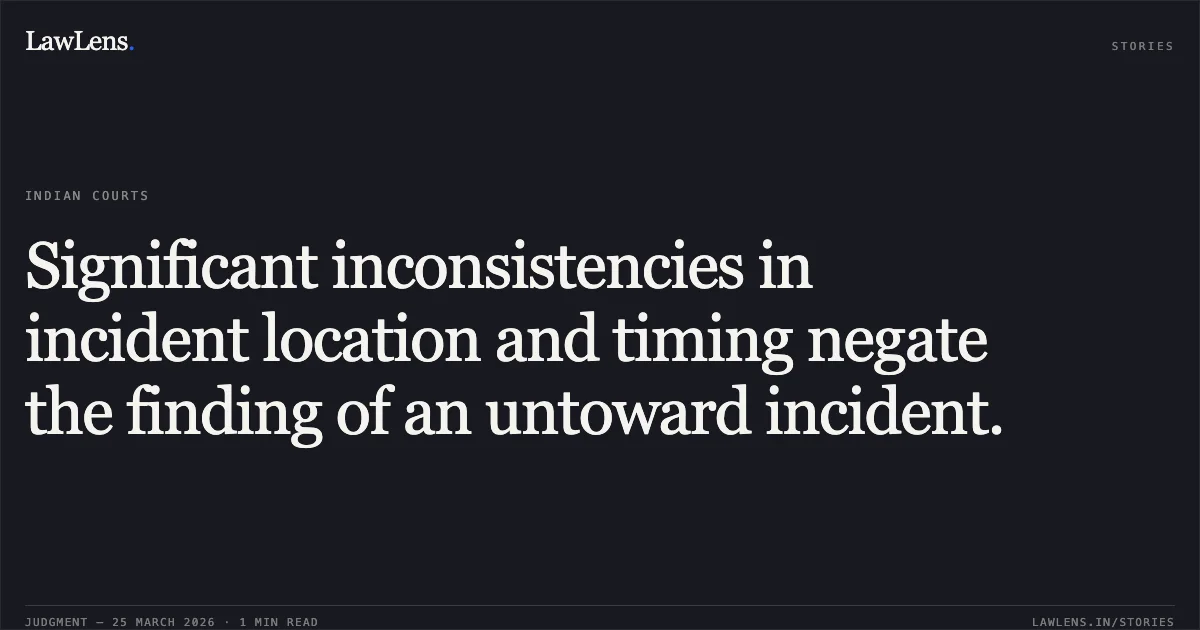
Source reference: p. 3, para. 7First, while the appellant claimed he fell near Sadar Bazar, the Medico-Legal Certificate (MLC) recorded the place of incident as Platform No. 10 of Old Delhi Railway Station; however, the Malwa Express does not pass through Old Delhi Station, running instead via New Delhi.
Source reference: p. 3, para. 7Second, the Court noted a critical time discrepancy: the appellant claimed the incident occurred at 18:30 hours, yet police records (DD No. 3-A) showed information was received at 01:30 am the following day.
Source reference: p. 3, para. 8This unexplained seven-hour delay made it improbable that the appellant survived unattended with double amputations for such a duration.
Source reference: p. 3-4, para. 8Furthermore, the Court noted that while other belongings were recovered during jamatalashi, the ticket was not, and the appellant's explanation for its loss was unconvincing.
Source reference: p. 2, para. 4Consequently, the Court determined that the foundational facts were unsubstantiated, failing the threshold of an "untoward incident".
Source reference: p. 4, para. 9Holding
The Court held that the appellant failed to prove the occurrence of an "untoward incident" or his status as a bona fide passenger due to the gross inconsistencies in the evidence.
The High Court upheld the Tribunal's judgment and dismissed the appeal, granting no relief to the appellant.
Source reference: p. 4, para. 10Acts & Sections Cited
1 provisions across 1 statute referred to in this judgment. Each provision opens on LawLens.
Railway Claims Tribunal Act, 19871
Original Court PDF
Tulsi DasvsUnion Of India
Click to open original judgment
Original judgment, available to read, download and summarize on LawLens.in