Facts
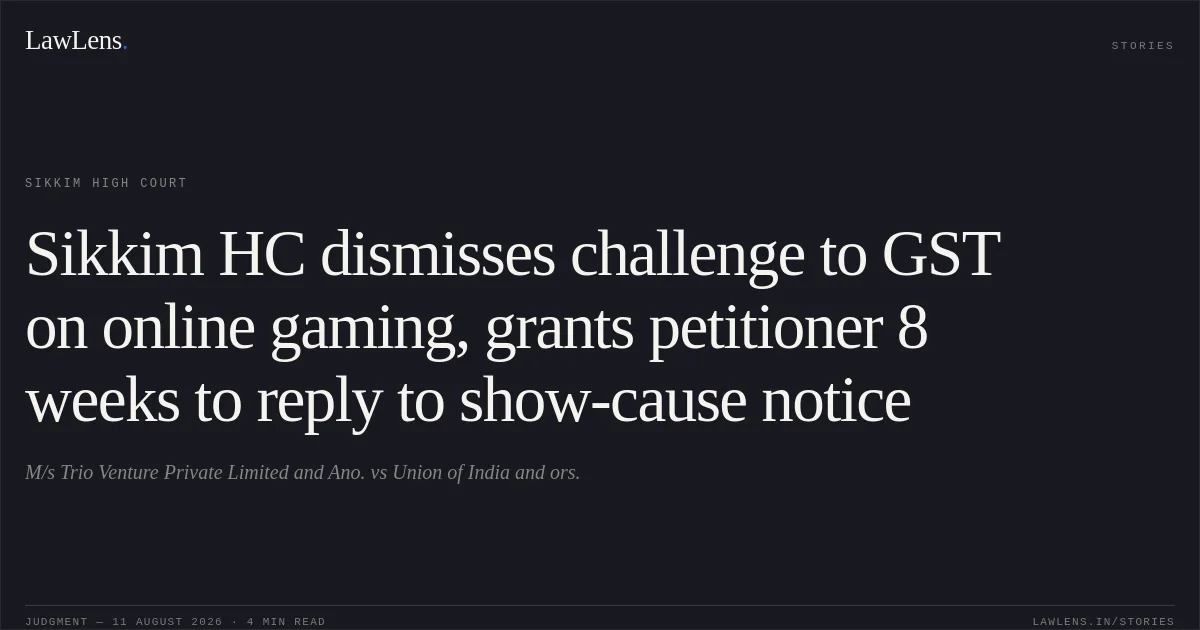
The petitioners instituted a writ petition challenging the levy and related statutory and executive measures concerning GST on betting, gambling, online gaming and allied transactions.
Source reference: no citationOn 20 September 2024, counsel had informed the High Court that similar issues were pending before the Supreme Court.
Source reference: p.1The High Court had thereafter kept the matter pending in view of the Supreme Court proceedings.
Source reference: p.1By judgment dated 27 May 2026, reported as 2026 INSC 595, the Supreme Court upheld the constitutional and statutory validity of the GST framework applicable to actionable claims arising from betting and gambling, including online gaming, fantasy sports and casino transactions.
Source reference: pp.1–8The High Court noted that all five substantive prayers in the writ petition raised issues that had been considered and decided by the Supreme Court.
Source reference: p.8Issues
1. Whether the levy of GST on actionable claims arising from betting, gambling, online gaming and fantasy sports transactions is constitutionally and statutorily valid under the CGST Act and corresponding State GST enactments
Source reference: pp.1–8; paras. 84, 862. Whether Sections 2(31), 2(52), 7, 9 and 15 of the CGST Act, Schedule III, and Rules 31A, 31B and 31C are constitutionally valid and within the legislative competence conferred by Article 246A of the Constitution
Source reference: pp.2–4, 7; paras. 84(ii)–(ix), 86(ii)–(iii)3. Whether online gaming operators are suppliers of taxable actionable claims and whether the entire amount staked or appropriated towards participation constitutes consideration and taxable value, without deduction of prize pools, winnings or payouts
Source reference: pp.4–5; para. 84(vii)–(x)4. Whether pending show-cause notices, adjudication proceedings and consequential demands relating to online gaming, fantasy sports and casino transactions should be determined under Rules 31B and 31C and the principles laid down by the Supreme Court
Source reference: pp.4–8; paras. 84(x)–(xi), 86(v)–(vi)5. Whether the petitioners were entitled to continuation of interim protection and directions permitting them to reply to the show-cause notice within a specified period
Source reference: pp.8–9, para. 6Law Applied
The Court applied Sections 2(31), 2(52), 7, 9 and 15 of the Central Goods and Services Tax Act, 2017, together with the corresponding State GST provisions, Schedule III and Rules 31A, 31B and 31C of the CGST Rules.
Source reference: no citationThe governing rule was that actionable claims arising from betting and gambling, including online gaming and fantasy sports involving stakes placed on uncertain outcomes, constitute taxable supplies for GST purposes.
Source reference: pp.1–4; para. 84(i)–(iii)Article 246A confers legislative competence to impose GST on such supplies, while Articles 14, 19(1)(g), 21 and 265 do not invalidate the levy merely because it causes commercial hardship or increased tax incidence.
Source reference: p.2; para. 84(iv)The Supreme Court further held that organised gaming platforms themselves supply the relevant actionable claims, that the amount staked or appropriated constitutes consideration, and that prize pools, winnings and payouts cannot be deducted from taxable value.
Source reference: p.4; para. 84(vii)–(viii)Rules 31A, 31B and 31C were treated as valid machinery and valuation provisions, with the 2023 amendments operating retrospectively in the manner stated by the Supreme Court.
Source reference: pp.3–4, 7; paras. 84(viii)–(x), 86(ii)–(iii)Pending proceedings were required to be dealt with under the applicable valuation framework and the Supreme Court’s findings.
Source reference: pp.4–8; paras. 86.1, 86.2 and 86.5Reasoning
The High Court held that the Supreme Court had authoritatively decided every substantive issue raised in the writ petition, including the validity of the GST levy, the statutory provisions, the valuation rules and their application to pending proceedings.
Source reference: p.8, para. 4Since no independent issue remained for determination, the High Court applied the Supreme Court’s binding conclusions and declined to re-examine the petitioners’ challenges.
Source reference: no citationThe interim protection consequently could not continue because the Supreme Court had upheld the impugned GST framework and directed that pending proceedings be pursued under Rules 31B and 31C, as applicable.
Source reference: pp.7–8; paras. 86.1 and 86.5However, consistent with the procedural relief granted by the Supreme Court, the High Court granted the petitioners eight weeks from the date of its order to submit their reply to the show-cause notice and directed the competent authority to pass an order within twelve weeks thereafter, in accordance with law and the Supreme Court’s judgment.
Source reference: p.9, para. 6Holding
The writ petition was dismissed and disposed of in terms of the Supreme Court’s judgment in 2026 INSC 595.
The High Court accepted that the petitioners’ substantive constitutional and statutory challenges were conclusively governed by that judgment.
Source reference: p.8, paras. 4–5The interim order earlier granted by the High Court was vacated.
Source reference: p.8, para. 5The petitioners were permitted to file their reply to the show-cause notice within eight weeks from the date of the High Court’s order, and the competent authority was directed to consider the reply and pass appropriate orders within twelve weeks thereafter, in accordance with law and the Supreme Court’s findings.
Source reference: p.9, para. 6Acts & Sections Cited
6 provisions across 2 statutes referred to in this judgment. Each provision opens on LawLens.
Central Goods and Services Tax Act, 20175
Transfer of Property Act, 18821
Original Court PDF
M/s Trio Venture Private Limited and Ano.vsUnion of India and ors.
Click to open original judgment
Original judgment, available to read, download and summarize on LawLens.in