Facts
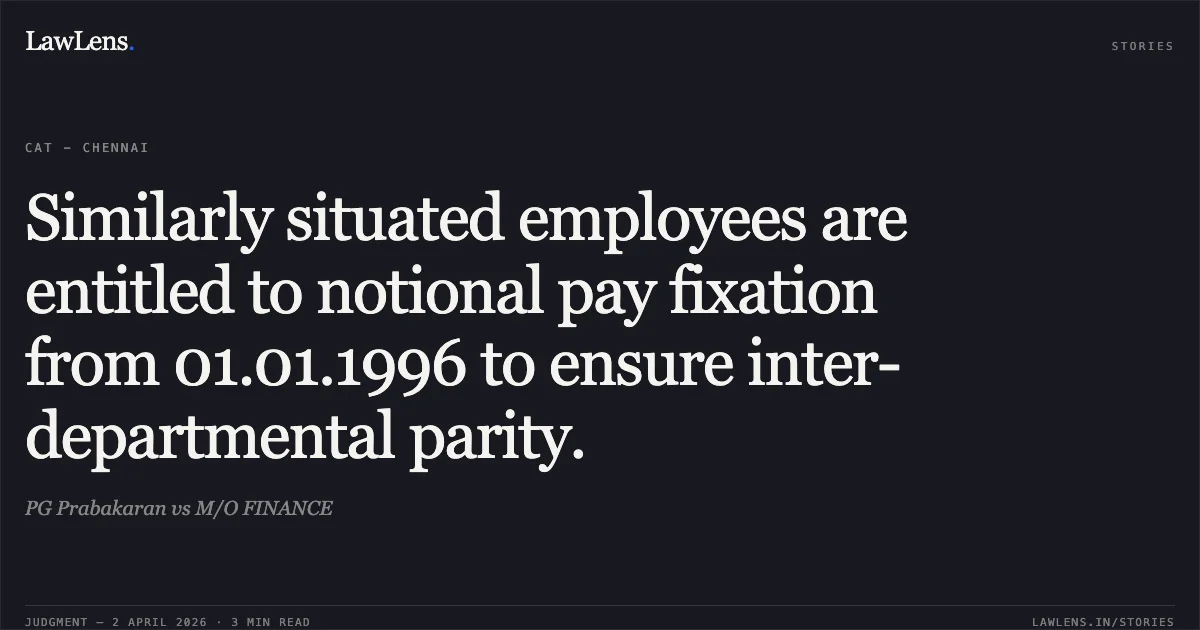
The 23 applicants, serving as Inspectors and Superintendents in the Central Excise and Customs Department (CBIC), sought the retrospective application of revised pay scales (Rs. 6500–10500 and Rs. 7500–12000 respectively) with effect from 01.01.1996, the implementation date of the 5th Central Pay Commission (CPC).
Source reference: p. 5-6Although the 5th CPC recommendations were accepted, the revised scales were only made effective from 21.04.2004 via Office Memoranda.
Source reference: p. 5Following litigation by similarly situated employees in the Income Tax Department (CBDT) and other regions, a Special Anomaly Committee recommended notional fixation from 01.01.1996, which the Government implemented for those specific litigants.
Source reference: p. 17The applicants filed the present OA after their representations for similar parity were rejected or ignored, while the respondents contended the claim was barred by limitation and that the applicants were "fence-sitters".
Source reference: p. 11-13Issues
1. Whether the revised pay scales under the 5th CPC should be granted notionally from 01.01.1996 instead of 21.04.2004 to maintain parity with similarly situated employees.
Source reference: para 212. Whether the Original Application is barred by limitation and laches under Section 21 of the Administrative Tribunals Act, 1985.
Source reference: para 13, 303. Whether judicial precedents granting retrospective pay fixation in this matter operate in rem (applicable to all) or in personam (restricted to litigants).
Source reference: para 32, 36Law Applied
The Tribunal primarily applied the principle of parity under Article 14 of the Constitution, asserting that similarly situated employees must be treated equally in service jurisprudence.
Source reference: para 32, 35It relied on State of Karnataka v. C. Lalitha, which establishes that benefits granted to one set of employees should extend to others similarly placed.
Source reference: para 32Regarding limitation, the court applied the doctrine of "recurring cause of action" in matters of pay fixation, as supported by the Delhi High Court's reasoning that delay does not bar relief when the Government has accepted the underlying anomaly.
Source reference: para 31It further invoked Lt. Col Suprita Chandel v. Union of India, holding that "fence-sitters" should not be penalized for not litigating earlier if the issue involves a settled principle of law.
Source reference: para 33Reasoning
The Tribunal reasoned that CBDT and CBIC both function under the Department of Revenue; therefore, the recommendations of the Special Anomaly Committee (constituted via the Kolkata High Court’s direction) must apply uniformly to both boards to avoid discrimination.
Source reference: para 27-28The court rejected the "fence-sitter" argument, noting that the Special Anomaly Committee’s report was only finalized in September 2023, providing a fresh context for the applicants' claims.
Source reference: para 30It observed that the respondents had already implemented similar orders for over 1,500 employees across various bences, making the denial to the current applicants arbitrary.
Source reference: para 11, 38The Tribunal emphasized that when a judicial decision settles a principle of service law, it operates in rem, and a "model employer" should extend the benefit to all eligible employees without forcing each to approach the court.
Source reference: para 34, 36Holding
The Tribunal allowed the OA and quashed the impugned orders to the extent they limited the effective date to 21.04.2004.
It held that the applicants are entitled to the upgraded pay scales of Rs. 6500-10500 (Inspectors) and Rs. 7500-12000 (Superintendents) notionally from 01.01.1996.
Source reference: para 41The court directed the respondents to refix the applicants' pay and pensionary benefits accordingly, granting actual monetary arrears from 21.04.2004. The exercise is ordered to be completed within two months of the receipt of the order.
Source reference: para 41Acts & Sections Cited
2 provisions across 1 statute referred to in this judgment. Each provision opens on LawLens.
Administrative Tribunals Act, 19852
Original Court PDF
PG PrabakaranvsM/O FINANCE
Click to open original judgment
Original judgment, available to read, download and summarize on LawLens.in