Facts
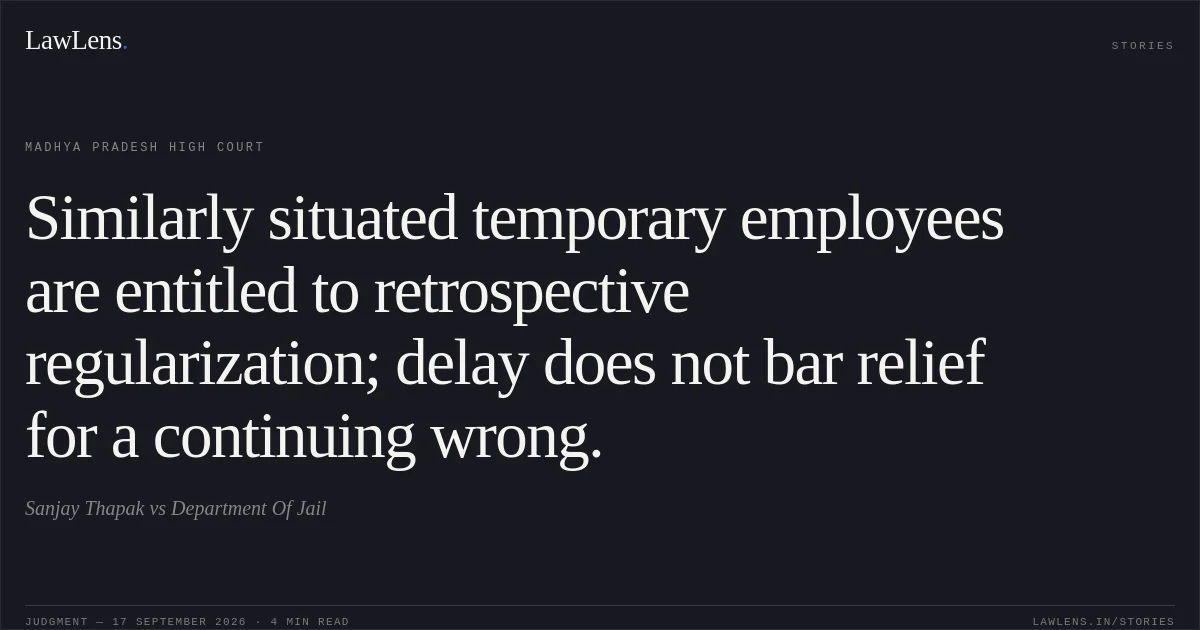
The petitioner was initially engaged as a temporary Jail Warder for 89 days from 29 March 1996. His engagement was thereafter continuously extended by imposing artificial one-day breaks. Pursuant to an earlier direction of the Court, his services were regularized with effect from 16 December 2008.
Source reference: para. 3; para. 6The petitioner claimed parity with Smt. Sarojini Katare, whose services had been regularized with effect from 4 July 2003 pursuant to W.P. No. 8256/2009. The same effective date was subsequently extended to Smt. Shyama Rajput, Smt. Shobha Shrivastava and Smt. Usha Arya by the coordinate Bench in W.P. No. 8189/2021.
Source reference: para. 3; para. 7The petitioner, whose initial appointment was earlier than that of some of those employees, submitted a representation seeking regularization from 4 July 2003. The representation was rejected by the respondents.
Source reference: paras. 3.1, 6 and 9The State opposed the claim on the grounds that the petitioner had initially been engaged only as a daily-wage/temporary worker, was not appointed against a sanctioned vacant post through a regular selection process, had accepted regularization from 16 December 2008, and had approached the Court after substantial delay.
Source reference: para. 4Issues
Whether the petitioner, having been regularized from 16 December 2008, was entitled to parity with similarly situated Jail Warders and to regularization with effect from 4 July 2003?
Source reference: paras. 3, 6, 9 and 13Whether the petitioner’s delayed claim was barred by laches, acquiescence or acceptance of the earlier regularization order?
Source reference: paras. 4, 9–12Whether the rejection of the petitioner’s representation was arbitrary and violative of the principle that similarly situated employees must receive equal treatment under Article 14 of the Constitution?
Source reference: paras. 6, 10–13Law Applied
The Court exercised jurisdiction under Article 226 of the Constitution and applied the principle of equal treatment under Article 14, holding that similarly situated employees in service matters should ordinarily receive the same benefit.
Source reference: paras. 10–11Relying on State of U.P. v. Arvind Kumar Shrivastava, (2015) 1 SCC 347, the Court noted that employees identically situated to those who have obtained relief should normally receive the same benefit, subject to exceptions based on delay, laches and acquiescence; however, such exceptions do not apply where the claim involves a continuing wrong or where the judgment or policy has wider application.
Source reference: paras. 10–11The Court also relied on Union of India v. Tarsem Singh, (2008) 8 SCC 648, for the rule that delay and laches do not ordinarily defeat claims arising from a continuing wrong, including matters involving pay fixation, refixation and pensionary or recurring service benefits.
Source reference: para. 11The coordinate Bench’s decision in Shyama Rajput v. State of M.P., W.P. No. 8189/2021, was relied upon for the proposition that employees similarly situated to Smt. Sarojini Katare were entitled to regularization from 4 July 2003 and consequential benefits.
Source reference: para. 7The Court also referred to Bhikhani Devi v. Union of India, 2026 SCC OnLine SC 1055, particularly for the principle that pensionary or recurring service benefits may constitute a continuing cause of action, although arrears may be subject to limitation principles.
Source reference: para. 8Reasoning
The Court found that the petitioner had initially entered service in 1996 and had continuously worked despite artificial breaks, while his services were ultimately regularized from 16 December 2008.
Source reference: para. 6Since similarly situated Jail Warders, including employees appointed later than the petitioner, had been granted regularization from 4 July 2003, denying the petitioner the same effective date amounted to unequal treatment.
Source reference: paras. 9–12The Court treated the disparity in the effective dates of regularization as a continuing wrong and therefore rejected the State’s objection based on delay and laches.
Source reference: paras. 9–12The fact that the petitioner had accepted regularization from 16 December 2008 did not justify denying him the earlier effective date when the respondents had extended that benefit to similarly situated employees.
Source reference: paras. 6, 7 and 13Applying the parity principle from Arvind Kumar Shrivastava and the coordinate Bench’s decision in Shyama Rajput, the Court held that the petitioner was entitled to the same treatment as Smt. Sarojini Katare and the other employees.
Source reference: paras. 6, 7 and 13Holding
The Court quashed the impugned rejection order insofar as it denied the petitioner the benefit claimed.
It directed the respondents to regularize the petitioner’s services with effect from 4 July 2003, the date from which Smt. Sarojini Katare, Smt. Shyama Rajput, Smt. Shobha Shrivastava and Smt. Usha Arya had been regularized, and to extend all consequential benefits within three months from receipt of the certified copy of the order.
Source reference: para. 13The petition, along with the connected petitions referred to in the order, was allowed and disposed of.
Source reference: paras. 14–15Original Court PDF
Sanjay ThapakvsDepartment Of Jail
Click to open original judgment
Original judgment, available to read, download and summarize on LawLens.in