Facts
The petitioner was appointed as an untrained Assistant Teacher on 24.04.1997 based on a Certificate in Physical Education obtained in the 1993–94 session.
Source reference: para. 8, 5He completed in-service training in 1999 and was granted a regular pay scale as a trained teacher effective 08.03.2000.
Source reference: para. 9-10After nearly 29 years of service, and despite two prior inquiries in 2021 and 2024 clearing him of allegations regarding his qualifications, a third inquiry was initiated in 2025.
Source reference: para. 13, 16, 17This inquiry alleged that the petitioner pursued two regular courses simultaneously—the Certificate of Physical Education and the Intermediate Examination—during the 1993–94 academic session.
Source reference: para. 18, 25Consequently, the Basic Shiksha Adhikari (BSA), Gautam Buddha Nagar, issued an order dated 11.12.2025 terminating the petitioner's services.
Source reference: para. 2, 24The petitioner challenged this termination, citing a lack of statutory prohibition against simultaneous degrees and procedural lapses.
Source reference: para. 26, 30Issues
1. Whether the simultaneous pursuit of two educational courses in one academic session constitutes a valid ground for termination in the absence of a statutory prohibition.
Source reference: para. 432. Whether the termination of a permanent employee after nearly three decades of service is sustainable without conducting a regular departmental inquiry under the U.P. Basic Education (Staff) Service Rules, 1973.
Source reference: para. 34, 483. Whether an appointment can be annulled based on educational qualifications that have not been cancelled or invalidated by the competent issuing authority.
Source reference: para. 36, 49Law Applied
The court primarily applied the principle from Kuldeep Kumar Pathak v. State of U.P. (2016) 3 SCC 521, which holds that in the absence of a statutory embargo, simultaneous pursuit of courses cannot disqualify a candidate.
Source reference: para. 31, 44It relied on State of U.P. v. Saroj Kumar Sinha (2010) 2 SCC 772 regarding the necessity of adhering to natural justice and formal disciplinary procedures for termination.
Source reference: para. 48The court further invoked the equitable principle from State of Maharashtra v. Milind (2001) 1 SCC 4 and Anita Rani v. State of Uttar Pradesh (2026), asserting that long-standing appointments (especially those spanning decades) should not be disturbed absent a finding of fraud or forgery.
Source reference: para. 28, 46, 47Reasoning
The Court found that the respondents failed to produce any statute or regulation prohibiting the simultaneous acquisition of two qualifications at the time the petitioner obtained them.
Source reference: para. 43-44Since the petitioner’s High School, Intermediate, and Physical Education certificates remain valid and uncancelled by the respective Boards, the Court held there was no legal basis to declare his appointment invalid.
Source reference: para. 45, 49The Court observed a "procedural infirmity," noting that the BSA terminated the petitioner’s services based on mere notices rather than a full departmental inquiry involving the formulation of charges and adducing of evidence as required by the 1973 and 1999 Rules.
Source reference: para. 48Furthermore, the Court emphasized that terminating an employee after 29 years of "unblemished service" without a categorical finding of fraud is disproportionate and legally unsustainable.
Source reference: para. 46, 50Holding
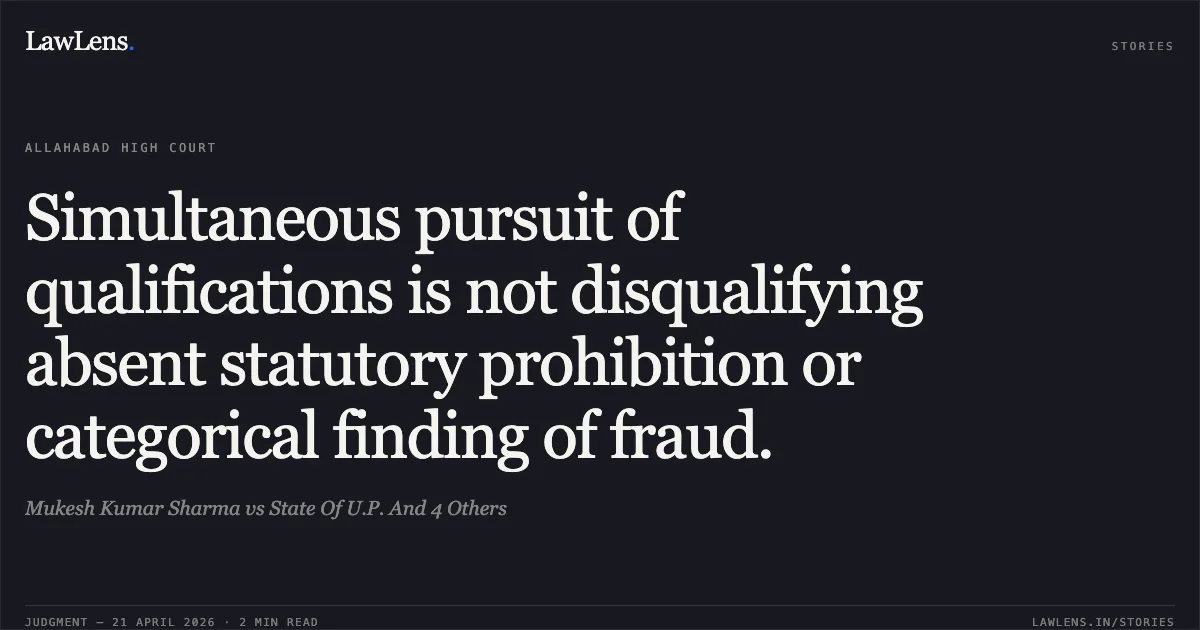
The Court answered the issues in favor of the petitioner, holding that the termination was arbitrary, procedurally flawed, and lacked a statutory basis.
The High Court quashed the termination order dated 11.12.2025 passed by the Basic Shiksha Adhikari, Gautam Buddha Nagar. The writ petition was allowed, effectively restoring the petitioner to his position with all consequential benefits.
Source reference: para. 51, 52Original Court PDF
Mukesh Kumar SharmavsState Of U.P. And 4 Others
Click to open original judgment
Original judgment, available to read, download and summarize on LawLens.in


