Facts
The deceased and the appellant were long-time friends with close family and financial ties
Source reference: p. 1, 6Following a dispute over borrowed grain and tractor accounts, a physical altercation was initially calmed by neighbors
Source reference: p. 2Later that day, the deceased was called to a location where a second quarrel erupted
Source reference: p. 2During this heat-of-the-moment exchange, and following an exhortation from another party, the appellant fired a single shot from his licensed gun, killing the deceased
Source reference: p. 2, 6The Trial Court convicted the appellant under Section 302 read with Section 34 of the IPC, sentencing him to life imprisonment
Source reference: p. 1The appellant challenged this, not disputing the act of killing, but seeking to reclassify the nature of the offense
Source reference: p. 3Issues
1. Whether the act of the appellant, committed during a sudden quarrel without premeditation, constitutes murder under Section 300 or culpable homicide not amounting to murder under Section 304 of the IPC
Source reference: p. 4, 72. Whether the lack of prior enmity and the presence of a single-shot injury during an altercation necessitates a reduction in the nature of the conviction
Source reference: p. 6, 7Law Applied
The court applied the distinction between Sections 299, 300, and 304 of the IPC, which differentiates murder from culpable homicide based on the degree of mens rea
Source reference: p. 4It relied heavily on the precedent of Anbazhagan v. State (2024), which mandates that the mental element must be inferred from the "entire factual matrix," including the relationship between parties and the genesis of the dispute, rather than just the weapon used or the injury's location
Source reference: p. 5The court also applied the principle that if an injury is inflicted without a pre-conceived plan during a sudden fight, it may fall under Section 304 Part II if only "knowledge" of the likely fatal result—rather than "intention" to kill—is established
Source reference: p. 5Reasoning
The court found that the Trial Court erred by assuming that a shot to the chest with a firearm automatically equated to an intent to murder
Source reference: p. 7By examining the background, the High Court noted the parties had a historically cordial relationship and were related by marriage, suggesting a lack of long-standing malice
Source reference: p. 6The evidence showed the incident was not premeditated but was the result of a sudden revival of a dispute over wheat and tractor accounts
Source reference: p. 6The court reasoned that while the appellant possessed the "knowledge" that a gunshot is likely to cause death (satisfying Section 299), the prosecution failed to prove the higher degree of specific intent required for murder under Clause Thirdly of Section 300
Source reference: p. 7The single shot fired during the heat of an argument suggested a reactive act rather than a calculated attempt to eliminate the deceased
Source reference: p. 6, 7Holding
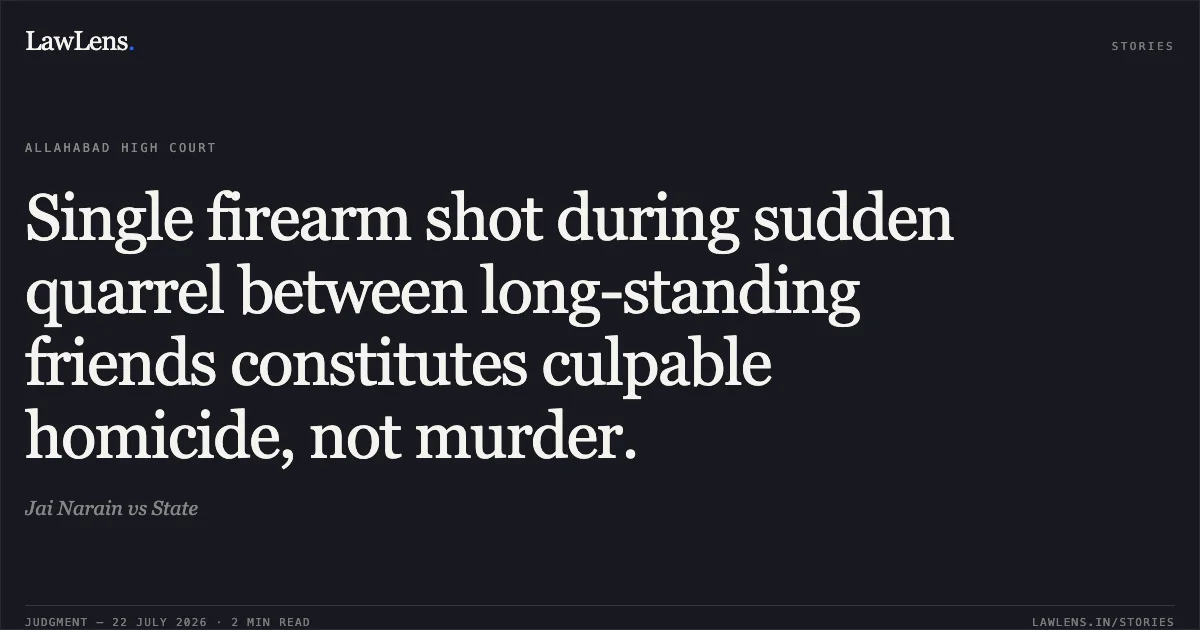
The court allowed the appeal in part, setting aside the conviction under Section 302 IPC and altering it to Section 304 Part II IPC
Holding that the ends of justice would be served by a proportionate sentence given the appellant’s age (90 years) and the 40-year duration of the proceedings, the court sentenced him to the period already undergone and imposed a fine of Rs. 1,00,000
Source reference: p. 8Failure to pay the fine results in one year of rigorous imprisonment
Source reference: p. 9Acts & Sections Cited
7 provisions across 2 statutes referred to in this judgment. Each provision opens on LawLens.
Indian Penal Code, 18606
Code of Criminal Procedure, 19731
Original Court PDF
Jai NarainvsState
Click to open original judgment
Original judgment, available to read, download and summarize on LawLens.in


