Facts
The Petitioner, a Kolkata-based Chartered Accountant and registered Insolvency Professional, was appointed as the Resolution Professional (RP) for Gemus Engineering Limited by the NCLT, Kolkata Bench
Source reference: para. 2, 4Following the conclusion of the CIRP and the appointment of a Liquidator, a complaint was filed alleging that the Petitioner unauthorizedly operated the CIRP bank account
Source reference: para. 3Consequently, the Insolvency and Bankruptcy Board of India (IBBI), headquartered in Delhi, issued a Show Cause Notice and a subsequent suspension order on 26.02.2026, suspending the Petitioner’s registration for two years
Source reference: para. 3-4The Petitioner challenged these orders before the Delhi High Court, invoking its jurisdiction primarily on the basis that the IBBI is situated in Delhi and the impugned orders were issued from its Delhi office
Source reference: para. 4-5Issues
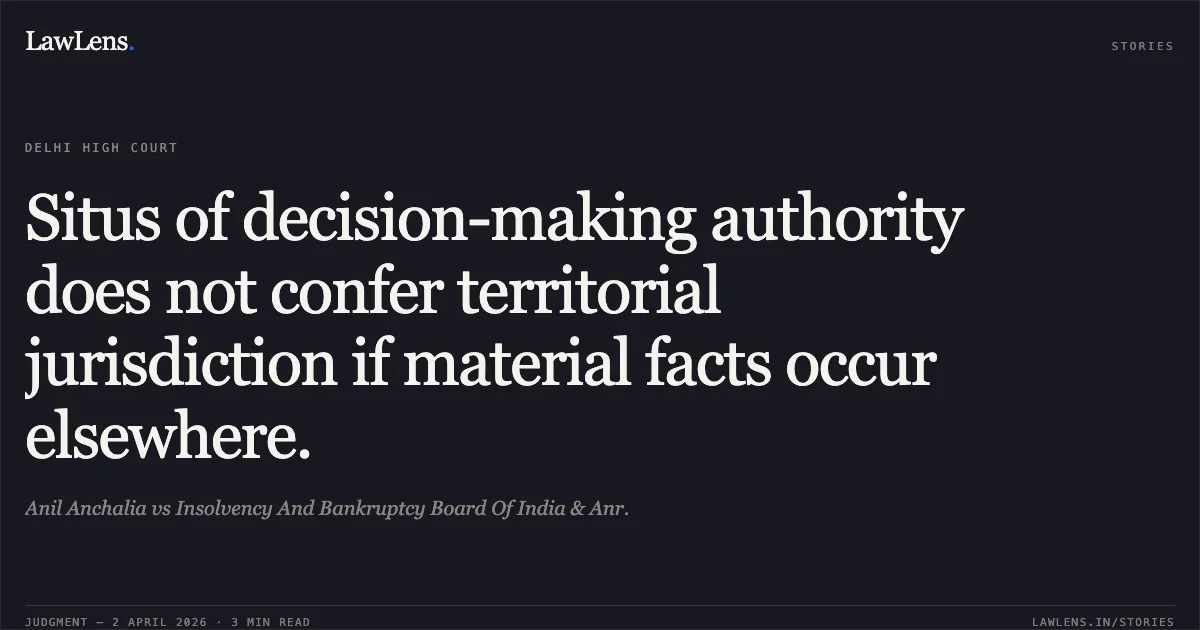
1. Whether the mere situs of the respondent authority and the issuance of an order within the territory of Delhi is sufficient to compel the High Court to entertain a writ petition under Article 226 when the underlying material facts arose elsewhere
Source reference: para. 4, 62. Whether the doctrine of forum conveniens should be invoked to refuse exercise of discretionary jurisdiction
Source reference: para. 6Law Applied
The court primarily applied the doctrine of forum conveniens as established by the Supreme Court in Kusum Ingots & Alloys Ltd. v. Union of India and Anr., which holds that even if a small part of the cause of action arises within a court's jurisdiction, the court may refuse to exercise its discretionary jurisdiction if it is not the most appropriate forum
Source reference: para. 6It further relied on its own decision in The Indure Pvt. Ltd. v. Government of NCT of Delhi, affirming that the situs of a head office or the act of passing an order in the national capital are "unchanging constants" and do not constitute "dominant" or "integral" facts sufficient to determine territorial jurisdiction if the legal injury and foundational facts occurred elsewhere
Source reference: para. 7-10Finally, it cited Mangal Rajendra Kamthe vs. Tahsildar, Purandhar & Ors. for the principle that a court becomes functus officio regarding interim relief once the main petition is dismissed
Source reference: para. 15Reasoning
The Court observed that while the IBBI’s headquarters and the issuance of the suspension order provided a technical "part of the cause of action" in Delhi, the dominant facts were rooted in Kolkata, where the Petitioner resides, the NCLT proceedings occurred, and the alleged professional misconduct took place
Source reference: para. 4, 11The Court reasoned that treating the presence of national authorities in Delhi as a determinative factor would erroneously transform the Delhi High Court into a "mini-pan-India Superior Court" over all events occurring across the country
Source reference: para. 8Applying the "integral facts" test, the Court found that the act of passing the order in Delhi was merely incidental to the respondent being located in the capital and was non-essential to the actual dispute
Source reference: para. 9-10Consequently, the Court determined that Delhi was an inconvenient forum and the matter should be adjudicated by the jurisdictional High Court where the substance of the grievance arose
Source reference: para. 12Holding
The Court dismissed the writ petition and all pending applications, declining to exercise jurisdiction on the grounds of forum conveniens
It relegated the Petitioner to approach the jurisdictional High Court (Calcutta High Court)
Source reference: para. 12Regarding the prayer for interim protection, the Court held that such relief could not be granted because, upon dismissal of the petition, the Court became functus officio
Source reference: para. 15Acts & Sections Cited
2 provisions across 1 statute referred to in this judgment. Each provision opens on LawLens.
Insolvency and Bankruptcy Code, 2016.2
Original Court PDF
Anil AnchaliavsInsolvency And Bankruptcy Board Of India & Anr.
Click to open original judgment
Original judgment, available to read, download and summarize on LawLens.in