Facts
The petitioners challenged show-cause notices and a consequential debarment order dated 13.04.2026 issued by the National Highways Authority of India (NHAI).
Source reference: para. 1The debarment, lasting one year plus a financial penalty, arose from alleged construction defects and safety concerns in a highway project located in Kerala.
Source reference: paras. 2–4The project was executed under contracts dated 08.02.2021 and 31.03.2021 for the six-laning of the Thaliparamba to Muzhapilangad section of NH-17.
Source reference: para. 2The petitioners approached the Delhi High Court primarily because NHAI’s headquarters is located in New Delhi.
Source reference: para. 6Issues
1. Whether the mere location of the respondent authority’s head office in Delhi is sufficient to vest territorial jurisdiction in the Delhi High Court when the underlying cause of action arose elsewhere.
Source reference: paras. 6–92. Whether the Court should exercise its discretionary jurisdiction under the doctrine of forum conveniens given that the material facts occurred in Kerala.
Source reference: paras. 11, 15–16Law Applied
The Court applied the doctrine of forum conveniens and the principle of "material, essential, and integral" cause of action.
Source reference: no citationSterling Agro Industries Ltd v. Union of India, which held that the location of an authority alone does not constitute forum conveniens.
Source reference: para. 13Alchemist Ltd. v. State Bank of Sikkim regarding the requirement of integral facts for jurisdiction.
Source reference: para. 13Kusum Ingots & Alloys Ltd. v. Union of India, which establishes that a High Court may refuse to exercise discretionary jurisdiction even if a small part of the cause of action arises within its territory.
Source reference: para. 16The Indure Pvt. Ltd. v. Government of NCT of Delhi, affirming that the "situs" of a head office does not determine territorial jurisdiction.
Source reference: para. 7Reasoning
The Court reasoned that the substance of the matter—the project execution, inspections, and alleged lapses—all occurred in Kerala, outside the Court's jurisdiction.
Source reference: para. 11It observed that while NHAI is headquartered in Delhi, this is an "unchanging constant" for various national bodies and does not constitute a "dominant" or "material" fact to the specific lis.
Source reference: paras. 9–10The Court distinguished Subodh Chandra Saha v. Punjab National Bank, noting it did not address forum conveniens, and aligned its reasoning with M/s Vedanta Ltd. v. Nominated Authority, where the Division Bench held that a material cause of action is required beyond the mere issuance of notices from Delhi.
Source reference: paras. 12–13The Court concluded that the integral part of the cause of action arose in Kerala, making Delhi an inconvenient forum.
Source reference: para. 11Holding
The Court dismissed the writ petitions on the grounds of lack of territorial jurisdiction and the doctrine of forum conveniens.
It held that the material cause of action arose in Kerala and the mere location of NHAI in Delhi was insufficient to entertain the petitions.
Source reference: para. 11The Court granted the petitioners liberty to approach the jurisdictional High Court (Kerala) to agitate their grievances.
Source reference: para. 17Original Court PDF
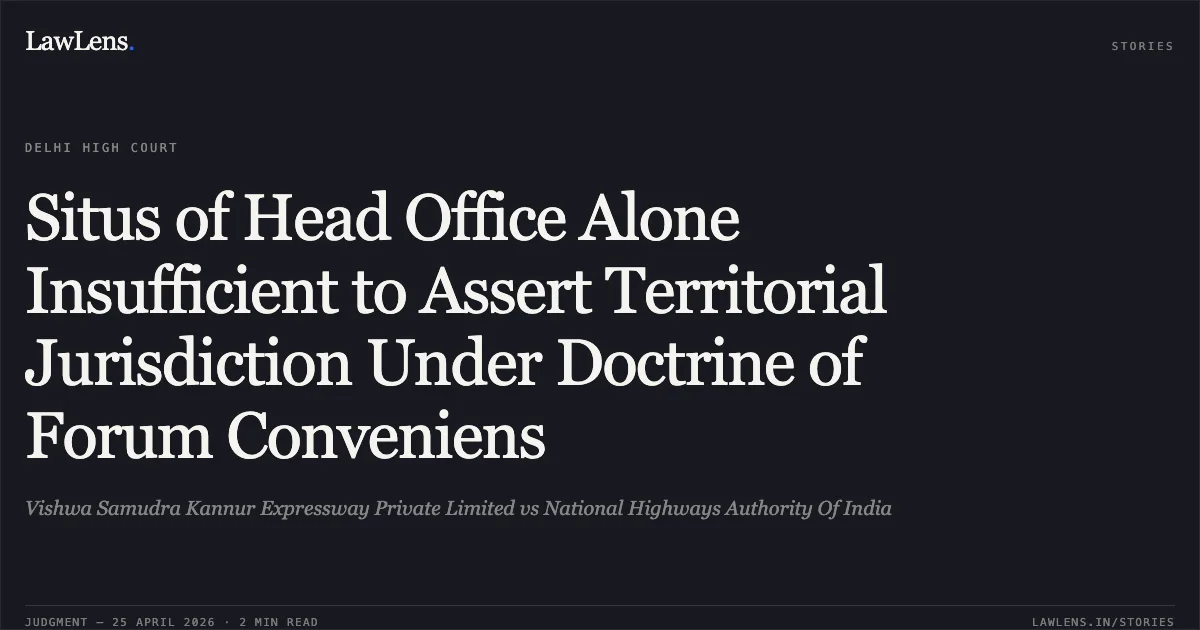
Vishwa Samudra Kannur Expressway Private LimitedvsNational Highways Authority Of India
Click to open original judgment
Original judgment, available to read, download and summarize on LawLens.in