01Facts
The Petitioner, a proprietary concern, filed a writ petition under Article 226/227 seeking to set aside an order dated 31.08.2022 passed by the State Consumer Disputes Redressal Commission (SCDRC), Punjab
¶ 1(a)Additionally, the Petitioner sought a writ of mandamus for the payment of an insurance claim amounting to Rs. 60,00,000, along with compensation and litigation expenses
¶ 1(b)-(c)The underlying dispute originated from a complaint filed before the District Consumer Disputes Redressal Forum, Mansa, Punjab, which was subsequently appealed before the SCDRC, Punjab
¶ 5The Petitioner approached the Delhi High Court on the sole ground that the National Consumer Disputes Redressal Commission (NCDRC), which entertained the revision petition, is situated in Delhi
¶ 202Issues
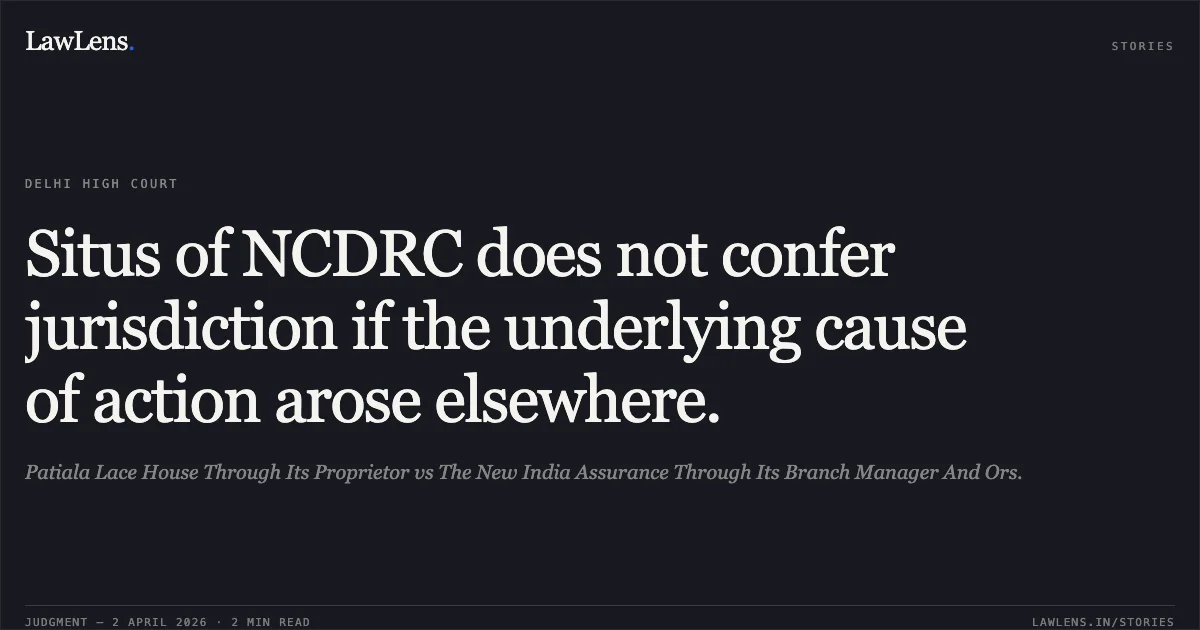
i.Whether the Delhi High Court has the territorial jurisdiction to entertain a writ petition challenging orders arising from consumer disputes where the entire cause of action occurred in another state, solely because the NCDRC is located in Delhi?
¶ 2, 803Law Applied
The Court relied on the Supreme Court’s decision in Siddharth S. Mookerjee and Anr. v. Madhab Chand Mitter and Anr. (2024 SCC OnLine SC 4285), which held that the location of the NCDRC does not vest jurisdiction in the Delhi High Court if the cause of action arose elsewhere
¶ 6It further applied the principle from General Manager Punjab National Bank and Ors. v. Rohit Malhotra (2024:DHC:7035), affirming that the situs of a Tribunal or Authority exercising control over multiple states is not a deciding factor for jurisdiction
¶ 7The court also referenced Ibrat Faizan v. Omaxe Buildhome Private Limited, clarifying that the "concerned High Court" or "jurisdictional High Court" under Article 227 refers to the court under whose territorial jurisdiction the dispute arose
¶ 704Reasoning
The Court observed that the entire cause of action—including the filing of the initial complaint, the adjudication by the District Forum in Mansa, and the subsequent appeal before the State Commission—transpired outside the territorial jurisdiction of Delhi
¶ 8Justice Kaurav reasoned that the NCDRC is a National Authority, and its physical location in the capital is incidental to its function over multiple states
¶ 8Relying on the extracted precedents, the Court determined that the Petitioner must approach the High Court under whose jurisdiction the dispute actually arose (the Punjab and Haryana High Court) rather than the Delhi High Court
¶ 3, 9The mere fact that a revisionary body (NCDRC) is seated in Delhi does not override the requirement of a territorial nexus with the cause of action
¶ 805Holding
The Court held that the petition was not maintainable before the Delhi High Court for want of territorial jurisdiction
¶ 8-9The petition was dismissed, with liberty granted to the Petitioner to approach the appropriate jurisdictional High Court
¶ 9All rights and contentions of the parties were left open
¶ 10Original Court PDF
Patiala Lace House Through Its ProprietorvsThe New India Assurance Through Its Branch Manager And Ors.
Click to open original judgment
Original judgment, available to read, download and summarize on LawLens.in