Facts
The Petitioner, a resident of Nadiad, Gujarat, served as a Notary Public (Registration No. 21125) authorized to perform functions within District Kheda, Gujarat, under the Notaries Act, 1952
Source reference: para. 1On October 10, 2024, the Petitioner applied for a five-year renewal of his license, which was set to expire on March 8, 2025
Source reference: para. 2Despite subsequent reminders, the Respondent-Ministry failed to decide on the renewal application, prompting the Petitioner to file a writ petition before the Delhi High Court
Source reference: para. 2The Petitioner invoked the jurisdiction of the Delhi High Court solely on the basis that the Respondent-Ministry is situated in Delhi
Source reference: para. 3-4Issues
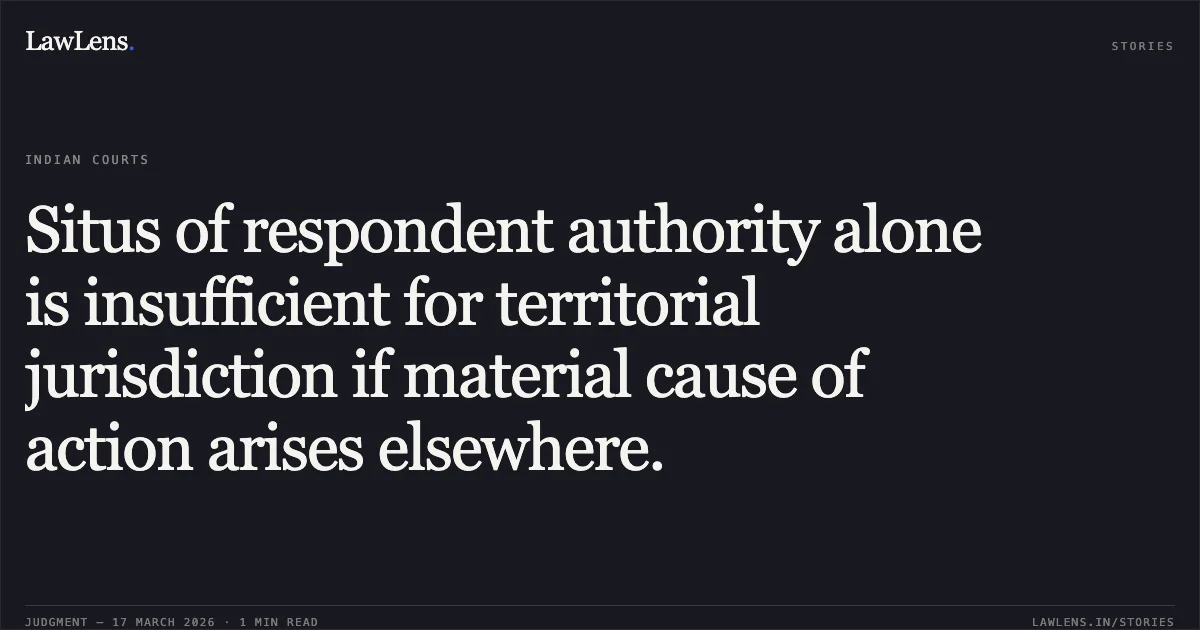
Whether the physical location (situs) of a Respondent-authority in Delhi is sufficient to vest territorial jurisdiction in the Delhi High Court when the underlying cause of action arose outside Delhi
Source reference: para. 4-5Whether the Court should decline to exercise its discretionary jurisdiction under the doctrine of forum conveniens even if a part of the cause of action arises within its jurisdiction
Source reference: para. 10Law Applied
The Court applied the principle that the situs of the respondent does not determine territorial jurisdiction, emphasizing the "dominant facts" and "material, essential, and integral" facts test established in The Indure Pvt. Ltd. v. Government of NCT of Delhi
Source reference: paras. 5-7It further relied on the Supreme Court’s decision in Kusum Ingots & Alloys Ltd. v. Union of India, which permits a High Court to refuse the exercise of discretionary jurisdiction by invoking the doctrine of forum conveniens even if a small part of the cause of action arises within its territorial limits
Source reference: para. 10Reasoning
The Court reasoned that the Petitioner is based in Gujarat and his professional functions are restricted to that state; therefore, the "legal injury" or "foundational facts" are centered in Gujarat
Source reference: para. 1, 7It observed that because Delhi is the national capital, various authorities with pan-India jurisdiction are located there, but this "unchanging constant" or "static facet" is immaterial to the actual lis (dispute)
Source reference: para. 7-8The Court held that allowing petitions solely based on the Ministry's location would erroneously transform the Delhi High Court into a "mini-pan-India Superior Court"
Source reference: para. 6Even if the decision-making process occurred in Delhi, the Court determined that the substance of the matter lacked a sufficient connection to the territory to justify exercising jurisdiction, especially when a more appropriate forum (the High Court of Gujarat) exists
Source reference: para. 9-10Holding
The Court dismissed the petition, holding that the location of the Respondent-Ministry in Delhi is not a determinative factor for entertaining the suit
Invoking the doctrine of forum conveniens, the Court granted the Petitioner liberty to approach the jurisdictional High Court (Gujarat) to agitate the grievance
Source reference: para. 11All rights and contentions of the parties were left open
Source reference: para. 12Original Court PDF
Shri Kandarp Laxminarayan MehtavsUnion Of India
Click to open original judgment
Original judgment, available to read, download and summarize on LawLens.in