Facts
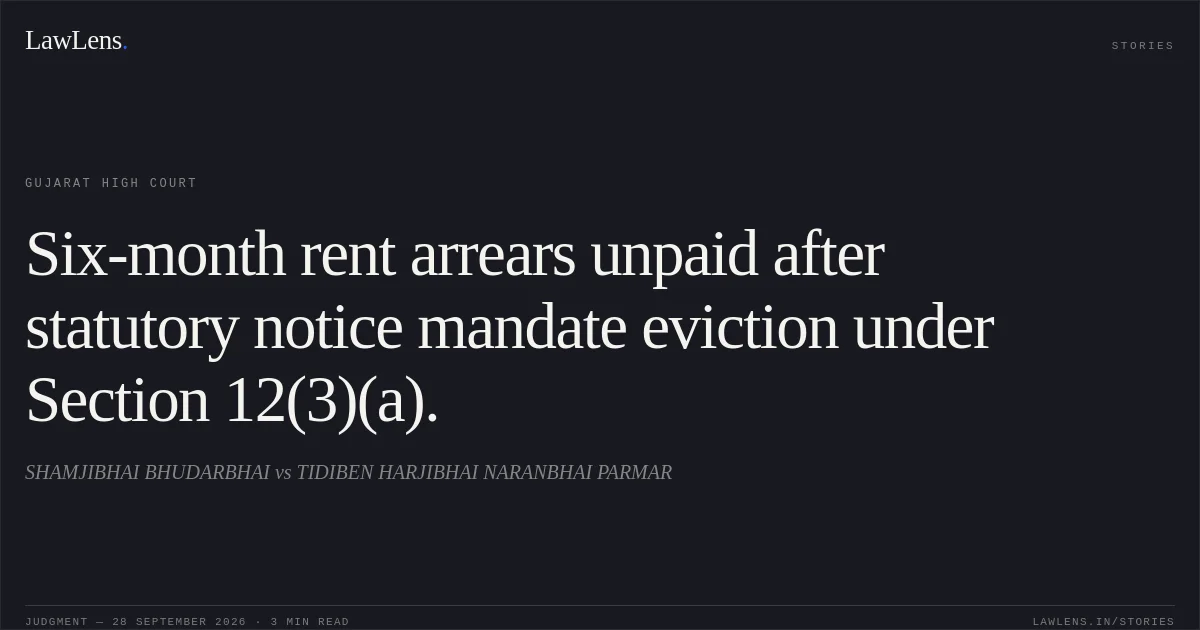
The landlord alleged that the tenant’s father had executed a rent agreement on 15 July 1991 and that rent remained unpaid from 1 March 2008 to 30 September 2010.
Source reference: para. 4–4.1After serving a statutory notice on 1 October 2010, the landlord brought an eviction suit.
Source reference: para. 4–4.1The tenant’s reply did not dispute the landlord–tenant relationship, but the tenant later contested that relationship in the suit.
Source reference: para. 4–4.1The Small Cause Court dismissed the suit, finding that the relationship had not been proved.
Source reference: para. 4.2On appeal, the Appellate Bench reversed that decision, found the relationship established, and ordered eviction for non-payment of rent.
Source reference: para. 4.2–4.3The tenants challenged the appellate decree under Section 29(2) of the Bombay Rents, Hotel and Lodging House Rates Control Act, 1947.
Source reference: para. 2, 4.4Issues
Whether the evidence established a landlord–tenant relationship sufficient to confer jurisdiction on the Rent Court, despite the tenant’s challenge to the landlord’s title.
Source reference: para. 5.1–6.4, 8–12Whether the tenant’s failure to pay arrears within the statutory period entitled the landlord to an eviction decree under Section 12(3)(a) of the Act.
Source reference: para. 5.3, 6.5, 14–16Whether the Appellate Court’s findings disclosed perversity or an error warranting interference in revision.
Source reference: para. 5, 16–17Law Applied
Section 5(3) of the Act defines “landlord” to include a person entitled or authorised to receive rent; proof of ownership is not a prerequisite to maintaining an eviction suit as landlord.
Source reference: para. 9; Section 5(3) quoted at para. 6.4Sections 28 and 29A confer jurisdiction over landlord–tenant disputes on the designated Rent Court while preserving a party’s ability to establish title before a competent court; the Rent Court does not determine title.
Source reference: para. 10The Court applied Section 116 of the Indian Evidence Act, 1872, as estopping a tenant from disputing the landlord’s title in the tenancy relationship.
Source reference: para. 6.3, 12Under Section 12(3)(a) of the Act, where rent is payable monthly, is in arrears for six months or more, and the tenant fails to pay within one month after statutory notice, an eviction decree follows; a standard-rent dispute must be raised within the statutory period.
Source reference: para. 14–15The Court relied on Arjun Khiamal Makhijani v. Jamnadas C. Tuliani, (1989) 4 SCC 612, applying its discussion of Harbanslal Jagmohandas on the statutory timing and consequence of raising a standard-rent dispute.
Source reference: para. 14–15Revisional interference is confined to egregious legal error, perversity, or a decision contrary to settled law, not mere reappreciation of evidence.
Source reference: para. 17Reasoning
The High Court found that the rent agreement executed by the tenant’s father was produced and admitted by the tenant, the tenant had not disputed the landlord’s status in the reply to the statutory notice, and the original owner’s evidence supported the landlord’s authority to collect rent.
Source reference: para. 8–12The landlord had also built the cottages and let one to the tenant’s father.
Source reference: para. 8–12This evidence supported the Appellate Court’s finding that the plaintiff was a “landlord” under Section 5(3); proof of ownership was unnecessary, and the Rent Court was not required to determine title.
Source reference: para. 8–12The asserted status-quo order concerning the land did not alter the Rent Court’s determination of the tenancy dispute.
Source reference: para. 13The tenant had not paid the arrears within one month after notice and had not raised a standard-rent dispute within the prescribed time.
Source reference: para. 14–16Given the monthly tenancy and arrears exceeding six months, the Court held that Section 12(3)(a) required eviction.
Source reference: para. 14–16It found no perversity or legal error justifying revisional intervention.
Source reference: para. 16–17Holding
The High Court dismissed the revision application and declined to interfere with the appellate eviction decree; the connected stay application was disposed of and notice discharged, with no order as to costs.
The Court also rejected the tenants’ request to suspend its order to enable them to approach a higher forum.
Source reference: para. 19Acts & Sections Cited
7 provisions across 2 statutes referred to in this judgment. Linked provisions open on LawLens.
Bombay Rents, Hotel and Lodging House Rates Control Act, 19476
Indian Evidence Act, 18721
Original Court PDF
SHAMJIBHAI BHUDARBHAIvsTIDIBEN HARJIBHAI NARANBHAI PARMAR
Click to open original judgment
Original judgment, available to read, download and summarize on LawLens.in