Facts
The petitioner, a resident and activist from Coimbatore, filed a Public Interest Litigation (PIL) seeking a Writ of Mandamus to prevent the slaughter of cows and calves in public places and non-designated areas during the festival of Bakrid.
Source reference: p. 3The petitioner submitted a representation on May 18, 2026, which remained unconsidered.
Source reference: p. 2The respondent police filed a counter-affidavit admitting that a temporary shed had been erected for cow slaughter (Qurban) in a non-public area in Coimbatore.
Source reference: p. 3Issues
1. Whether cows and calves can be sacrificed in places not designated as slaughterhouses on the occasion of Bakrid
Source reference: p. 3, para 22. Whether the slaughter of cows is a fundamental or obligatory religious practice for Muslims under the Constitution
Source reference: p. 4, para 83. Whether the State is mandated to prohibit the slaughter of cows and calves under existing statutes and constitutional provisions
Source reference: p. 4-5Law Applied
The Court applied Article 48 of the Constitution of India, which directs the State to prohibit the slaughter of cows and calves.
Source reference: p. 4Section 4 of the Tamil Nadu Animal Preservation Act, 1958, which prohibits slaughter without a certificate certifying the animal is over 10 years old and unfit for work and breeding.
Source reference: p. 5G.O.Ms.No.1715 (authored by Chief Secretary V. Karthikeyan), which enforces a total ban on cow slaughter in all slaughterhouses in Tamil Nadu.
Source reference: p. 6Section 113 of the Tamil Nadu Urban Local Bodies Act, 1998, and Rules 297 and 298 of the Tamil Nadu Urban Local Bodies Rules, 2023, which mandate that slaughter occur only in licensed, designated premises.
Source reference: p. 8-13Precedential reliance was placed on Mohammed Hanif Quareshi v. State of Bihar and State of West Bengal v. Ashutosh Lahiri, establishing that cow sacrifice is not an essential religious practice.
Source reference: p. 4Reasoning
The Court reasoned that since cow slaughter is not an essential religious practice for Muslims, it does not enjoy protection as an obligatory act.
Source reference: p. 4It strictly interpreted Section 4(3)(a) of the Tamil Nadu Animal Preservation Act, noting that the conjunctive "and" requires an animal to be over 10 years old and unfit for both work and breeding before a certificate can be issued.
Source reference: p. 5-6The Court also highlighted that executive powers are co-terminus with legislative powers, thus G.O.Ms.No.1715 carries the force of law to ban cow slaughter.
Source reference: p. 7Regarding the location of slaughter, the Court analyzed the Urban Local Bodies Rules, 2023, concluding that the detailed licensing and sanitary requirements (CCTV, drainage, screening from public view) effectively prohibit the use of temporary sheds or public areas for slaughter.
Source reference: p. 14Holding
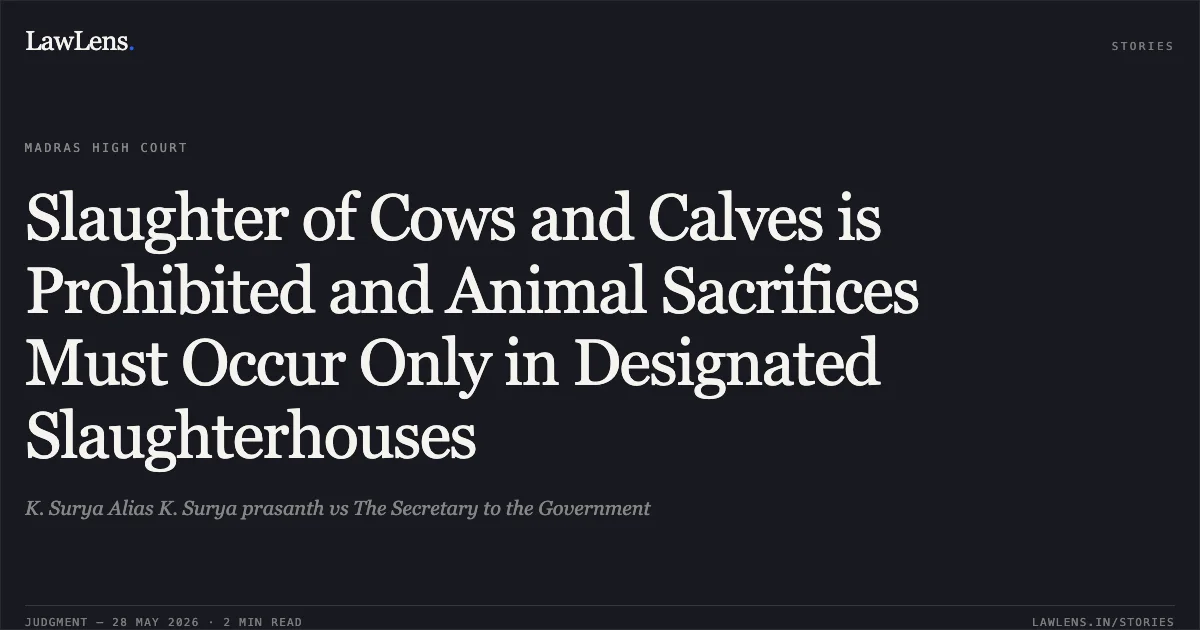
The Court allowed the writ petition, answering that animals can only be slaughtered in designated, licensed slaughterhouses and never in public or temporary places.
The Court held that cow slaughter is prohibited in Tamil Nadu per G.O.Ms.No.1715 and statutory restrictions.
Source reference: p. 14It directed the State to ensure no cow or calf is slaughtered on the eve of Bakrid or any other day, ordering the Chief Secretary and ADGP (Law and Order) to issue instructions for strict compliance.
Source reference: p. 14The matter was posted for compliance on May 29, 2026.
Source reference: p. 14Acts & Sections Cited
1 provisions across 1 statute referred to in this judgment. Each provision opens on LawLens.
Tamil Nadu Animal Preservation Act, 19581
Original Court PDF
K. Surya Alias K. Surya prasanthvsThe Secretary to the Government
Click to open original judgment
Original judgment, available to read, download and summarize on LawLens.in