Facts
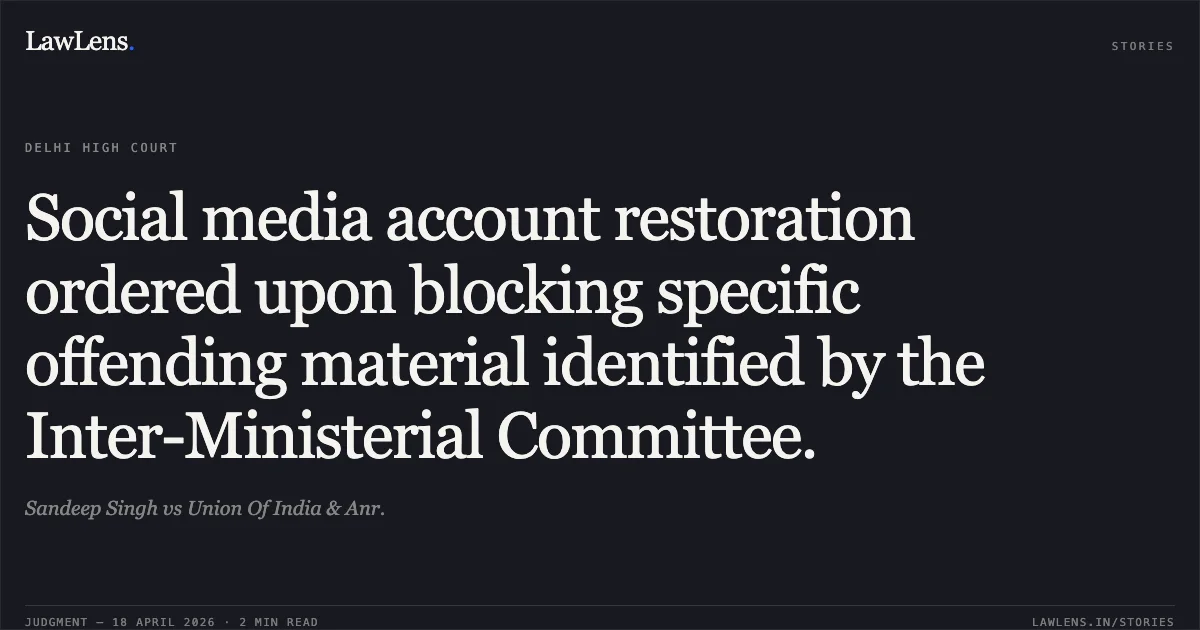
The Petitioner, a social worker operating the X (formerly Twitter) handle “@ActivistSandeep,” received a notice from X Corp. on March 19, 2026, stating his account had been withheld in India pursuant to a blocking order issued by the Ministry of Electronics & Information Technology (MeitY) under Section 69A of the Information Technology Act, 2000.
Source reference: para. 2On March 27, 2026, MeitY requested ID proof and scheduled a hearing before the Inter-Ministerial Committee (IMC).
Source reference: para. 2The Petitioner approached the High Court seeking restoration of his account and production of the blocking order, alleging violations of fundamental rights under Articles 14, 19(1)(a), and 21.
Source reference: para. 1The Petitioner undertook to remove any material deemed objectionable by the IMC provided he was granted a hearing.
Source reference: para. 4Issues
1. Whether the wholesale blocking of the Petitioner’s social media account under Section 69A of the IT Act is sustainable when the Petitioner is willing to remove specific offending content.
Source reference: para. 1, 42. Whether the procedure followed for blocking the account adhered to the Information Technology (Procedure and Safeguards for Blocking for Access of Information by Public) Rules, 2009.
Source reference: para. 1Law Applied
Section 69A of the Information Technology Act, 2000, which empowers the Central Government to issue directions for blocking public access to information in the interest of national sovereignty, integrity, or public order.
Source reference: para. 2Rules 8 and 9 of the Information Technology (Procedure and Safeguards for Blocking for Access of Information by Public) Rules, 2009, which delineate the procedural requirements for such orders.
Source reference: para. 1The judicial approach established in Prateek Sharma v. Union of India, Kumar Nayan v. Union of India, and Shilpa Kumari v. Union of India, which emphasize balancing administrative blocking powers with the user's right to be heard and the principle of proportionality.
Source reference: para. 6Reasoning
The Court observed that the controversy was largely governed by recent precedents where the Delhi High Court facilitated a middle ground between regulatory oversight and freedom of expression.
Source reference: para. 6By noting the Petitioner’s willingness to delete offending material and the fact that an IMC hearing was already scheduled, the Court determined that an absolute withholding of the account was unnecessary if the specific objectionable content could be isolated.
Source reference: para. 4, 6The Court reasoned that once the IMC identifies specific offending posts and the Intermediary (X Corp.) blocks those specific instances, the account itself should be restored to the user to prevent an overbroad restriction on speech.
Source reference: para. 6(ii)This approach ensures that the "least restrictive measure" is applied while maintaining MeitY’s power to monitor future content for legal compliance.
Source reference: para. 6(iv)Holding
The Court disposed of the petition by directing the Petitioner to appear before the IMC on April 15, 2026.
The IMC was directed to point out the specific objectionable material, after which Respondent No. 2 (X Corp.) is to temporarily block said material.
Source reference: para. 6(ii)Crucially, the Court ordered that upon compliance with the removal of specific offending content, the Petitioner’s X account must be restored.
Source reference: para. 6(ii)The final status of the account and content remains subject to the IMC’s final adjudication, with MeitY reserved the liberty to monitor the account for any further objectionable posts.
Source reference: para. 6(iii)-(iv)Acts & Sections Cited
1 provisions across 1 statute referred to in this judgment. Linked provisions open on LawLens.
Information Technology Act, 20001
Original Court PDF
Sandeep SinghvsUnion Of India & Anr.
Click to open original judgment
Original judgment, available to read, download and summarize on LawLens.in