Facts
The informant, Pannu Oraon (PW-3), alleged that on June 28, 1992, he and Chumnu Oraon (deceased) visited the house of accused Etwa Oraon and Champa Oraon to discuss funeral rites.
Source reference: para. 6After consuming wine, the accused allegedly assaulted Chumnu with a knife, leading to his death.
Source reference: para. 7The informant fled and later discovered the body in a ditch.
Source reference: para. 7The Trial Court convicted Champa Oraon under Sections 302/34, 201, and 379 of the IPC, sentencing him to rigorous imprisonment for life.
Source reference: para. 5The co-accused, Etwa Oraon, died during the pendency of the appeal, causing the proceedings against him to abate.
Source reference: para. 3Champa Oraon appealed the conviction on grounds of contradictions in testimony and lack of independent corroboration.
Source reference: para. 13Issues
1. Whether the uncorroborated testimony of a sole eyewitness (PW-3) is sufficiently reliable to sustain a conviction for murder.
Source reference: para. 312. Whether the prosecution successfully established the Place of Occurrence (PO) given the contradictions between the FIR, ocular evidence, and the investigation report.
Source reference: para. 55Law Applied
The Court applied Section 302 (murder), Section 201 (causing disappearance of evidence), and Section 379 (theft) read with Section 34 (common intention) of the Indian Penal Code.
Source reference: para. 5It relied on Section 134 of the Evidence Act, which stipulates that no particular number of witnesses is required to prove a fact, provided the sole witness is "wholly reliable".
Source reference: para. 35The Court cited *Bipin Kumar Mondal v. State of W.B.* (2010) regarding the "quality over quantity" of evidence.
Source reference: para. 36The Court cited *Narendrasinh Keshubhai Zala v. State of Gujarat* (2023) emphasizing that unnatural conduct by a witness can be grounds for disbelieving them.
Source reference: para. 58The "benefit of doubt" principle from *Sharad Birdhichand Sarda v. State of Maharashtra* (1984) was applied to mandate acquittal when two views are possible.
Source reference: para. 63Reasoning
The Court found several irreconcilable infirmities in the prosecution's case.
Source reference: no citationFirstly, the testimony of the sole eyewitness (PW-3) was deemed "unnatural" as he claimed to have fled three miles while being chased by two armed men immediately after consuming several bottles of wine.
Source reference: para. 46Secondly, there were significant contradictions regarding the Place of Occurrence; the informant’s FIR suggested the assault happened outside the house, whereas the Investigating Officer (PW-7) identified the interior of the house as the primary PO.
Source reference: para. 53-54Crucially, no bloodstains or incriminating objects were recovered from the house.
Source reference: para. 54The Court noted that despite the incident occurring at 1:30 PM in a neighborhood with 35 houses, no independent witnesses were examined.
Source reference: para. 56These unexplained circumstances rendered the sole witness's testimony unreliable and insufficient to bridge the gap between "suspicion" and "proof".
Source reference: para. 58-61Holding
The Court answered the issues in the negative, holding that the prosecution failed to prove the charges beyond a reasonable doubt.
The Court allowed the appeal, quashing the judgment of conviction dated December 17, 1997, and the order of sentence dated December 18, 1997.
Source reference: para. 65Champa Oraon was acquitted of all charges and discharged from his bail bonds.
Source reference: para. 67The Court highlighted that in criminal jurisprudence, the benefit of doubt must be afforded to the accused when the evidence lacks a "ring of truth".
Source reference: para. 61-63Acts & Sections Cited
5 provisions across 2 statutes referred to in this judgment. Each provision opens on LawLens.
Code of Criminal Procedure, 19731
Indian Penal Code, 18604
Original Court PDF
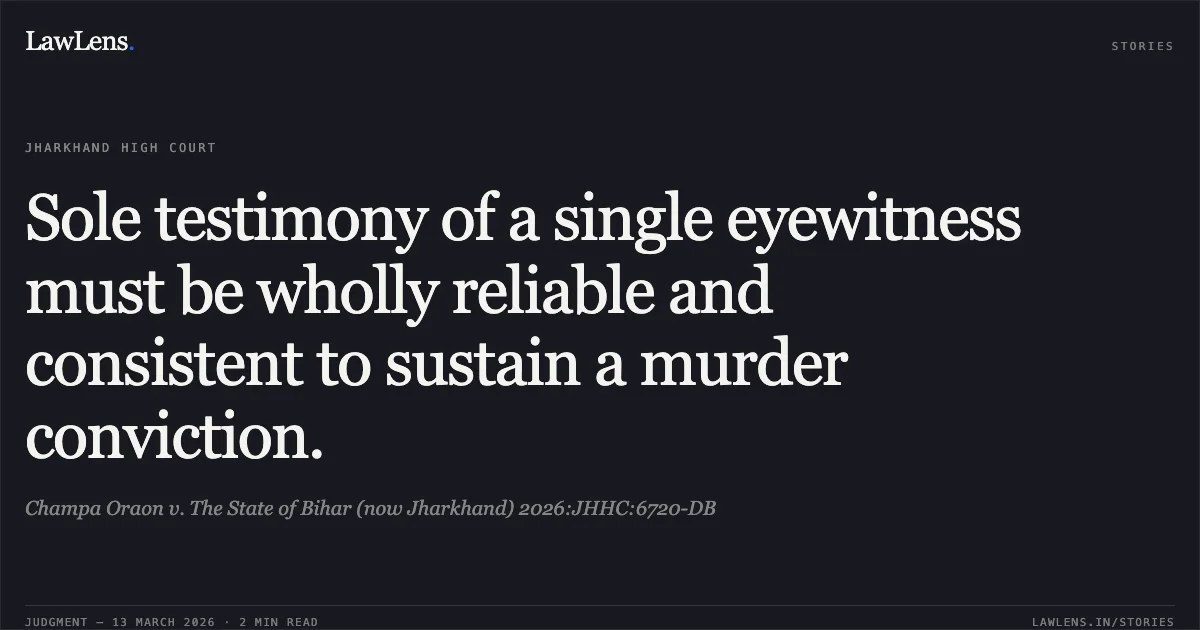
Champa Oraon v. The State of Bihar (now Jharkhand) 2026:JHHC:6720-DB
Click to open original judgment
Original judgment, available to read, download and summarize on LawLens.in