Facts
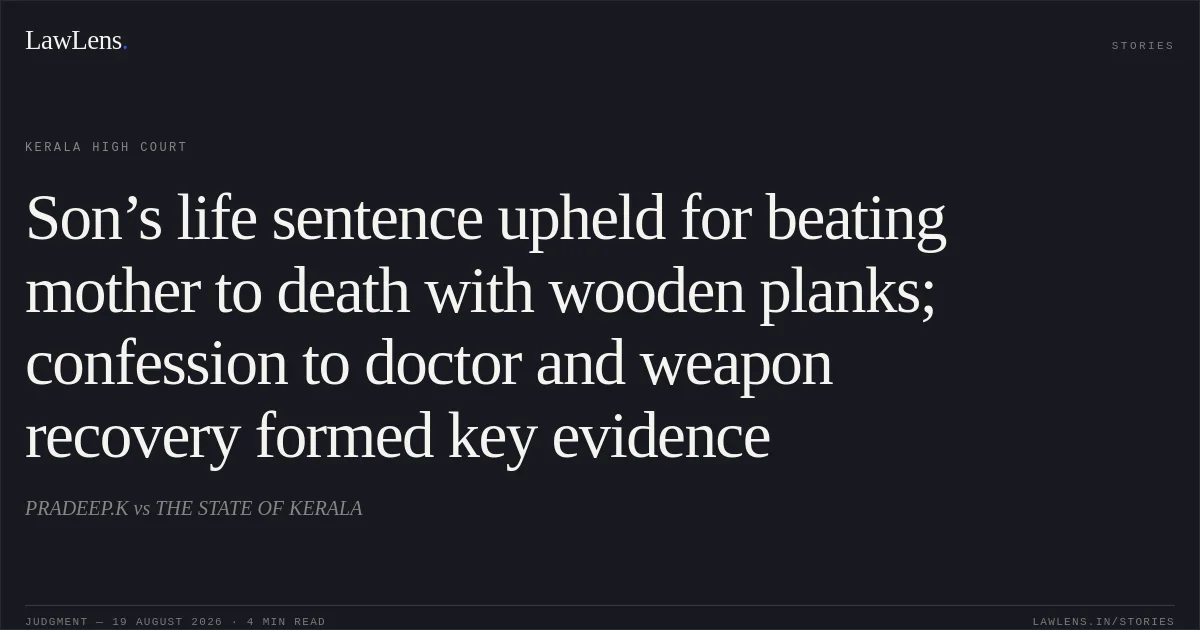
On 15 September 2016 at approximately 6:00 p.m., the appellant allegedly trespassed into the house where his mother, Chandrika, was residing with Balakrishnan, and assaulted her and Balakrishnan with wooden planks.
Source reference: para. 3; pp. 3–4Chandrika sustained multiple injuries, including severe head injuries, and died at the Taluk Headquarters Hospital later that night. Balakrishnan suffered grievous injuries, including a fracture of the left tibia.
Source reference: para. 3; pp. 3–4The prosecution relied principally on circumstantial evidence, the history recorded by PW12, Dr. Ananthanadhan, in the wound certificates, and the recovery of two wooden planks allegedly at the appellant’s instance.
Source reference: paras. 28.1–28.5, 45, 61The injured eyewitness, Balakrishnan, died by suicide before trial and could not be examined.
Source reference: para. 45Several material witnesses turned hostile, while the medical and forensic evidence supported the prosecution case that Chandrika’s death was homicidal and caused by multiple blunt-force injuries.
Source reference: paras. 42–43The Additional Sessions Court convicted the appellant under Sections 450, 324, 326 and 302 IPC, sentencing him to life imprisonment and fine for murder, along with separate terms of imprisonment and fines for the other offences.
Source reference: para. 2; pp. 2–3The appellant challenged the conviction in the present appeal.
Source reference: paras. 1, 7Issues
1. Whether the prosecution proved beyond reasonable doubt that Chandrika’s death was homicidal and caused by injuries inflicted with wooden planks.
Source reference: paras. 41–432. Whether the prosecution established the appellant’s presence and involvement in the assault despite the case resting on circumstantial evidence and several witnesses turning hostile.
Source reference: paras. 44–52, 90–913. Whether the alleged extra-judicial confession made by the appellant to PW12, the treating doctor, was voluntary, reliable and legally sufficient to be relied upon.
Source reference: paras. 61–764. Whether the recovery of MO1 and MO2 wooden planks pursuant to the appellant’s disclosure was admissible and reliable under Section 27 of the Indian Evidence Act.
Source reference: paras. 77–875. Whether the appellant’s act amounted to murder under Section 302 IPC or only culpable homicide not amounting to murder under Section 304 Part II IPC.
Source reference: paras. 88–89Law Applied
The Court applied Sections 302, 324, 326 and 450 of the Indian Penal Code concerning murder, voluntarily causing hurt with dangerous weapons, voluntarily causing grievous hurt with dangerous weapons, and house-trespass in order to commit an offence.
Source reference: paras. 1–3In assessing circumstantial evidence, it relied on Hanumant v. State of M.P., Naseem Ahmed v. Delhi Administration, Sharad Birdhichand Sarda v. State of Maharashtra, Padala Veera Reddy v. State of A.P., and State of U.P. v. Dr. Ravindra Prakash Mittal: the circumstances must be fully established, conclusive, consistent only with guilt, exclude reasonable hypotheses of innocence, and form a complete chain pointing to the accused.
Source reference: paras. 46–51Regarding extra-judicial confession, the Court applied Sections 24–27 of the Indian Evidence Act and the principles in Mulk Raj v. State of U.P., State of Rajasthan v. Raja Ram, Sahadevan v. State of Tamil Nadu, State of U.P. v. M.K. Anthony and Ramanand alias Nandlal Bharti v. State of Uttar Pradesh: a voluntary and truthful confession may sustain conviction if proved through a credible witness, although it must be scrutinised with care.
Source reference: paras. 62–70Under Section 27, only that portion of information supplied by an accused in police custody which distinctly relates to a fact discovered is admissible; discovery includes the place of concealment and the accused’s knowledge of it, and recovery is not invalid merely because the place is accessible to others.
Source reference: paras. 78–83Reasoning
The Court accepted the medical evidence of PW20, the post-mortem doctor, that Chandrika had 24 ante-mortem injuries, including extensive head injuries, subarachnoid haemorrhage and rib fractures, and that death resulted from multiple blunt-force injuries.
Source reference: paras. 42–43The injuries were inconsistent with a single fall into a canal and were capable of being caused by wooden planks.
Source reference: paras. 42–43Although the injured eyewitness was unavailable and several witnesses were hostile, PW12’s contemporaneous recording of the appellant’s statement that he had beaten his mother with a wooden plank, together with the appellant’s conduct in bringing her to the hospital, was treated as a voluntary and reliable extra-judicial confession made to a medical professional in the course of treatment.
Source reference: paras. 74–76The Court further relied on the recovery of MO1 and MO2 from the veranda and bedroom at the appellant’s instance, supported by the evidence of the investigating officer and police witnesses, notwithstanding the hostility of the independent seizure witness.
Source reference: paras. 84–87The medical evidence, blood evidence, recovery, the appellant’s presence at the scene, the injuries to Balakrishnan, and the confession were considered cumulatively.
Source reference: paras. 90–93Applying the circumstantial-evidence test, the Court held that these circumstances formed a complete chain inconsistent with the appellant’s innocence.
Source reference: paras. 90–93The multiplicity and severity of the blows, particularly to the head, the force used, and the nature of the wooden weapons established the requisite intention and brought the offence within Section 302 IPC rather than Section 304 Part II.
Source reference: paras. 88–89Holding
The High Court answered the issues against the appellant.
It held that Chandrika’s death was homicidal, that the prosecution had proved the appellant’s involvement beyond reasonable doubt, that the extra-judicial confession and recovery evidence were admissible and reliable, and that the offence constituted murder under Section 302 IPC.
Source reference: paras. 89, 91, 93Criminal Appeal No. 764 of 2020 was dismissed, and the judgment of the Additional Sessions Court-I, Wayanad, in S.C. No. 63 of 2017 was confirmed, including the convictions and sentences under Sections 302, 326, 450 and 324 IPC.
Source reference: para. 93; pp. 52–53Acts & Sections Cited
7 provisions across 3 statutes referred to in this judgment. Each provision opens on LawLens.
Indian Penal Code, 18604
Code of Criminal Procedure, 19732
Bharatiya Nagarik Suraksha Sanhita, 20231
Original Court PDF
PRADEEP.KvsTHE STATE OF KERALA
Click to open original judgment
Original judgment, available to read, download and summarize on LawLens.in