Facts
The petitioners, a company and a partnership firm involved in manufacturing soybean products, challenged multiple orders including a suo moto revision order dated 19.07.2012 and subsequent recovery-related orders
Source reference: paras. 2, 11Historically, the entities underwent various assessments for the fiscal year 2002-2003, during which an adjudicating authority initially granted tax exemptions on "Soya Flour" by classifying it as "flour" under a 2002 government notification
Source reference: para. 5However, the Revenue Department reopened the matter, and the Revisional Authority later determined that Soya Flour was a taxable commodity, imposing Central Sales Tax at 10%
Source reference: para. 6The petitioners argued they were never served with the 2012 revision order and only discovered it during 2017 recovery proceedings, leading to several rounds of litigation before the High Court
Source reference: paras. 7-10Issues
1. Whether Soya Flour qualifies for tax exemption as "flour" (atta) or "besan" under Notification No. 48 dated 23.04.2002
Source reference: para. 122. Whether the suo moto revision and subsequent recovery orders were legally sustainable or barred by limitation and procedural irregularities
Source reference: paras. 18, 26Law Applied
The court primarily applied Section 62 of the M.P. Commercial Tax Act, 1994, which governs revisions and suo moto powers of the Commissioner
Source reference: paras. 1, 6It interpreted Notification No. 48 dated 23.04.2002, which provides conditional exemptions for atta (flour) of cereals and besan of pulses
Source reference: para. 28The court underscored the principle of strict construction of tax exemption notifications, noting that Soya Flour had been moved to a taxable entry (Entry 77, Part 5, Schedule 2) as of March 2000
Source reference: para. 28The court considered the definition of "oilseeds" versus "pulses" in the context of trade nomenclature
Source reference: para. 28Reasoning
The court reasoned that the exemption notification was explicit in its scope, limited specifically to flour derived from "cereals" and besan derived from "pulses"
Source reference: para. 28Since soybeans are legally and commercially classified as "oilseeds" rather than cereals or pulses, the flour manufactured from them does not fall within the exempted categories listed in the 2002 notification
Source reference: paras. 28, 29The court found that the original assessment granting the exemption was detrimental to public revenue and contrary to the statutory entries in force at the material time
Source reference: para. 28Regarding procedural grievances, the court noted that despite the petitioners' claims of non-service and lack of opportunity, the matter had been extensively litigated and considered across multiple forums, and the substantive tax liability remained valid based on the classification of the goods
Source reference: paras. 28-29Holding
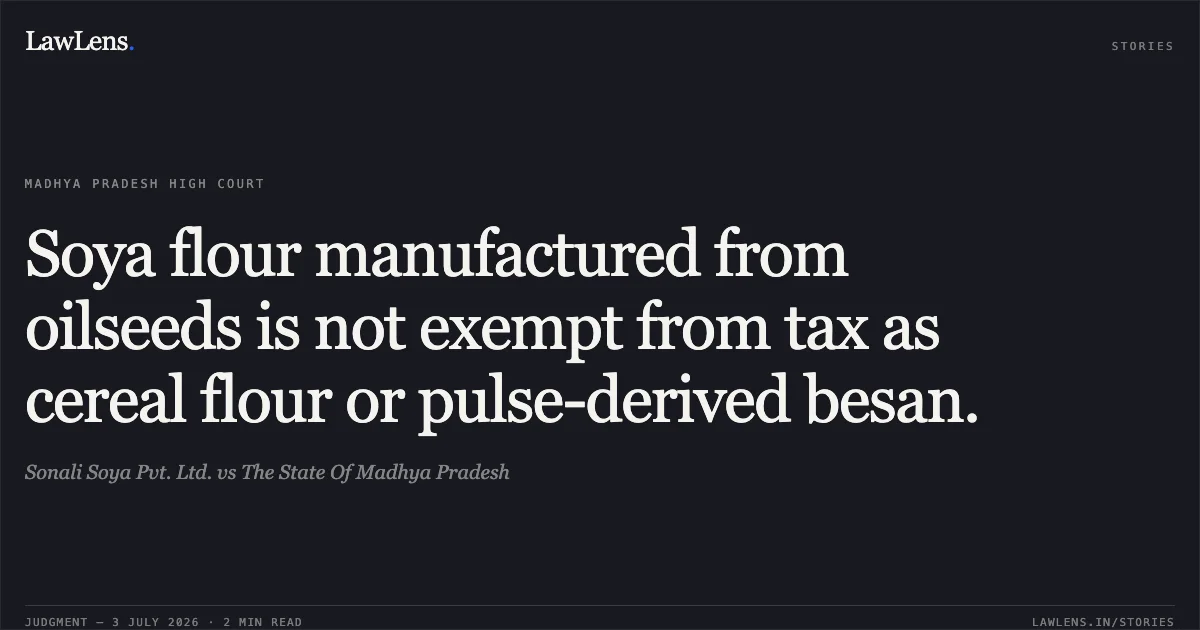
The Court held that Soya Flour is a taxable commodity and does not qualify for the exemption intended for cereal-based flour or pulse-based besan
Consequently, the imposition of Central Sales Tax at 10% due to the lack of supporting C-Forms was upheld
Source reference: para. 28The court found no jurisdictional error or patent illegality in the impugned orders and dismissed the Writ Petition
Source reference: para. 29Acts & Sections Cited
1 provisions across 1 statute referred to in this judgment. Each provision opens on LawLens.
Central Sales Tax Act, 19561
Original Court PDF
Sonali Soya Pvt. Ltd.vsThe State Of Madhya Pradesh
Click to open original judgment
Original judgment, available to read, download and summarize on LawLens.in