Facts
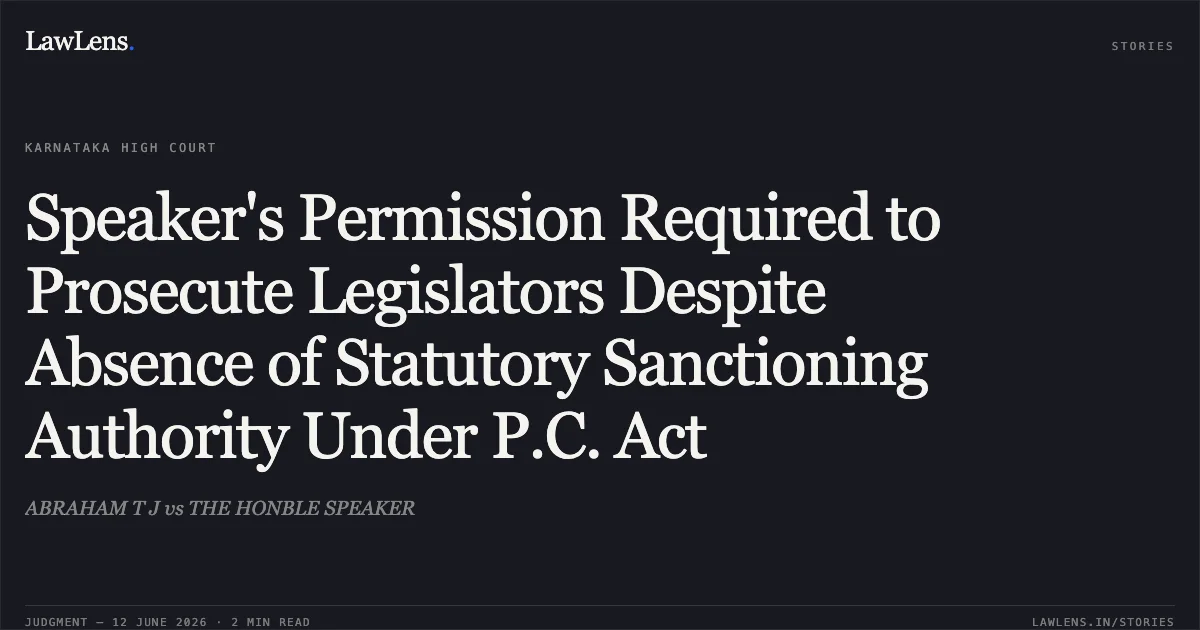
The Petitioner, a social activist, filed a private complaint (PCR No. 77/2020) against several Members of the Legislative Assembly (MLAs), alleging they offered and received bribes to switch political parties, punishable under the Prevention of Corruption Act (P.C. Act).
Source reference: para. 4-6The Trial Court initially took cognizance, but the High Court, in a previous challenge (W.P. No. 14322/2021), set aside the order and directed the complainant to obtain sanction for prosecution as per Section 19(1)(c)(ii) of the P.C. Act.
Source reference: para. 7-9The Petitioner applied to the Speaker of the Karnataka Legislative Assembly for sanction, but on April 25, 2022, the Deputy Secretary issued a communication stating that since the Speaker is not the appointing authority for elected representatives, the question of granting sanction or permission for investigation does not arise.
Source reference: para. 1, 13The Petitioner challenged this endorsement via the present Writ Petition.
Source reference: para. 2Issues
1. Whether the Speaker of the Legislative Assembly is the competent authority to grant permission/sanction for the prosecution of an MLA under the Prevention of Corruption Act, 1988.
Source reference: para. 182. Whether the communication dated 25.04.2022 (Annexure-F) is sustainable in law.
Source reference: no citationLaw Applied
Section 19(1)(c)(ii) of the Prevention of Corruption Act, 1988 regarding sanction for prosecution of public servants.
Source reference: no citationThe principle that even if there is no technical 'appointing authority' for an MLA, the Speaker is the person competent to remove the person from office for the purpose of granting sanction under the P.C. Act.
Source reference: no citationReasoning
The court examined the scope of Section 19 of the Prevention of Corruption Act and the necessity of obtaining sanction before a court can take cognizance of an offense against a public servant.
Source reference: no citationThe court reasoned that the Speaker holds the administrative and disciplinary authority over the members of the House, and for the purposes of the P.C. Act, serves as the competent authority to decide on the grant of sanction to ensure legislators are not subjected to vexatious prosecutions without merit.
Source reference: no citationHolding
The Speaker of the Legislative Assembly is the competent authority to grant permission or sanction for the prosecution of an MLA under the Prevention of Corruption Act.
The Court set aside the impugned communication and directed the Speaker to reconsider the application for sanction in accordance with law.
Source reference: no citationActs & Sections Cited
12 provisions across 2 statutes referred to in this judgment. Each provision opens on LawLens.
Prevention of Corruption Act, 1988
Indian Penal Code, 18603
Original Court PDF
ABRAHAM T JvsTHE HONBLE SPEAKER
Click to open original judgment
Original judgment, available to read, download and summarize on LawLens.in