Facts
The appellant (husband) and respondent (wife) were married in 2021. Following domestic disputes, the respondent, a serving judicial officer in Bihar, filed for maintenance under the DV Act
Source reference: p. 2In her Affidavit of Assets and Liabilities, she marked her income and assets as "N/A," despite her employment status
Source reference: p. 2An ex-parte maintenance order was subsequently passed against the appellant
Source reference: p. 2-3The appellant initiated proceedings under Section 340 Cr.P.C. (now Section 379 BNSS) for perjury and filed Contempt Application (Civil) No. 3201 of 2024, alleging violation of the guidelines in Rajnesh v. Neha
Source reference: p. 3The learned Single Judge disposed of the contempt plea on August 13, 2024, without a finding on contempt, directing the appellant to pursue the pending Section 340 Cr.P.C. application to avoid multiplicity of proceedings
Source reference: p. 3, 11The appellant challenged this order via an intra-court Special Appeal
Source reference: p. 3Issues
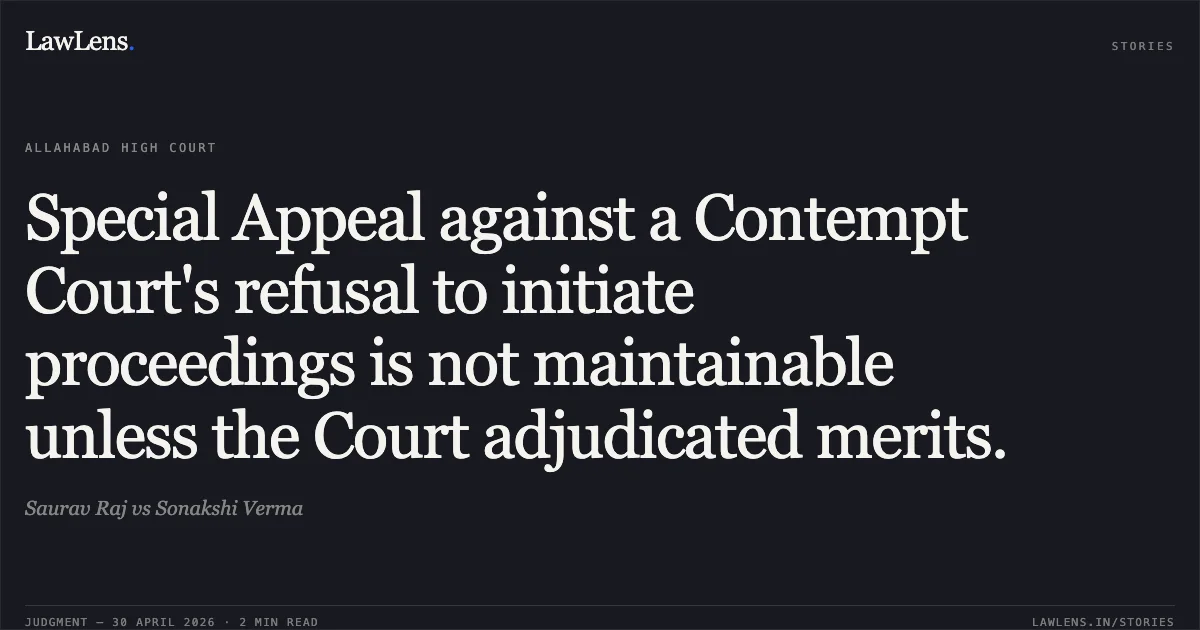
1. Whether a Special Appeal under Chapter VIII Rule 5 of the Allahabad High Court Rules, 1952, is maintainable against an order of the Contempt Court declining to initiate proceedings
Source reference: para. 4Law Applied
Chapter VIII Rule 5 of the Rules, 1952, which governs intra-court appeals
Source reference: para. 10Supreme Court’s decision in Midnapore Peoples' Coop. Bank Ltd. v. Chunni Lal Nanda, which establishes that a special appeal is maintainable against a contempt court's order only if the court adjudicates on the merits of the underlying dispute or issues directions beyond the scope of contempt jurisdiction
Source reference: para. 12Section 19 of the Contempt of Courts Act, 1971, noting it only permits appeals against orders imposing punishment
Source reference: para. 12, 13The maxim quando aliquid prohibetur ex directo, prohibetur et per obliquum (what cannot be done directly cannot be done indirectly) regarding the lack of statutory appeal for refusing to initiate contempt
Source reference: para. 21Reasoning
The Court examined whether the Single Judge’s order "overstepped" jurisdiction by deciding on the merits of the matrimonial dispute. It found that the Single Judge merely made a procedural observation—that multiple proceedings on the same facts (contempt and perjury) should be avoided—and provided liberty to transfer the pending perjury application
Source reference: para. 11, 19The Bench reasoned that "merits" in this context refers to the substantive legal/factual questions of the original litigation (the maintenance dispute), which the Single Judge did not touch
Source reference: para. 13, 18Since the Single Judge declined to initiate contempt without determining the rights of the parties or altering the original maintenance order, the order did not possess the "trappings of a final order" necessary to trigger an intra-court appeal
Source reference: para. 13, 20The Court clarified that while Rajnesh v. Neha allows for simultaneous perjury and contempt actions, it does not mandate that the High Court must exercise both powers in every instance
Source reference: para. 16Holding
The Court held that the Special Appeal is not maintainable
It ruled that an intra-court appeal under Chapter VIII Rule 5 does not lie against an order where the Single Judge has declined to initiate contempt proceedings without delving into the merits of the original dispute
Source reference: para. 22The appeal was dismissed without a representative finding on the merits of the alleged false affidavit
Source reference: para. 23Acts & Sections Cited
5 provisions across 4 statutes referred to in this judgment. Each provision opens on LawLens.
Bharatiya Nagarik Suraksha Sanhita, 20231
Code of Criminal Procedure, 19731
Protection of Women from Domestic Violence Act, 20051
Contempt of Courts Act, 19712
Original Court PDF
Saurav RajvsSonakshi Verma
Click to open original judgment
Original judgment, available to read, download and summarize on LawLens.in