Facts
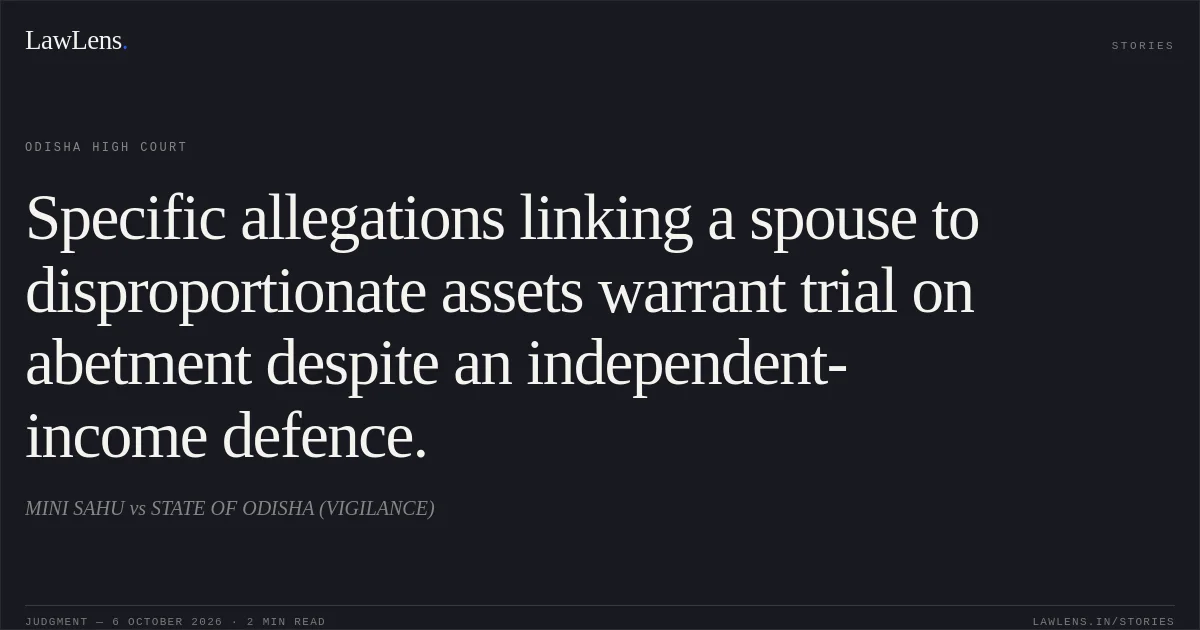
The petitioner, a government schoolteacher and the second wife of a WESCO Junior Accountant, was charged under Section 109 IPC for allegedly abetting her husband’s offence under Sections 13(2) read with 13(1)(e) of the Prevention of Corruption Act, 1988.
Source reference: pp. 4–8The prosecution alleged that her husband possessed disproportionate assets of ₹90,04,811, including five properties registered in her name.
Source reference: pp. 4–8After the Special Judge rejected her application for discharge under Section 239 CrPC, she challenged that order in revision.
Source reference: pp. 4–8She maintained that her independent income and savings explained the properties
Source reference: pp. 4–8The petitioner had previously been granted liberty to pursue discharge before the appropriate forum
Source reference: p. 3Issues
1. Whether the charge-sheet materials disclosed a prima facie case that the petitioner abetted her husband’s acquisition or possession of disproportionate assets, warranting refusal of discharge under Section 239 CrPC
Source reference: pp. 9–132. Whether the petitioner’s asserted independent income and explanation for the properties could be considered at the discharge stage
Source reference: pp. 7–8, 12–13Law Applied
Section 13(1)(e) of the Prevention of Corruption Act concerns a public servant’s possession of assets disproportionate to known sources of income; under Section 13(2), such conduct is punishable.
Source reference: pp. 8, 11A non-public servant may be tried for abetting an offence under the Act where the material supports abetment: P. Nallammal v. State, (1999) 6 SCC 559, and P. Shanthi Pugazhenthi v. State, 2005 SCC OnLine SC 1091
Source reference: pp. 8, 11Under Sections 107 and 109 IPC, abetment requires conduct amounting to instigation, conspiracy, or intentional aid; mere registration of property in a relative’s name, without material indicating abetment, is insufficient.
Source reference: pp. 9–12The court referred to Smt. Kumudini Padhy v. State of Odisha (Vig.), AIR Online 2019 ORI 153, and Smt. E. Swarnalata @ P. Swarnalata v. State of Odisha (Vigilance), CRLMC No. 2660 of 2023, on that principle
Source reference: pp. 9–12At the charge stage, the court assesses whether the record discloses a prima facie case or grave suspicion; it does not conduct a mini-trial or weigh the defence evidence
Source reference: pp. 9–10, 12Reasoning
The court noted that the prosecution specifically alleged the petitioner had facilitated her husband’s acquisition and holding of assets, and identified five properties registered in her name that were included in the disproportionate-assets calculation
Source reference: pp. 5–6, 12Although the petitioner asserted that her salary, GPF withdrawal, and savings independently accounted for the properties, the court treated that explanation as a defence whose correctness and evidentiary weight required assessment at trial, rather than determination in revision at the discharge stage
Source reference: pp. 7–8, 12–13On the materials before it, the court found no basis to disturb the trial court’s refusal to discharge her
Source reference: p. 13Holding
The High Court held that the petitioner should face trial and establish her defence on its merits.
It dismissed the criminal revision and declined to interfere with the Special Judge’s order rejecting discharge
Source reference: p. 13Acts & Sections Cited
6 provisions across 4 statutes referred to in this judgment. Each provision opens on LawLens.
Bharatiya Nagarik Suraksha Sanhita, 20232
Prevention of Corruption Act, 19881
Indian Penal Code, 18602
Code of Criminal Procedure, 19731
Original Court PDF
MINI SAHUvsSTATE OF ODISHA (VIGILANCE)
Click to open original judgment
Original judgment, available to read, download and summarize on LawLens.in