Facts
The petitioners, comprising the husband and his parents, sought to quash an FIR registered at Police Station Bagsewaniya, Bhopal, for an alleged offence under Section 85 of the Bharatiya Nyaya Sanhita, 2023 (BNS), and the consequential proceedings.
Source reference: para. 1The wife alleged harassment and dowry demands; the petitioners disputed those allegations, relied on documents concerning jewellery and vehicles, and argued that the FIR was delayed and based on general allegations.
Source reference: paras. 2–3The State and the wife opposed quashing, relying on her statements, witness accounts and other material collected during the investigation; the State also submitted that the charge-sheet had been filed.
Source reference: para. 4The High Court considered the petition under Section 528 of the Bharatiya Nagarik Suraksha Sanhita, 2023 (BNSS).
Source reference: para. 1Issues
1. Whether the FIR and consequential proceedings should be quashed where the petitioners disputed the allegations, asserted delay in lodging the FIR, and relied on defence documents.
Source reference: paras. 2, 192. Whether the allegations and material referred to by the prosecution disclosed a prima facie case warranting continuation of the criminal proceedings.
Source reference: paras. 4, 19–21Law Applied
Section 528 of the BNSS provides the High Court’s inherent jurisdiction to prevent abuse of process and secure the ends of justice; the Court considered the established principles governing the corresponding power under Section 482 of the Code of Criminal Procedure, 1973 (CrPC).
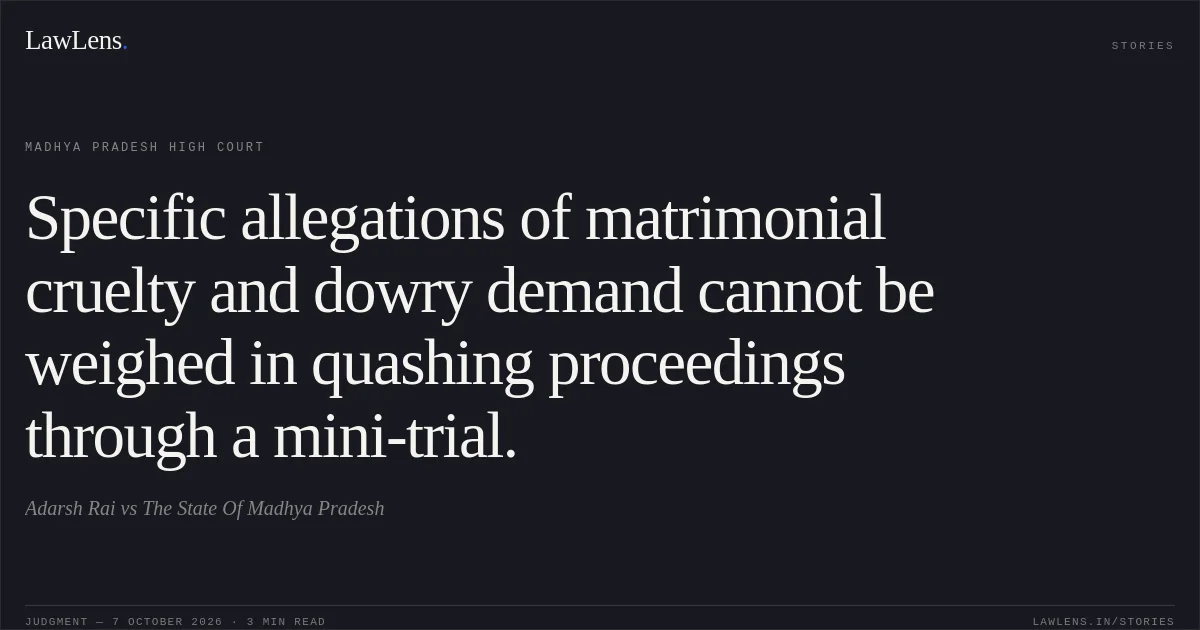
Source reference: paras. 1, 6, 10Under Amit Kapoor v. Ramesh Chander, as summarised in Supriya Jain v. State of Haryana, quashing is to be exercised sparingly: the Court considers whether the allegations, taken at face value, prima facie establish an offence, but must not conduct a mini-trial or assess the likely sufficiency or reliability of evidence.
Source reference: para. 6The Court also relied on State of Haryana v. Bhajan Lal and subsequent Supreme Court authorities, including CBI v. Aryan Singh, Abhishek v. State of M.P., Mahendra K.C. v. State of Karnataka and State of Maharashtra v. Maroti, for the principles that quashing is appropriate in defined exceptional circumstances, that the Court must not adjudicate disputed facts or test evidentiary truth at this stage, and that the prosecution record—not defence material introduced by an accused—must guide the prima facie assessment.
Source reference: paras. 7–9, 13–18Reasoning
The Court treated the wife’s allegations of cruelty and dowry demands, made in the FIR and in statements recorded under Sections 180 and 183 of the BNSS, as sufficient to require the matter to proceed to trial.
Source reference: para. 19It declined to treat the delay in lodging the FIR as determinative, observing that an attempt to preserve the marriage could explain delayed reporting.
Source reference: para. 19The petitioners’ competing account and supporting documents raised disputed questions of fact and could not be assessed in a quashing proceeding; determining their weight would amount to evaluating evidence or conducting a mini-trial.
Source reference: paras. 16–19In light of the prosecution material and the governing limits on inherent jurisdiction, the Court found no basis to terminate the proceedings.
Source reference: paras. 20–21Holding
The Court held that no ground was made out to quash the FIR or consequential criminal proceedings under Section 528 of the BNSS.
The petition was dismissed; the Trial Court was directed to decide the matter in accordance with law, uninfluenced by the High Court’s observations.
Source reference: paras. 22–23Acts & Sections Cited
16 provisions across 5 statutes referred to in this judgment. Each provision opens on LawLens.
Bharatiya Nagarik Suraksha Sanhita, 20233
Bharatiya Nyaya Sanhita, 20231
Indian Penal Code, 18601
Code of Criminal Procedure, 1973
Original Court PDF
Adarsh RaivsThe State Of Madhya Pradesh
Click to open original judgment
Original judgment, available to read, download and summarize on LawLens.in