Facts
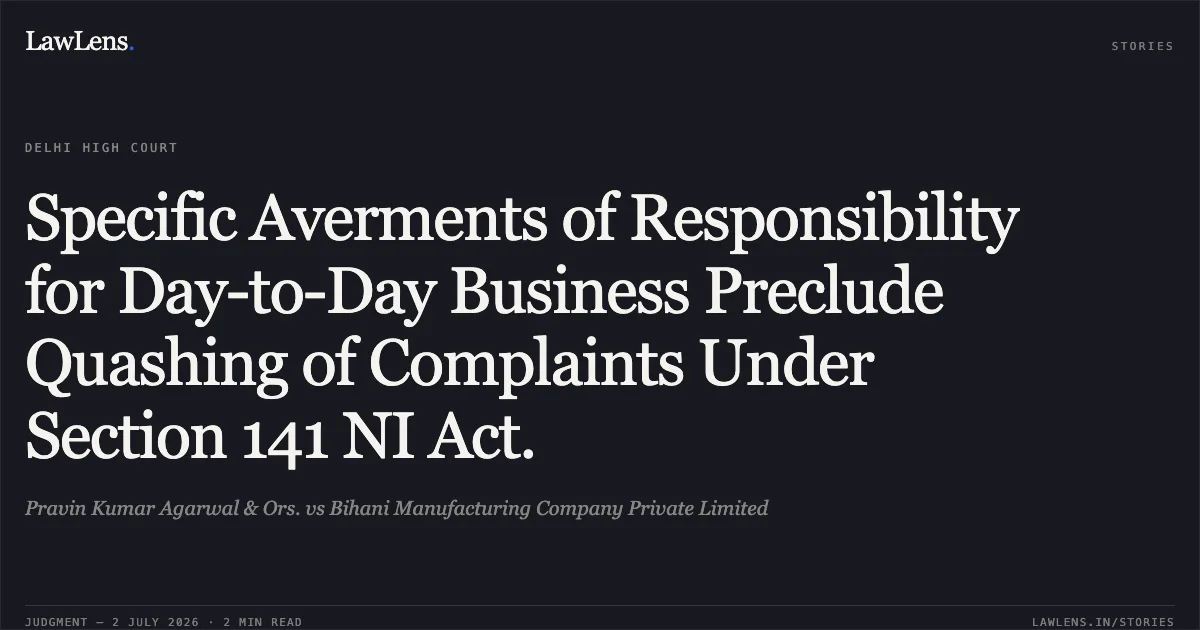
The petitioners (accused nos. 2, 4, and 5) were arrayed as accused in a criminal complaint filed by the respondent under Section 138 read with Section 141 of the Negotiable Instruments Act, 1881.
Source reference: para. 1The competent court took cognizance of the offence on 13.03.2024.
Source reference: para. 1The petitioners challenged this cognizance order before the High Court of Delhi, contending that they were not responsible for the day-to-day business or regular affairs of the accused company.
Source reference: para. 1The complainant alleged in the complaint that the petitioners were directors who enjoyed overall control, acted as the "alter ego," and jointly transacted with the complainant.
Source reference: para. 3Issues
1. Whether the summoning order and cognizance under Sections 138/141 of the NI Act are sustainable when the accused directors claim they are not responsible for the day-to-day conduct of the company.
Source reference: paras. 1, 42. Whether the averments made in the complaint satisfy the statutory requirements of Section 141 of the NI Act to initiate proceedings against individual directors.
Source reference: paras. 3, 7Law Applied
Section 141 of the Negotiable Instruments Act, 1881, which governs vicarious liability of persons in charge of a company.
Source reference: para. 1A complaint must specifically aver that at the time of the offence, the accused was in charge of and responsible for the conduct of the business (S.M.S. Pharmaceuticals Ltd. v. Neeta Bhalla).
Source reference: para. 5Liability depends on the actual role played rather than mere designation, and that specific averments are mandatory for non-signatory directors (Sunita Palita and Ors. v. Panchami Stone Quarry).
Source reference: para. 6Scope of Section 482 of the CrPC (now Section 528 of the BNSS) regarding the prevention of roving enquiries at the preliminary stage.
Source reference: para. 8Reasoning
The court examined the specific pleadings in paragraph 4 of the original complaint, where the respondent had explicitly stated that the petitioners were "in charge of and are the persons responsible for the day-to-day business" and the "key managerial persons" who represented the management during the transactions.
Source reference: paras. 3, 7The court found that these averments prima facie satisfied the "essential requirement" of Section 141 as mandated by S.M.S. Pharmaceuticals.
Source reference: paras. 4, 5Regarding the petitioners' defense that they were not actually involved in daily operations, the court reasoned that such factual disputes must be examined during the trial rather than in a quashing petition.
Source reference: para. 8The court emphasized that at this stage, it could not conduct a "roving enquiry" into the veracity of the directors' roles, as the objective of the NI Act is to sustain the credibility of commercial transactions.
Source reference: para. 8Holding
The court held that the requirement for initiating a complaint under Sections 138/141 of the NI Act was prima facie met due to the specific averments made by the complainant.
The court declined to interfere with the complaint or the order of cognizance. The petition was disposed of, granting the petitioners liberty to raise their factual defenses during the trial.
Source reference: paras. 9, 10Acts & Sections Cited
4 provisions across 3 statutes referred to in this judgment. Each provision opens on LawLens.
Negotiable Instruments Act, 18812
Code of Criminal Procedure, 19731
Bharatiya Nagarik Suraksha Sanhita, 20231
Original Court PDF
Pravin Kumar Agarwal & Ors.vsBihani Manufacturing Company Private Limited
Click to open original judgment
Original judgment, available to read, download and summarize on LawLens.in