01Facts
The marriage between Petitioner No. 1, Rajesh Kumar, and Respondent No. 2 was solemnised on 20 February 2002; Petitioner No. 2, Rani, is Rajesh’s step-mother and Respondent No. 2’s mother-in-law
¶ 3Rani allegedly began residing separately from the couple in 2003, while Rajesh and Respondent No. 2 continued cohabitation until 30 October 2013
¶ 4, 7Respondent No. 2 alleged dowry demands, including demands for a sedan car and money, physical and mental cruelty by Rajesh, and retention of her jewellery and stridhan by Rajesh and Rani
¶ 5–8She approached the CAW Cell on 3 April 2017, after unsuccessful reconciliation efforts, and FIR No. 369/2017 was registered on 30 August 2017 under Sections 498A, 406 and 34 IPC and Section 4 of the Dowry Prohibition Act
¶ 5, 8–9The Magistrate framed charges under Section 498A read with Section 34 IPC against all accused and under Section 406 IPC against Rani
¶ 10In revision, the step-brother and step-sister were discharged because the allegations against them were general; the charges under Section 498A IPC against Rajesh and Section 406 IPC against Rani were sustained
¶ 11The Petitioners thereafter invoked Section 482 CrPC seeking quashing of the FIR, proceedings and the revisional order
¶ 1202Issues
i.1. Whether the proceedings against Petitioner No. 1 under Section 498A IPC were barred by limitation under Section 468 CrPC because the parties separated on 30 October 2013 and the complaint was filed in April 2017.
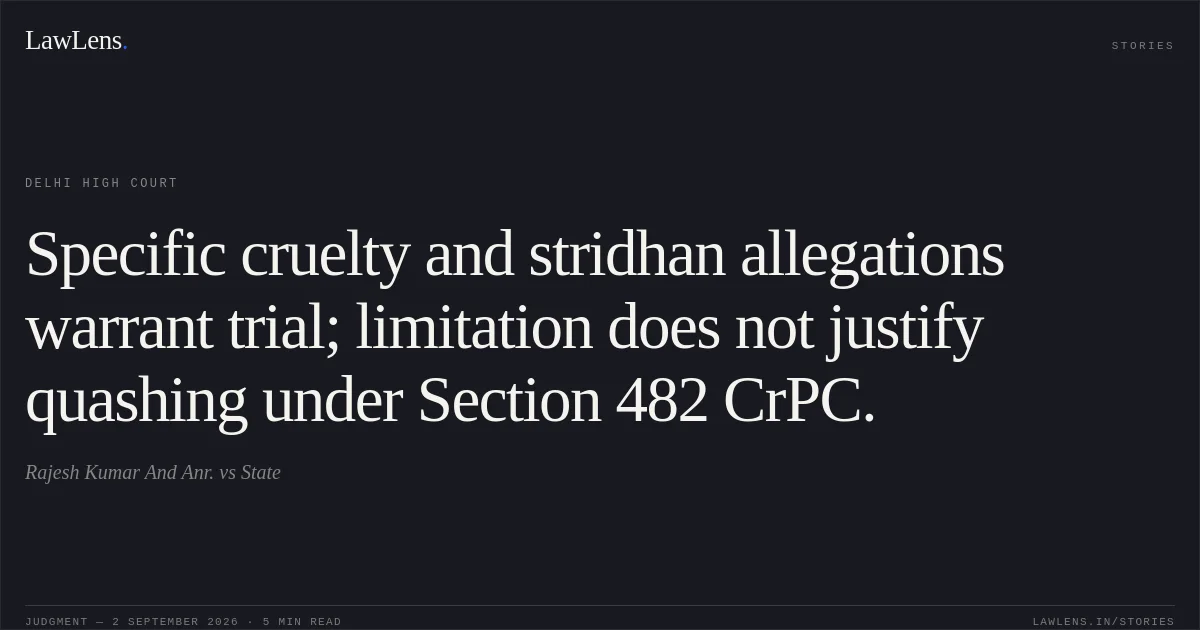
¶ 28–34ii.2. Whether the allegations of dowry-related cruelty against Petitioner No. 1 were sufficiently specific to justify continuation of the Section 498A IPC proceedings at the stage of charge.
¶ 26–27iii.3. Whether the allegations that Petitioner No. 2 took and retained Respondent No. 2’s jewellery and failed to return it despite demands disclosed a prima facie offence under Section 406 IPC, notwithstanding her separate residence since 2003 and the alleged delay in prosecution.
¶ 35–44iv.4. Whether the High Court should exercise its inherent jurisdiction under Section 482 CrPC after the Petitioners had already availed and partly succeeded in revision against the order on charge.
¶ 23–2503Law Applied
The Court applied Section 482 CrPC, under which the High Court’s inherent power to prevent abuse of process must be exercised sparingly and cautiously, particularly after revisional jurisdiction has already been invoked.
¶ 23Relying on Rajinder Prasad v. Bashir and Krishnan v. Krishnaveni, the Court held that Section 482 cannot ordinarily be used to circumvent the bar against a second revision.
¶ 23Under Amit Kapoor v. Ramesh Chander, quashing a charge is exceptional; at the charge stage, the Court must determine only whether a prima facie case exists and must not conduct a meticulous evaluation of evidence or credibility.
¶ 24Section 468 CrPC prescribes limitation for taking cognizance, but Section 473 CrPC permits cognizance after limitation where the delay is properly explained or where doing so is necessary in the interests of justice.
¶ 29–31In Vanka Radhamanohari v. Vanka Venkata Reddy, the Supreme Court held that Section 473 has overriding effect and may permit prosecution under Section 498A IPC despite delay.
¶ 29–31Under Rashmi Kumar v. Mahesh Kumar Bhada, entrustment or dominion over a wife’s stridhan, followed by dishonest misappropriation or refusal to return it, may constitute criminal breach of trust under Section 406 IPC; the question of entrustment is ordinarily factual and may be established through the circumstances of the case.
¶ 38The Court also relied on Praveen Mittal v. State (NCT of Delhi) for the principle that specific allegations regarding taking and non-return of stridhan should not be rejected at the charge stage merely because their evidentiary worth remains to be proved.
¶ 44Provisions in the judgment · 9 · Linked ones open on LawLens
Code of Criminal Procedure, 1973 Section 482Section 91Section 161Section 468Section 473Section 397
Indian Penal Code, 1860 Section 406Section 34
Dowry Prohibition Act, 1961 Section 4
04Reasoning
The Court held that the allegations against Rajesh were not vague or omnibus: the complaint specifically alleged a demand for a sedan car, physical assault, payment of approximately ₹6 lakh by Respondent No. 2’s family, a further demand of approximately ₹2 lakh, and repeated acts of physical and mental cruelty.
¶ 26Although the complaint was filed more than three years after separation, the Court held that limitation could not be determined solely by treating 30 October 2013 as the terminal date.
¶ 32–34The complaint recorded that Respondent No. 2 initially awaited reconciliation, approached the CAW Cell for counselling, and initiated legal action after mediation failed; these circumstances attracted consideration under Section 473 CrPC and did not establish an incontrovertible legal bar.
¶ 32–34As to Rani, the complaint specifically alleged that she took Respondent No. 2’s jewellery at the inception of the marriage, retained it, and refused to return it despite demands.
¶ 36–37Her separate residence since 2003 did not make prior entrustment impossible, and the absence of purchase bills did not negate the prima facie case because ownership, entrustment, demand and refusal were matters for trial.
¶ 39–42The Court further noted that it was not treating either Section 498A or Section 406 as automatically continuing offences; rather, limitation had to be assessed in light of the pleaded explanation, subsequent demands and alleged refusal.
¶ 34, 43Since the revisional court had already distinguished between specific and general allegations and discharged two accused, the surviving proceedings did not reflect mechanical or indiscriminate prosecution.
¶ 4705Holding
The High Court found no patent illegality, abuse of process or incontrovertible legal bar warranting interference under Section 482 CrPC.
¶ 49–50The Section 498A IPC proceedings against Petitioner No. 1 and the Section 406 IPC proceedings against Petitioner No. 2 were permitted to continue; the Petition was dismissed and pending applications were disposed of.
¶ 49–50The Court clarified that its observations were prima facie and would not influence the Trial Court, which was directed to decide the case independently on the evidence led before it.
¶ 51Original Court PDF
Rajesh Kumar And Anr.vsState
Click to open original judgment
Original judgment, available to read, download and summarize on LawLens.in