Facts
The Appellant filed Indian Patent Application No. 201817033732 seeking a patent for deuterated heterocycle-fused gamma-carbolines used for treating 5-HT 2A receptor-related disorders
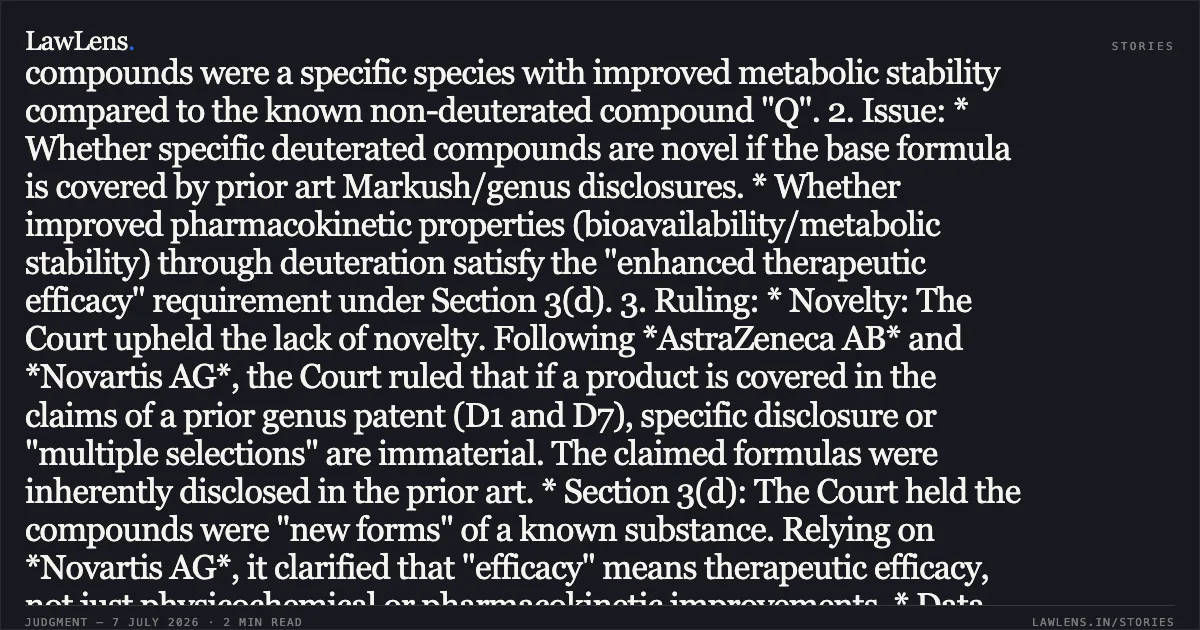
Source reference: para 1, 41The Appellant claimed that although the base compound (Formula Q) was known, the specific deuterated versions (Formulas I-IV) exhibited unexpectedly improved metabolic stability
Source reference: para 42-45The Controller of Patents rejected the application on April 27, 2023, citing lack of novelty under Section 2(1)(j), lack of inventive step under Section 2(1)(ja), and non-patentability under Section 3(d) of the Patents Act, 1970
Source reference: p. 1-2, para 1The Appellant challenged the order, arguing that the Controller conflated distinct legal standards and ignored an expert affidavit regarding therapeutic efficacy
Source reference: para 13, 17Issues
1. Whether the claimed deuterated compounds satisfy the requirement of novelty under Section 2(1)(j) in light of prior art disclosing the genus of the compounds
Source reference: para 60, 632. Whether the claimed invention is barred under Section 3(d) as a "new form of a known substance" without a significant enhancement in therapeutic efficacy
Source reference: para 67, 76Law Applied
The court applied Section 2(1)(j) of the Patents Act regarding novelty and Section 3(d) regarding the non-patentability of derivatives of known substances
Source reference: para 1, 66specific disclosure is immaterial if a product is "covered" by the claims of a prior genus patent. (AstraZeneca AB v. Intas Pharmaceuticals Ltd. and Boehringer Ingelheim Pharma GMBH & Co. KG v. Vee Excel Drugs)
Source reference: para 35, 63"efficacy" under Section 3(d) means "therapeutic efficacy" and that increased bioavailability is insufficient unless it translates into enhanced therapeutic benefit proven by research data. (Novartis AG v. Union of India)
Source reference: para 36, 67, 77, 86Reasoning
Regarding novelty, the court found that Prior Art D1 and D7 already disclosed the chemical formulas resulting in the Appellant's claimed compounds
Source reference: para 53, 58-60The court rejected the Appellant’s "multiple selections" argument, holding that if a product is covered by a genus patent, it lacks novelty regardless of whether it was specifically disclosed
Source reference: para 63-65Regarding Section 3(d), the court characterized the claimed invention as a derivative of the known "Compound Q"
Source reference: para 68, 78Reviewing "Example 7" and the co-inventor's affidavit, the court noted that the data showed 72% higher parent drug exposure (bioavailability) and reduced amide formation
Source reference: para 74, 83However, the court reasoned that under the Novartis standard, improved pharmacokinetic stability or bioavailability does not inherently constitute "therapeutic efficacy"
Source reference: para 79-81The Appellant failed to provide clinical data demonstrating that these improved properties resulted in a superior therapeutic outcome on a molecular basis compared to the known substance
Source reference: para 86-87, 89Holding
The court dismissed the appeal and upheld the Controller's rejection.
It held that the claims lacked novelty under Section 2(1)(j) because they were covered by Prior Art D1 and D7
Source reference: para 60-61Furthermore, the claims fell under the Section 3(d) bar because the Appellant failed to prove, via research data, that the improved metabolic stability led to a "significant enhancement of known therapeutic efficacy"
Source reference: para 87-89Having upheld the rejection on novelty and Section 3(d) grounds, the court declined to rule on the issue of inventive step
Source reference: para 90Acts & Sections Cited
3 provisions across 1 statute referred to in this judgment. Each provision opens on LawLens.
Patents Act, 19703
Original Court PDF
Intra-Cellular Therapies, Inc.vsThe Controller Of Patents
Click to open original judgment
Original judgment, available to read, download and summarize on LawLens.in