Facts
The original suit (Title Suit No. 11/1994) was filed by Sabiha Naseem and Najma Ismaili (Respondent No. 2) against the Petitioner challenging a Waqf property registration
Source reference: p. 2-3The suit was decreed in favor of the plaintiffs in 1999
Source reference: p. 3The Petitioner filed a miscellaneous case under Order 9 Rule 13 of the CPC to set aside the decree, which was dismissed in 2001
Source reference: p. 3While the Petitioner’s subsequent appeal (Misc. Appeal No. 01/2002) was pending, Respondent No. 2 died on 04.02.2008
Source reference: p. 3Respondent No. 1 informed the appellate court of this death via application on 25.02.2008
Source reference: p. 3-4On 21.10.2008, the Petitioner filed for substitution of heirs along with a limitation condonation petition
Source reference: p. 4The learned Additional District Judge-IV, Patna, rejected the substitution petition on 16.10.2014, holding that the appeal had abated because the Petitioner’s counsel was present when the death was initially reported and had a duty to read the order sheet
Source reference: p. 2, 7The Petitioner challenged this order, asserting she was a Pardanashin lady and had not been served formal notice of the death
Source reference: p. 5Issues
1. Whether the learned appellate court erred in rejecting the substitution petition and declaring abatement by imputing knowledge of the death to the Petitioner through her counsel’s presence in court.
Source reference: p. 72. Whether the court is or is not mandatorily required to provide notice of a party's death to the opposite party under Order 22 Rule 10-A of the CPC.
Source reference: p. 7-8Law Applied
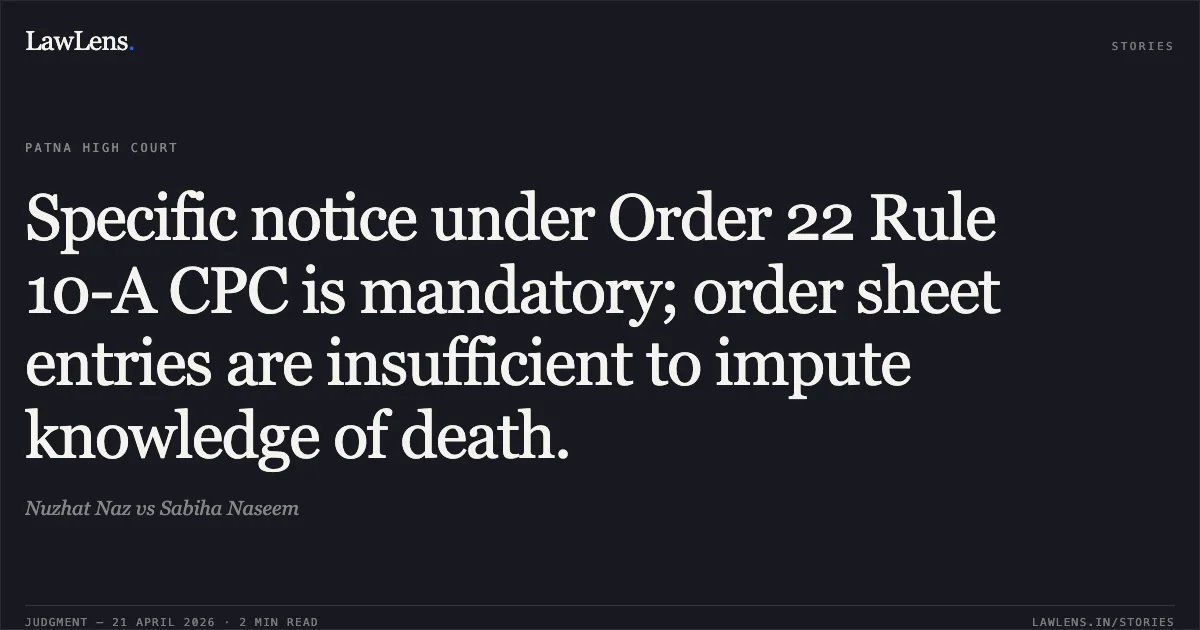
The court primarily applied Order 22 Rule 10-A of the Code of Civil Procedure (CPC), which stipulates that when a pleader becomes aware of the death of a party they represent, they must inform the court, and the court "shall thereupon give notice of such death to the other party"
Source reference: p. 7The court further observed that the contract between the pleader and the deceased party is deemed to subsist for this specific purpose
Source reference: p. 7Reasoning
The High Court found that the lower court’s reasoning—that the Petitioner’s counsel had a duty to read the order sheet to gain knowledge of the death—ran contrary to the express statutory provisions of the CPC
Source reference: p. 7The court interpreted Order 22 Rule 10-A as casting a mandatory duty upon the Court to provide specific notice of the death to the other party once informed by the pleader
Source reference: p. 8The High Court held that a mere entry in the order sheet does not satisfy the requirement of "notice" under this rule
Source reference: p. 8Consequently, the period of limitation for substitution could not be strictly held against the Petitioner in the absence of such formal notice by the court
Source reference: p. 7-8The court noted that the lower court failed to exercise its jurisdiction correctly, resulting in material irregularity
Source reference: p. 8Holding
The High Court allowed the petition and set aside the impugned order dated 16.10.2014
The court allowed the Petitioner’s substitution application dated 21.10.2008 and directed the learned appellate court to dispose of the long-pending Misc. Appeal No. 01/2002 within three months, given its antiquity
Source reference: p. 8The court concluded that the statutory mandate for the court to give notice of death is specific and essential to prevent the abatement of claims without due process
Source reference: p. 7-8Acts & Sections Cited
4 provisions across 2 statutes referred to in this judgment. Each provision opens on LawLens.
Code of Civil Procedure, 19083
Limitation Act, 19631
Original Court PDF
Nuzhat NazvsSabiha Naseem
Click to open original judgment
Original judgment, available to read, download and summarize on LawLens.in