Facts
The appellant-plaintiff claimed rights over agricultural land bearing Survey/Block No. 286/1 at Bodakdev, Ahmedabad, which was stated to be restricted-tenure land. The original owners allegedly executed an agreement to sell dated 02.04.1985, delivered possession, and subsequently executed another agreement to sell dated 17.02.1990 along with irrevocable powers of attorney in the plaintiff’s favour. The plaintiff claimed that substantial and, according to him, the entire consideration had been paid, but the sale deed was not executed because requisite statutory permissions had not been obtained.
Source reference: paras. 2.1–2.4; pp. 2–3In 2018, defendant No.1 executed a registered sale deed in favour of defendant No.2 after the property was allegedly converted from new tenure to old tenure. The plaintiff claimed that he discovered the transaction in April–May 2019 and alleged that defendant No.1’s title was based on a forged Will and fraudulent mutation entries.
Source reference: para. 2.5; pp. 3–4The plaintiff instituted Special Civil Suit No. 615 of 2019 seeking specific performance of the agreements, cancellation/declaration of invalidity of the 2018 sale deed, declarations concerning mutation entries, and injunctions.
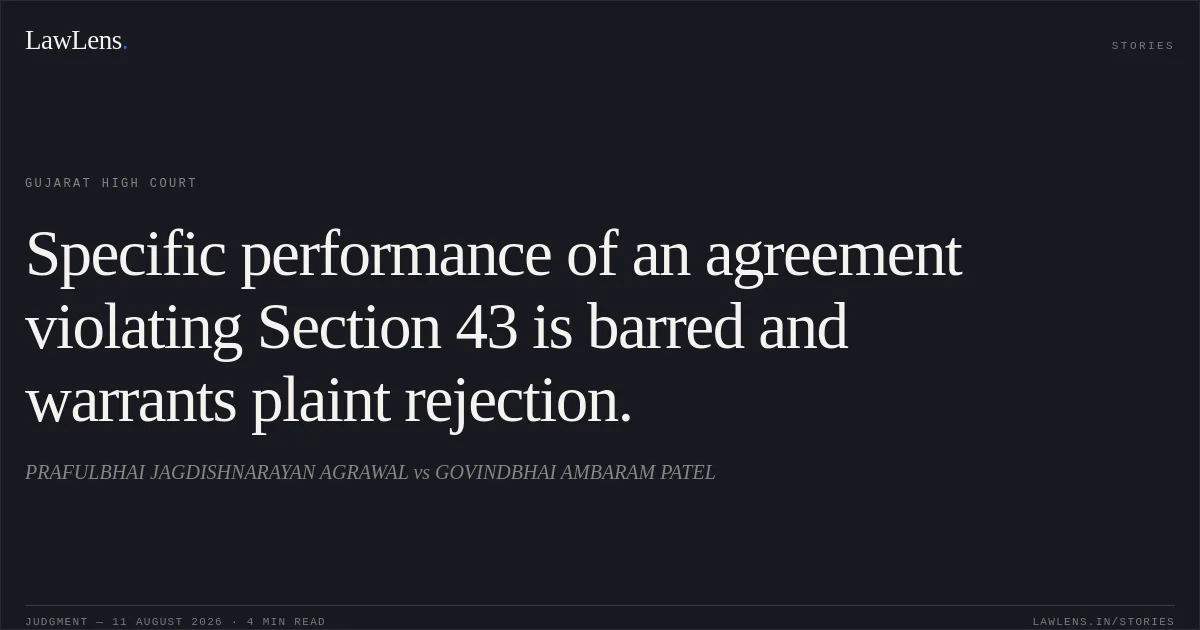
Source reference: para. 2.6; p. 4Defendant No.2 applied under Order VII Rule 11(a) and (d) of the Code of Civil Procedure, 1908, contending that the suit disclosed no cause of action and was barred by Section 43 of the Bombay Tenancy and Agricultural Lands Act, 1948 (“Tenancy Act”) and limitation. The Trial Court allowed the application and rejected the plaint on 12.12.2024.
Source reference: para. 2.7; p. 4Issues
Whether the plaint was liable to be rejected under Order VII Rule 11(d) CPC because the agreements to sell concerning restricted-tenure land were invalid under Section 43 of the Tenancy Act for want of prior sanction of the Collector.
Source reference: paras. 24, 28–31; pp. 18, 25–26Whether the suit for specific performance filed in 2019, based on agreements dated 02.04.1985 and 17.02.1990, was barred by limitation under Article 54 of the Limitation Act, 1963.
Source reference: paras. 16–22, 40; pp. 15–17, 32Whether the plaintiff’s additional declaratory and injunctive reliefs, allegations of fraud, possession claim, and reliance on irrevocable powers of attorney prevented rejection of the plaint under Order VII Rule 11 CPC.
Source reference: paras. 4.2–4.5, 34, 48; pp. 5–6, 30, 37–38Whether the plaintiff should be permitted, during the appeal, to amend the plaint by adding an alternative claim for compensation under Section 21 of the Specific Relief Act, 1963.
Source reference: paras. 41–43; pp. 33–34Law Applied
Section 43(1) and (2) of the Bombay Tenancy and Agricultural Lands Act, 1948 prohibits the transfer, or an agreement in writing to transfer, land or an interest in land governed by the provision without the previous sanction of the Collector; a transaction made in contravention is invalid.
Source reference: para. 26; pp. 18–25The Court relied on Decd. Shaikh Ismailbhai Hushainbhai Through LRs v. Vankar Ambalal Dhanabhai, (2024) 1 GLH 222, and Shashikant Mohanlal Desai v. State of Gujarat, AIR 1970 Gujarat 204, for the mandatory nature and agrarian-reform purpose of Section 43.
Source reference: para. 27; pp. 20–24Under Order VII Rule 11(a) and (d) CPC, the Court must reject a plaint that discloses no cause of action or appears from its own statements to be barred by law.
Source reference: paras. 32–38; pp. 26–32Article 54 of the Limitation Act prescribes three years for a suit for specific performance.
Source reference: para. 40; p. 32The Court also applied the principle that courts will not assist enforcement of an agreement expressly prohibited by statute, referring to Narayanamma and the doctrine ex turpi causa non oritur actio.
Source reference: para. 27; pp. 24–25It further relied on K.R. Suresh v. R. Poornima, 2025 SCC OnLine SC 1014, concerning appellate amendment to add a compensation claim, but held that such discretion is unavailable where the underlying claim is itself barred and time-barred.
Source reference: paras. 41–43; pp. 33–34Reasoning
The Court held that the plaintiff’s entire claim arose from the 1985 and 1990 agreements and related powers of attorney, executed when the property was restricted-tenure land. Since the agreements purported to effect a transfer without prior Collector’s sanction, they were prima facie invalid under Section 43(1) read with Section 43(2) of the Tenancy Act, notwithstanding that the agreements placed responsibility for obtaining permissions upon the original owners.
Source reference: paras. 18–20, 28–31; pp. 16–18, 25–26The subsequent conversion of the land to old tenure in 2018 did not retrospectively validate the earlier prohibited agreements.
Source reference: paras. 13, 23–24; pp. 14, 17–18The Court further found that the suit was instituted approximately 29–34 years after the agreements. The plaintiff’s explanation based on illness, his wife’s death, and litigation among the original owners’ heirs did not satisfactorily explain his failure to assert his alleged rights or seek impleadment in the intervening proceedings.
Source reference: paras. 14–17, 21–22; pp. 14–17The alleged discovery of the 2018 sale deed in 2019 could not revive a stale claim for specific performance.
Source reference: paras. 14–17, 21–22; pp. 14–17Because the agreements were statutorily unenforceable and the suit was ex facie barred by limitation, the additional declarations, injunctions, allegations of fraud, possession claim, and powers of attorney did not create an independent enforceable cause of action.
Source reference: paras. 34, 40, 43, 48–49; pp. 30–32, 34, 37–38The proposed amendment seeking compensation was likewise rejected because it was founded on the same invalid and time-barred transactions.
Source reference: paras. 41–43; pp. 33–34Holding
The High Court dismissed First Appeal No. 476 of 2025 and affirmed the Trial Court’s order rejecting the plaint under Order VII Rule 11(a) and (d) CPC.
It held that the agreements to sell were invalid under Section 43 of the Tenancy Act and that the specific-performance suit was barred by limitation under Article 54 of the Limitation Act.
Source reference: paras. 31, 40, 48–50; pp. 25–26, 32, 37–38The interim relief, if any, was vacated. Civil Application No. 1 of 2026 for additional evidence and Civil Application No. 2 of 2026 for directions were disposed of accordingly, and the record was ordered to be remitted to the concerned Court.
Source reference: paras. 50–52; pp. 38–39Acts & Sections Cited
11 provisions across 7 statutes referred to in this judgment. Each provision opens on LawLens.
Bombay Tenancy and Agricultural Lands Act-19484
Code of Civil Procedure, 19081
Transfer of Property Act, 18821
Banking Companies (Acquisition and Transfer of Undertakings) Act, 19701
Maharashtra Tenancy and Agricultural Lands (Vidarbha Region) Act.2
Limitation Act, 19631
Specific Relief Act, 19631
Original Court PDF
PRAFULBHAI JAGDISHNARAYAN AGRAWALvsGOVINDBHAI AMBARAM PATEL
Click to open original judgment
Original judgment, available to read, download and summarize on LawLens.in