Facts
The Appellant (plaintiff) filed a suit for specific performance based on an agreement for sale dated October 04, 2005, regarding the first floor and adjoining land of a property owned by the Respondents
Source reference: para 1The Appellant claimed to have paid the full consideration of Rs. 11,00,000/-
Source reference: para 9Respondent No. 1 (the mother) executed the agreement on her own behalf and allegedly as a Power of Attorney (PoA) holder for her children (Respondents No. 2 and 3)
Source reference: para 6Both the Trial Court and the First Appellate Court dismissed the suit, holding that the agreement was unenforceable because Respondent No. 1 lacked the capacity to sell her children’s shares, the PoA was not proved, the mortgage on the property was not shown to be released, and the property was unpartitioned
Source reference: paras 1, 22-24The Appellant sought a Second Appeal, arguing for at least partial performance of Respondent No. 1’s 1/3rd share
Source reference: para 9Issues
1. Whether there was a valid Power of Attorney executed by Respondent Nos. 2 and 3 in favour of Respondent No. 1?
Source reference: para 25(i)2. Whether the Courts below ought to have directed partial performance of the agreement regarding the 1/3rd share of Respondent No. 1?
Source reference: para 25(ii)3. Whether the suit property required partition as a prerequisite for transferring Respondent No. 1’s share?
Source reference: para 25(iii)4. Whether the agreement was a concluded and enforceable contract despite the bank mortgage?
Source reference: para 25(iv)Law Applied
The Court applied Section 65(a) and Section 66 (proviso) of the Indian Evidence Act, 1872, regarding the admissibility of secondary evidence when a document is in the possession of the adverse party
Source reference: paras 27-29It relied on Section 17 and Section 49 of the Registration Act, 1908, noting that while agreements for sale generally require registration, they are admissible as evidence in suits for specific performance even if unregistered
Source reference: paras 20-21The Court applied Section 12(3) of the Specific Relief Act, 1963, which allows partial performance of a contract if the party in default cannot perform the whole
Source reference: paras 48-49It further considered the precedent A. Abdul Rashid Khan v. P.A.K.A Shahul Hamid, which established that a co-sharer may be directed to execute a sale deed to the extent of their own share even if they lacked authority to sell the entire joint property
Source reference: paras 35, 40Reasoning
Regarding the PoA, the Court found that although Respondent No. 1 likely knew she would need to produce it, the Appellant failed to produce even a photocopy or attempt to admit secondary evidence during trial, thus failing to prove Respondent No. 1's authority over the shares of Respondents 2 and 3
Source reference: paras 31-33On the issue of partial performance, the Court distinguished this case from A. Abdul Rashid Khan. In the cited precedent, the contract covered an entire building; here, the contract was specifically for the "first floor"
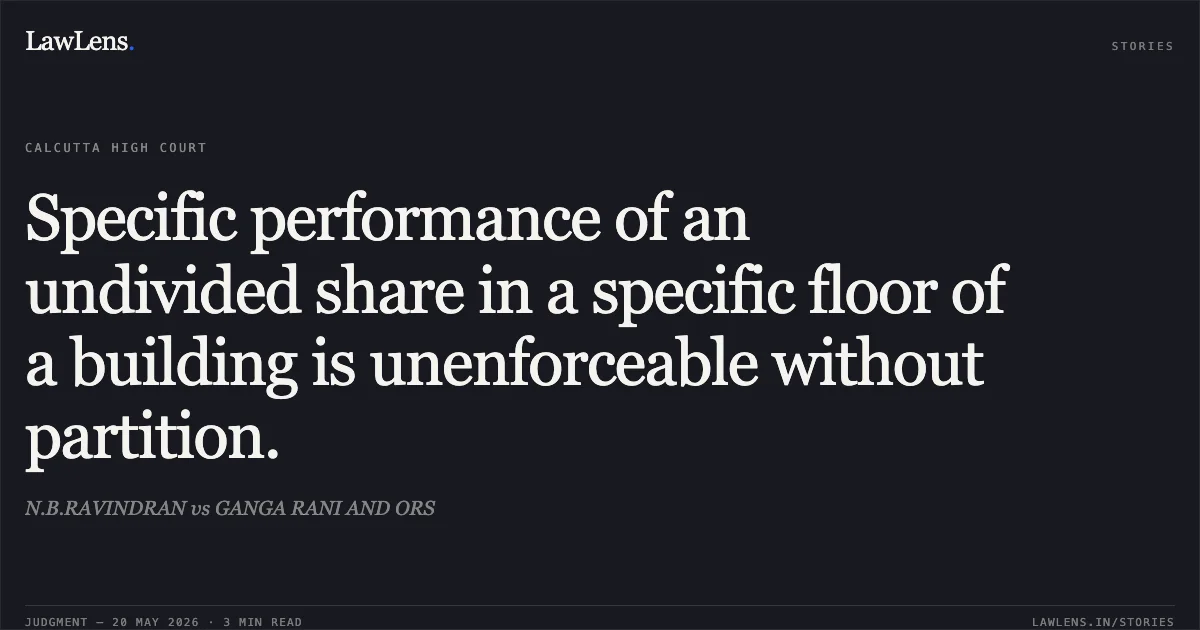
Source reference: para 43, 47Since the property was unpartitioned, Respondent No. 1’s 1/3rd share extended to the entire building, not specifically or exclusively to the first floor
Source reference: para 44Directing transfer of her share in the first floor only was legally impossible, while directing transfer of her share in the whole building would rewrite the contract beyond the parties' intent
Source reference: paras 45-46Regarding the mortgage, the Court noted Respondent No. 1 admitted the loan was liquidated, meaning the lower courts erred in calling the contract "contingent" or "unenforceable" on that ground
Source reference: paras 53-54However, the physical impossibility of segregating a 1/3rd share in only the first floor remained a fatal barrier to specific performance
Source reference: para 51Holding
The Court answered the issues by holding that: (1) no valid PoA was proved; (2) partial performance could not be granted because the specific share in the first floor could not be legally or physically identified without partition; and (3) while the mortgage did not render the contract void, the structural nature of the agreement made it unenforceable
The High Court affirmed the lower courts' dismissal of the suit. The second appeal (SA/8/2026) was dismissed on contest
Source reference: paras 56-57Acts & Sections Cited
4 provisions across 2 statutes referred to in this judgment. Each provision opens on LawLens.
Specific Relief Act, 19632
Registration Act, 19082
Original Court PDF
N.B.RAVINDRANvsGANGA RANI AND ORS
Click to open original judgment
Original judgment, available to read, download and summarize on LawLens.in