Facts
The Petitioner (a real estate developer) and Respondents (landowners) entered into a "Binding Heads of Terms" (Binding HoT) on 17.05.2023 for the development of 6.76 acres of land in Mehrauli, Delhi
Source reference: para. 2, 8The agreement contemplated a 42.3/57.7 revenue share and the future execution of a Definitive Collaboration Agreement
Source reference: para. 10-11Over 30 months, three addenda were executed extending the validity of the HoT, and the Petitioner paid approximately ₹8 Crores while pursuing statutory approvals
Source reference: para. 22-23, 32On 10.03.2026, the Respondents claimed the agreement had lapsed by efflux of time and subsequently refunded ₹2.8 Crores
Source reference: para. 29-30Apprehending the creation of third-party rights, the Petitioner sought interim protection under Section 9 of the Arbitration and Conciliation Act, 1996
Source reference: para. 1, 33Issues
1. Whether the "Binding HoT" constitutes a concluded and specifically enforceable contract despite contemplating a future definitive agreement
Source reference: para. 35, 1082. Whether time was of the essence of the contract, thereby terminating the agreement upon expiry of the stipulated timelines
Source reference: para. 92, 983. Whether the court should grant interim protection to preserve the subject matter of the dispute pending arbitration
Source reference: para. 34, 131Law Applied
The court primarily applied Section 9 of the Arbitration and Conciliation Act, 1996, which grants courts broad discretionary power to provide interim measures that are "just and convenient" to promote the efficacy of arbitration
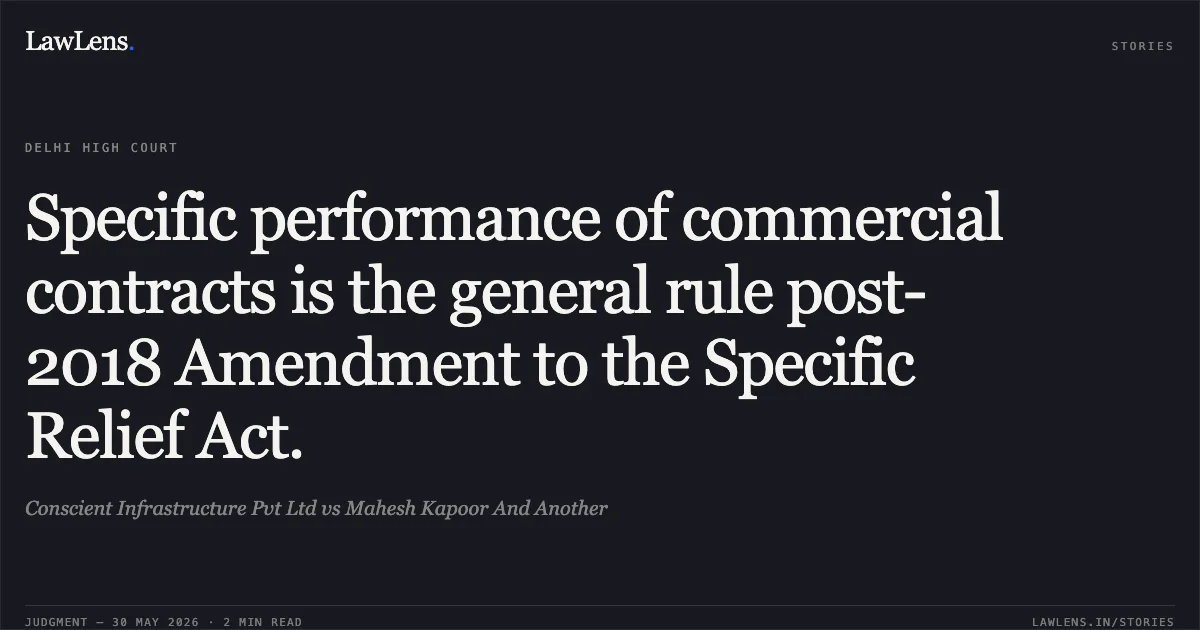
Source reference: para. 1, 134It relied on the post-2018 amendment framework of the Specific Relief Act (SRA), specifically Section 10, which makes specific performance a general rule rather than a discretionary exception
Source reference: para. 79, 122The court cited Trimex International FZE Ltd. v. Vedanta Aluminium Ltd. regarding the binding nature of "Heads of Terms" when essential terms are settled
Source reference: para. 111Global Music Junction Pvt. Ltd. v. Shatrughan Kumar regarding the legislative shift toward stronger enforcement of contracts
Source reference: para. 80, 122Reasoning
The court reasoned that since the HoT identified the land, revenue share, and financial obligations, it was not a mere "agreement to agree" but a binding commercial arrangement
Source reference: para. 109-110The court found that the continuous execution of addenda and substantial payments by the Petitioner demonstrated that the parties did not initially treat time as being of the essence
Source reference: para. 138-139Applying the principles from Essar House Private Limited, the court held that Section 9 jurisdiction is not strictly bound by the rigours of the CPC (Order XXXVIII Rule 5 or Order XXXIX) but is aimed at preventing the frustration of the arbitral process
Source reference: para. 133-134The court noted that the 2018 SRA amendment mandates enforcement of contracts unless specific statutory bars are proven, an exercise best left to the Arbitral Tribunal rather than decided summarily at the Section 9 stage
Source reference: para. 127-128Holding
The court held that the Petitioner established a strong prima facie case and that the balance of convenience favoured preservation of the status quo to prevent the creation of irreversible third-party interests
The Petition was allowed, and the Respondents were restrained from creating any third-party rights, alienating, or encumbering the Collaboration Land until the Arbitral Tribunal considers the matter
Source reference: para. 151The court clarified that these observations are prima facie and do not prejudice the final adjudication by the learned Arbitral Tribunal
Source reference: para. 152Acts & Sections Cited
17 provisions across 5 statutes referred to in this judgment. Each provision opens on LawLens.
Arbitration and Conciliation Act, 19962
Code of Civil Procedure, 19083
Specific Relief Act, 19638
Transfer of Property Act, 18823
Indian Trust Act, 18821
Original Court PDF
Conscient Infrastructure Pvt LtdvsMahesh Kapoor And Another
Click to open original judgment
Original judgment, available to read, download and summarize on LawLens.in