Facts
The appellants claimed compensation under the Railways Act, 1989 for the death of Ranjeet Chaudhary on 30 March 2011.
Source reference: p.3, para. 2Their case was that the deceased had purchased Journey Ticket No. 57257 from Anand Vihar to Ghaziabad, boarded an EMU train, and accidentally fell from it near Electric Pole No. 7/26-G, Anand Vihar Railway Station, due to heavy rush and a sudden jerk.
Source reference: p.3, para. 2The Union of India disputed both the deceased’s status as a bona fide passenger and the occurrence of an “untoward incident,” contending that the ticket had been issued after the incident and that the deceased had been crossing the railway track.
Source reference: p.3, para. 4The Railway Claims Tribunal dismissed the claim application, holding that the deceased was not a bona fide passenger and that the incident did not fall within the statutory definition of an untoward incident.
Source reference: p.3, para. 5The appellants challenged that decision under Section 23 of the Railway Claims Tribunal Act, 1987.
Source reference: p.3, para. 1The High Court also condoned the 493-day delay in filing the appeal, having regard to the appellant’s circumstances, the beneficial nature of the legislation, and the COVID-19 limitation exclusion orders.
Source reference: p.1–2, paras. 1–7Issues
Whether the deceased was a bona fide passenger holding a valid journey ticket at the time of the occurrence.
Source reference: p.3, para. 7; p.4–6, paras. 8–12Whether the deceased’s death resulted from an “untoward incident” under the Railways Act, 1989, or whether he was trespassing on or crossing the railway track.
Source reference: p.3, para. 7; p.6–7, paras. 13–16Whether the appeal was maintainable after condonation of the 493-day delay in filing it.
Source reference: p.1–2, paras. 1–7Law Applied
The appeal was considered under Section 23 of the Railway Claims Tribunal Act, 1987, which provides for an appeal to the High Court from an order of the Railway Claims Tribunal.
Source reference: p.3, para. 1The Court applied the provisions of the Railways Act, 1989 concerning compensation for death arising from an “untoward incident” and the requirement that the deceased be a bona fide passenger.
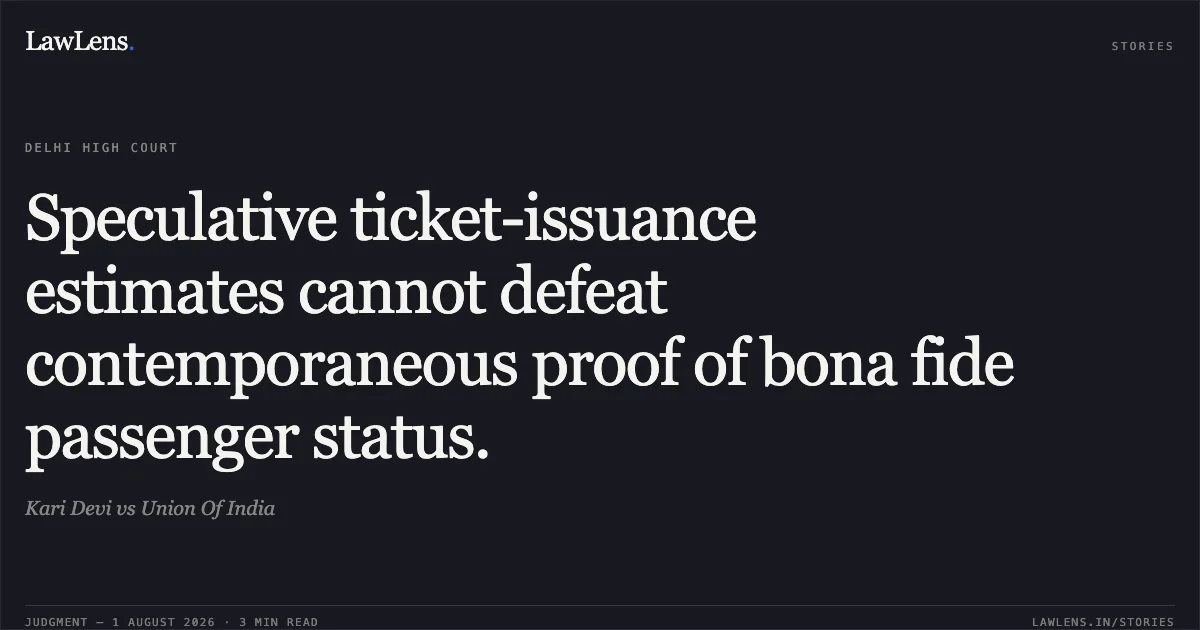
Source reference: p.3, paras. 2–5It held that an inference based on estimated ticket-sale timings cannot displace contemporaneous official records showing recovery of a journey ticket.
Source reference: p.4–6, paras. 9–12The Court further applied the principle that the earliest official records prepared immediately after an occurrence should not be discarded in favour of unsupported assumptions or inferences.
Source reference: p.7, para. 15On limitation, the Court relied on Mohsina v. Union of India and Reshma v. Union of India, which recognised a liberal approach in railway compensation matters, and In Re: Cognizance for Extension of Limitation, Suo Motu W.P. (Civil) No. 3 of 2020, under which the period from 15 March 2020 to 28 February 2022 was excluded for computing limitation.
Source reference: p.1–2, paras. 3–5Reasoning
The Tribunal had inferred from the ticket serial number and estimated ticket-sale patterns that Ticket No. 57257 was issued after the occurrence.
Source reference: p.4–5, paras. 9–11The High Court found that the railway register recorded only the range of ticket numbers issued during the day and not the precise time of issuance; therefore, the timing attributed to the ticket was merely an estimate and could not conclusively establish that it had been planted or manipulated.
Source reference: p.4–5, paras. 9–11The ticket’s recovery was corroborated by the contemporaneous seizure memo and inquest papers, and the respondent produced no evidence of fabrication.
Source reference: p.5–6, para. 12Regarding the nature of the occurrence, the earliest police records, the statement of an alleged eyewitness, the death report, and the investigating officer’s conclusion consistently treated the case as an accidental fall from an EMU train.
Source reference: p.6, para. 14The fact that the body was found between the railway lines, without more, did not establish that the deceased had been trespassing or crossing the track, particularly when no eyewitness or official investigative record supported that theory.
Source reference: p.7, para. 15The Court therefore held that the deceased was a bona fide passenger and that his death arose from an untoward incident.
Source reference: p.6–7, paras. 12–16Holding
The High Court condoned the 493-day delay in filing the appeal.
It set aside the Tribunal’s judgment dated 19 May 2019, held that the deceased was a bona fide passenger whose death resulted from an untoward incident, and allowed the appeal.
Source reference: p.7, paras. 16–18The matter was remanded to the Railway Claims Tribunal to assess the compensation payable in accordance with law and to direct disbursement within two months of receipt of the High Court’s order.
Source reference: p.7, para. 17The matter was directed to be listed before the Tribunal on 17 August 2026.
Source reference: p.7, para. 17Original Court PDF
Kari DevivsUnion Of India
Click to open original judgment
Original judgment, available to read, download and summarize on LawLens.in


