Facts
The appellant was convicted by the Special Court under the POCSO Act, Manjeri, for multiple sexual offences
Source reference: p. 3The prosecution alleged that the appellant, who ran a dance institution, subjected the minor victim (PW2) to aggravated sexual assault on 01.03.2014 and 04.03.2014
Source reference: p. 8-9Consequently, the victim became pregnant and gave birth to a child on 05.12.2014
Source reference: p. 9DNA profiling (Ext. P22) confirmed the appellant as the biological father of the child
Source reference: p. 21The appellant challenged the conviction primarily on the grounds of lack of proof regarding the victim's minority and a claim of a consensual relationship
Source reference: p. 5Issues
1. Whether the prosecution provided sufficient and acceptable proof of the victim’s age to attract the provisions of the POCSO Act
Source reference: p. 6 / para. 82. Whether the sexual relationship could be deemed consensual so as to mitigate the charges under the IPC and POCSO Act
Source reference: p. 5 / para. 63. Whether the conviction of the appellant under various sections of the IPC, POCSO Act, and Juvenile Justice (JJ) Act was legally sustainable
Source reference: p. 6-7 / para. 8Law Applied
The Court applied Section 376(2)(n) of the IPC regarding repeated sexual assault and Sections 5 and 6 of the POCSO Act regarding aggravated penetrative sexual assault
Source reference: p. 3Regarding age determination, the Court relied on Rule 12 of the Juvenile Justice (Care and Protection of Children) Rules, 2007, as interpreted in Jarnail Singh v. State of Haryana, which establishes a hierarchy of evidence: (1) Matriculation/equivalent certificate, (2) Date of birth from the first school attended, and (3) Birth certificate from a local authority
Source reference: p. 17-18It also followed Yuvaprakash P v. State, affirming that ossification tests/medical evidence are only secondary to the aforementioned documents
Source reference: p. 11-13The court applied Biju v. State of Kerala, which holds that even unchallenged oral testimony of the mother can be reliable proof of age under the Evidence Act
Source reference: p. 15-16Reasoning
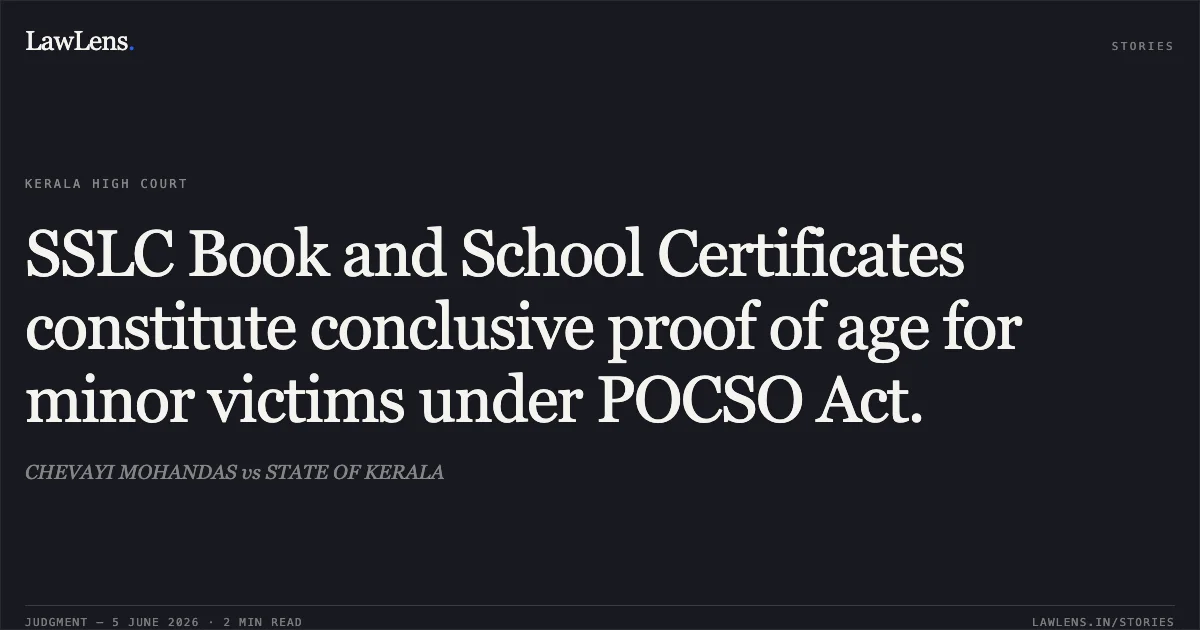
The Court rejected the appellant's contention regarding the victim's age, noting that the prosecution produced the victim’s original SSLC book (Ext. P1) and an extract from the school admission register (Ext. P6) through PW6
Source reference: p. 10-11Under the rule of law established in Jarnail Singh, the SSLC book is considered an "equivalent to matriculation" certificate and serves as the highest-rated option for conclusive proof of age
Source reference: p. 18Since the victim was proved to be under 18 years (born 05.09.1997), the Court held that the question of "consent" was legally irrelevant
Source reference: p. 23The Court found the testimony of the victim (PW2) to be of "sterling quality," supported by her parents (PW1, PW3) and scientific evidence, specifically DNA profiling which unequivocally linked the appellant to the victim's child
Source reference: p. 21-23Holding
The Court answered all issues in the affirmative for the prosecution, holding that the victim's minority was conclusively proved and the sexual assault established
The Court confirmed the conviction and the sentence of 10 years of rigorous imprisonment and a fine of ₹1,00,000 for each of the primary offences under the POCSO Act, as well as the conviction under Section 23 of the JJ Act. The appeal was dismissed, and the judgment of the Special Court was confirmed.
Source reference: p. 3, 23Acts & Sections Cited
6 provisions across 3 statutes referred to in this judgment. Each provision opens on LawLens.
Indian Penal Code, 18601
Protection of Children from Sexual Offences Act, 20123
Juvenile Justice (Care and Protection of Children) Act, 2015.2
Original Court PDF
CHEVAYI MOHANDASvsSTATE OF KERALA
Click to open original judgment
Original judgment, available to read, download and summarize on LawLens.in