Facts
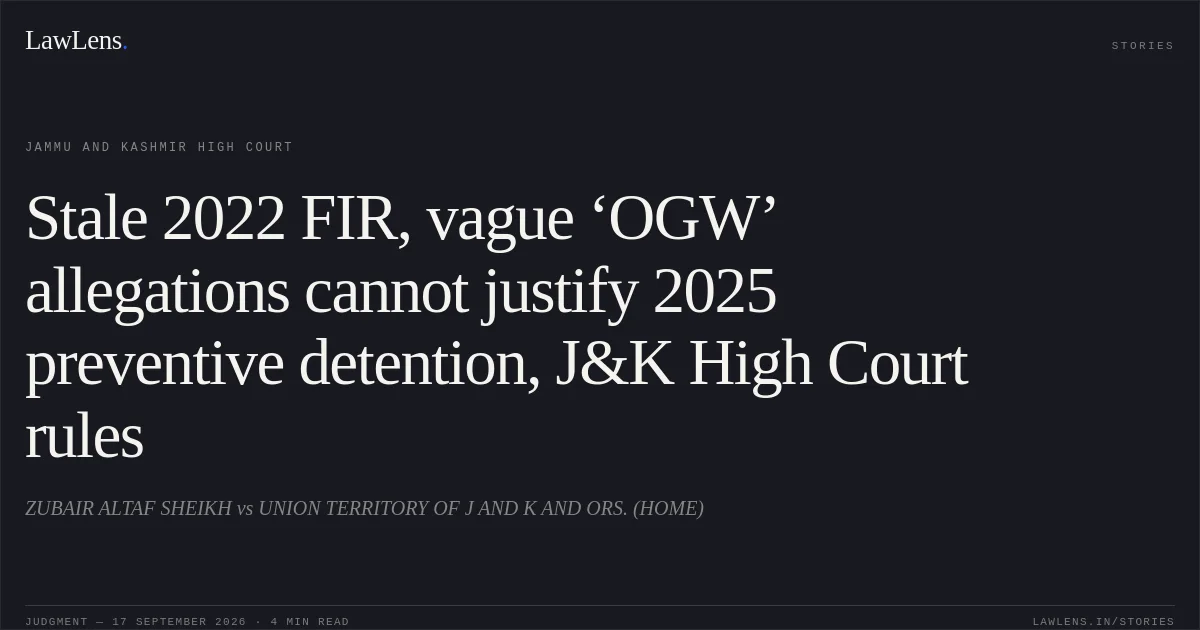
The petitioner challenged Detention Order No. DMS/PSA/40/2025 dated 12 September 2025, by which the District Magistrate, Srinagar, detained him under the Jammu and Kashmir Public Safety Act, 1978, to prevent conduct prejudicial to the security of the State.
Source reference: p.1, para.1The detention relied, inter alia, on FIR No. 15/2022 under provisions of the Unlawful Activities (Prevention) Act, the IPC and the Arms Act, in which the detenue had been arrested and granted bail on 26 September 2022.
Source reference: p.2, para.2An earlier PSA detention order dated 30 September 2022, based on the same background, had been quashed by the High Court on 3 April 2024 in WP(Crl) No. 707/2022.
Source reference: p.2, para.2; p.5, para.7The petitioner contended that the 2022 FIR was stale, that the allegations of being an “OGW” and motivating youth to join separatist groups were vague, and that Beat Books/Patrol Books dated 21 May, 4 June and 4 August 2025, allegedly relied upon by the authorities, were not supplied to the detenue.
Source reference: p.3, paras.2–3The respondents asserted that the 2025 detention was based on a fresh dossier submitted on 8 August 2025 and additional discreet information regarding the detenue’s alleged prejudicial activities.
Source reference: p.4, para.4The petitioner’s assertion that he was employed as a Store Manager at Gurugram, Delhi, during the relevant period remained unrebutted.
Source reference: p.7, para.11Issues
1. Whether the detention order was vitiated by reliance on the stale FIR of 2022 without a live and proximate nexus to the alleged necessity for preventive detention in 2025.
Source reference: p.5, para.6; p.6, para.72. Whether the allegations that the detenue was an “OGW” and was motivating youth to join separatist groups were sufficiently specific to enable an effective representation under Article 22(5) of the Constitution.
Source reference: p.7, para.103. Whether the failure to supply the Beat Books/Patrol Books allegedly relied upon by the detaining authority violated the detenue’s constitutional right to make an effective representation.
Source reference: p.8, para.13; p.9, para.144. Whether the subsequent detention order could validly be sustained despite the quashing of the earlier PSA detention order, the passage of time, and the detenue’s alleged employment at Gurugram.
Source reference: p.6, para.8; p.7, para.12Law Applied
The Court applied the Jammu and Kashmir Public Safety Act, 1978, and Article 22(5) of the Constitution, which require that preventive detention be based on relevant material and that the grounds of detention and relied-upon documents be communicated sufficiently to permit an effective representation.
Source reference: p.8, para.13Preventive detention is preventive, not punitive, and requires a live and proximate link between past conduct and the immediate necessity for detention, as stated in Sama Aruna v. State of Telangana, (2018) 12 SCC 150, and Khaja Bilal Ahmed v. State of Telangana, (2020) 13 SCC 632.
Source reference: p.4, para.6This principle was reiterated in Sushanta Kumar Banik v. State of Tripura, (2022) 1 SCC 416, which holds that unexplained delay may snap the live link between the grounds and the purpose of detention.
Source reference: p.6, para.8Under M. Ahamedkutty v. Union of India, (1990) 2 SCC 1, documents relied upon for subjective satisfaction must be supplied to the detenue.
Source reference: p.8, para.13The Court also applied the principle in Shibban Lal Saksena v. State of Uttar Pradesh, AIR 1954 SC 179, that where an irrelevant or legally untenable ground materially contributes to the detention decision, the Court cannot speculate that the authority would have reached the same conclusion without it.
Source reference: p.12, para.21Reasoning
The Court held that the 2022 FIR, considered against the nearly three-year lapse, the quashing of the earlier PSA order, and the absence of specific contemporaneous acts, could not independently establish a live and proximate link with the need for detention in 2025.
Source reference: p.5, para.7; p.13, para.22(i), (vii)Although fresh material may justify a subsequent detention order, the respondents had to demonstrate concrete and proximate prejudicial activity; the allegations that the detenue was an “OGW” and motivated youth were general and lacked particulars of dates, places, persons or specific acts.
Source reference: p.6, para.8; p.7, para.10The unrebutted evidence of his employment at Gurugram was a relevant circumstance that required consideration in assessing any continuing threat.
Source reference: p.7, para.11Further, the respondents failed to satisfactorily establish that the Beat Books/Patrol Books were either not relied upon or had been supplied. Their non-supply deprived the detenue of the ability to verify and rebut the material used against him, thereby infringing Article 22(5).
Source reference: p.9, paras.14–15The Screening Committee’s recommendation and the existence of additional material could not cure these substantive defects.
Source reference: p.10, para.18Holding
The Court answered the issues against the respondents and held that the detention order suffered from reliance on stale material, vague allegations, failure to consider relevant circumstances, absence of specific and proximate prejudicial activity, and non-supply of relied-upon documents, cumulatively defeating the detaining authority’s subjective satisfaction.
The petition was allowed, Detention Order No. DMS/PSA/40/2025 dated 12 September 2025 was quashed, and the respondents were directed to release the detenue forthwith unless his custody was required in connection with any other case.
Source reference: p.14, para.24Acts & Sections Cited
7 provisions across 3 statutes referred to in this judgment. Each provision opens on LawLens.
Unlawful Activities (Prevention) Act, 19674
Indian Penal Code, 18601
Arms Act, 19592
Original Court PDF
ZUBAIR ALTAF SHEIKHvsUNION TERRITORY OF J AND K AND ORS. (HOME)
Click to open original judgment
Original judgment, available to read, download and summarize on LawLens.in