Facts
Narothambhai Kalyanbhai owned lands bearing Block Nos. 474, 490, 498 and 539 at Bagumara, Surat, and died intestate on 9 April 1966.
Source reference: para. 3.1, pp.2–3The plaintiffs claimed that succession opened under Section 8 of the Hindu Succession Act, 1956, giving his widow Dahiben and five daughters equal undivided shares; after the death of one daughter, Ramiben, the surviving heirs allegedly held one-fifth shares each.
Source reference: para. 3.1, pp.2–3Despite allegedly owning only her undivided share, Dahiben executed a Will dated 8 February 1982 in favour of Gangaben concerning the entire property.
Source reference: paras. 3.1–3.2, pp.2–3Following Dahiben’s death in 1988, revenue entries were mutated in Gangaben’s favour, and Gangaben or her successors executed several sale deeds and caused further mutations between 2006 and 2015.
Source reference: paras. 3.1–3.2, pp.2–3The plaintiffs, heirs of Diwaliben and Bhikhiben, instituted Special Civil Suits Nos. 47 and 55 of 2016 seeking declaration of their shares, partition and separate possession, declaration that the Will was ineffective beyond Dahiben’s lawful share, cancellation of consequential sale deeds, and injunction.
Source reference: para. 3.3, p.3They pleaded that they first acquired knowledge of the disputed transactions through a newspaper public notice in February/March 2016.
Source reference: para. 3.3, p.3The defendants applied under Order VII Rule 11 CPC, contending that the suits were barred by limitation, disclosed no cause of action, and were not maintainable under the Hindu Succession Act.
Source reference: para. 3.4, p.3The Civil Court rejected the plaints on 31 March 2017, leading to the present appeals.
Source reference: paras. 1, 3.5, p.1 and p.3Issues
1. Whether the plaints disclosed a cause of action for declaration, partition, cancellation of the Will and consequential sale deeds, and injunction?
Source reference: para. 14, p.11; paras. 20–23, pp.13–142. Whether the suits were barred by limitation under Order VII Rule 11(d) CPC, despite the plaintiffs’ pleaded dates of knowledge in 2016?
Source reference: paras. 14–18, pp.11–13; para. 24, p.153. Whether the Civil Court could reject the plaints at the threshold under Order VII Rule 11 CPC without framing issues or recording evidence?
Source reference: paras. 25–27, pp.15–16; paras. 30–35, pp.17–224. Whether the plaintiffs’ claims of succession and co-ownership under Section 8 of the Hindu Succession Act were sufficient to maintain the suits in view of the alleged Will, revenue entries and subsequent alienations?
Source reference: paras. 19, 25–27, pp.13–16Law Applied
The Court applied Order VII Rule 11(a) and (d) CPC, under which a plaint must be rejected where it does not disclose a cause of action or where the suit appears from the plaint to be barred by law.
Source reference: para. 30, p.17Relying principally on Dahiben v. Arvindbhai Kalyanji Bhanusali, the Court held that Order VII Rule 11 is an independent and mandatory remedy; the Court may examine the plaint as a whole and documents relied upon by the plaintiff, but ordinarily cannot consider the defendant’s defence, and must reject the plaint where the action is manifestly barred or vexatious.
Source reference: paras. 31–35, pp.18–22The Court also applied Section 8 of the Hindu Succession Act, 1956 concerning intestate succession and the devolution of property upon Class-I heirs, and considered the plaintiffs’ contention that Section 14 could enlarge only Dahiben’s limited inherited interest and not confer ownership over the entire property.
Source reference: paras. 3.1, 4.2–4.4, pp.2–6On limitation, the Court relied on the principle that limitation begins when the right to sue first accrues, rather than merely on the date of alleged subsequent knowledge.
Source reference: para. 24, p.15Reasoning
The Court found that the plaintiffs’ asserted rights originated with Narothambhai’s death in 1966, while the Will, mutation in Gangaben’s favour, and subsequent transactions occurred between 1982 and 2015.
Source reference: paras. 6, 8–11, pp.8–11In its view, the plaintiffs and their predecessors remained silent for several decades and could not revive the claim merely by pleading knowledge of the transactions through a 2016 newspaper notice.
Source reference: paras. 8, 12, pp.8–12Although the plaintiffs characterised the action as one for partition based on continuing co-ownership and constructive possession, the Court held that the dominant reliefs challenged the Will, mutations and sale deeds after an inordinate delay, making the claims stale and time-barred.
Source reference: paras. 15–20, pp.12–14The Court further concluded that the plaints did not disclose a legally enforceable right to sue and that limitation was not a mixed question of law and fact requiring trial in the circumstances of the case.
Source reference: paras. 17–23, pp.12–14Applying the threshold standard under Order VII Rule 11, it held that no evidentiary trial was necessary because the alleged delay and absence of a valid cause of action appeared from the pleadings themselves.
Source reference: paras. 27, 32–36, pp.16, 21–22Holding
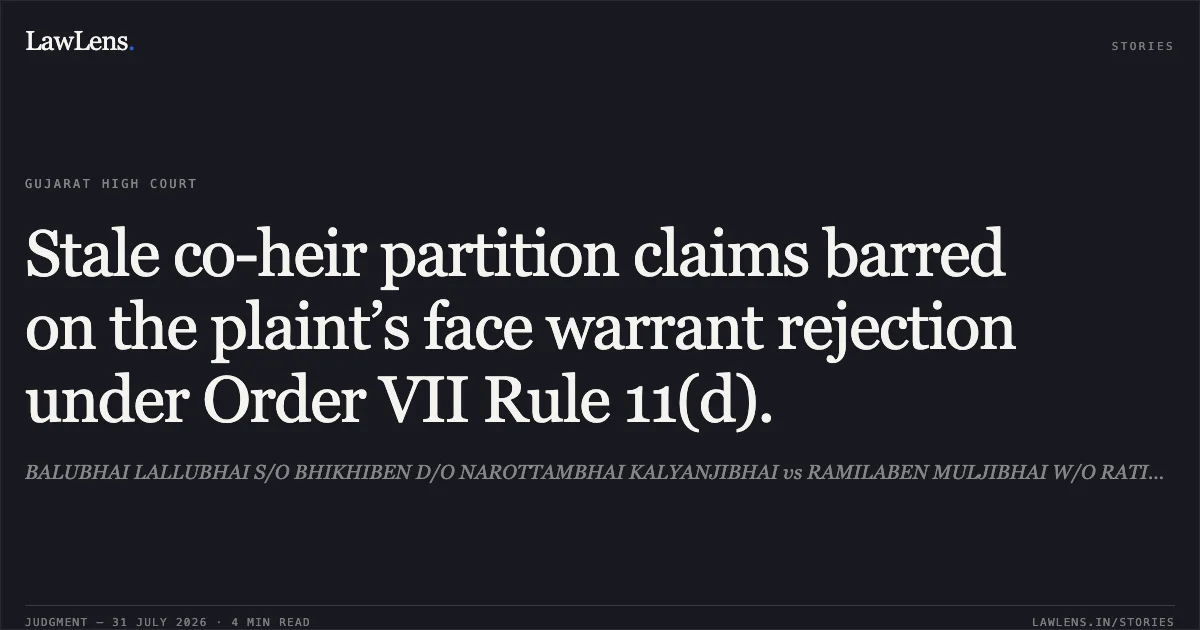
The Gujarat High Court dismissed both First Appeals and upheld the Civil Court’s orders rejecting Special Civil Suit Nos. 47 and 55 of 2016 under Order VII Rule 11 CPC.
It held that the plaintiffs’ claims, founded on succession allegedly arising in 1966 and challenging transactions dating from 1982 onward, were barred by limitation and did not disclose a valid cause of action notwithstanding the pleaded dates of knowledge in 2016.
Source reference: paras. 20–24, pp.13–15The record and proceedings were directed to be remitted to the concerned Civil Court.
Source reference: para. 37, p.23Acts & Sections Cited
5 provisions across 2 statutes referred to in this judgment. Each provision opens on LawLens.
Hindu Succession Act, 19564
Limitation Act, 19631
Original Court PDF
BALUBHAI LALLUBHAI S/O BHIKHIBEN D/O NAROTTAMBHAI KALYANJIBHAIvsRAMILABEN MULJIBHAI W/O RATILAL D/O GANGABEN D/O NAROTTAMBHAI KALYANJIBHAI
Click to open original judgment
Original judgment, available to read, download and summarize on LawLens.in