Facts
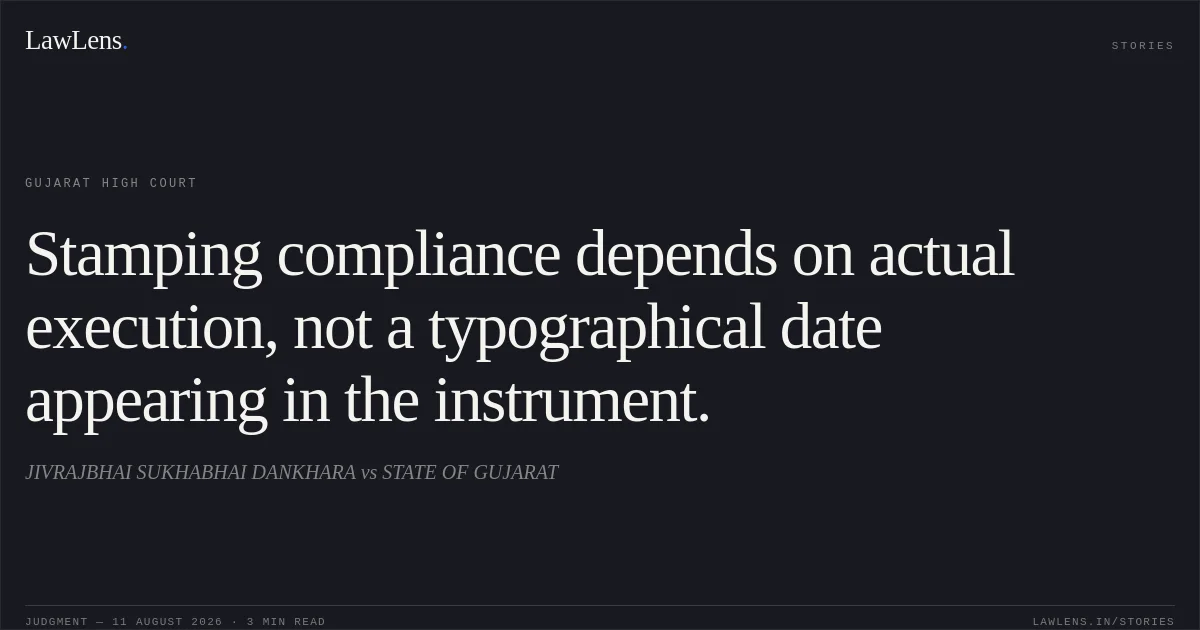
The petitioner, along with other purchasers, acquired immovable property situated at Village Variav, Surat, under a registered sale deed for a consideration of ₹2.65 crores.
Source reference: p.2The e-stamp certificate for ₹16,88,600 was purchased on 05.03.2011, and the sale deed was registered on 07.03.2011, the next working day.
Source reference: p.2However, the deed mentioned 03.03.2011 on its front page as the date of execution.
Source reference: p.2The petitioner contended that this was a typographical error and that the deed was actually executed upon purchase of the stamp on 05.03.2011 and registered on 07.03.2011.
Source reference: pp.4–6The Deputy Collector initiated proceedings under Sections 33 and 39(1) of the Bombay Stamp Act, holding that the stamp was not purchased within the time prescribed by Section 17, and directed recovery of ₹16,88,600 with a penalty of ₹5,400.
Source reference: p.6The Chief Controlling Revenue Authority confirmed that decision on 02.03.2017.
Source reference: pp.1–2The petitioner challenged both orders before the Gujarat High Court.
Source reference: pp.1–2Issues
Whether the date of execution of the sale deed was 03.03.2011 merely because that date appeared on its front page, or whether the authorities were required to determine the actual date on which the instrument was signed and executed.
Source reference: paras. 11–15Whether purchase of the e-stamp on 05.03.2011 and registration of the sale deed on 07.03.2011 complied with Section 17 of the Bombay Stamp Act.
Source reference: paras. 11–13Whether the authorities were justified in recovering the stamp duty amount and imposing a penalty solely on the basis of the date mentioned in the document.
Source reference: paras. 14–19Law Applied
The Court applied Section 2(i) of the Bombay Stamp Act, under which “executed” and “execution,” in relation to instruments, mean “signed” and “signature”.
Source reference: para. 11Section 17 requires an instrument chargeable with duty and executed in the State to be stamped before or at the time of execution, or immediately thereafter on the next working day following the day of execution.
Source reference: paras. 11–13The Court also considered the proceedings under Sections 33 and 39(1), concerning impounding of an insufficiently stamped instrument and recovery of duty and penalty.
Source reference: p.6The governing principle was that the date of execution is the date on which the instrument is actually signed, and not necessarily the date mechanically appearing on its first page.
Source reference: paras. 12, 16Reasoning
The Court found that the authorities had treated 03.03.2011 as the execution date solely because it was printed on the front page of the sale deed.
Source reference: paras. 14–15No affidavit, statement, reply, or other material from any party to the transaction supported the conclusion that the deed had actually been signed on that date.
Source reference: paras. 14–15In contrast, the petitioner’s case was supported by the e-stamp purchased on 05.03.2011 and registration on 07.03.2011, which was the next working day.
Source reference: no citationSince execution under Section 2(i) means signing, the date printed on the document could not, without more, establish the actual date of execution.
Source reference: no citationThe Court further observed that a sale transaction involves preparation and finalisation of the draft, corrections, payment, and eventual signing; therefore, the date on the front page is not determinative of execution.
Source reference: para. 16As none of the parties disputed the petitioner’s version and the authorities produced no contrary evidence, the recovery and penalty were held to be unsupported by material evidence.
Source reference: paras. 17–19Holding
The Court held that the authorities were not justified in treating 03.03.2011 as the date of execution merely because of the typographical entry on the front page.
The purchase of the e-stamp on 05.03.2011 and registration on 07.03.2011 were accepted as consistent with the petitioner’s case that the instrument was executed within the period contemplated by Section 17.
Source reference: paras. 17–19The orders of the Deputy Collector and the Chief Controlling Revenue Authority were quashed and set aside; the petition was allowed and Rule was made absolute.
Source reference: paras. 19–21Acts & Sections Cited
4 provisions across 1 statute referred to in this judgment. Each provision opens on LawLens.
Bombay Stamp Act, 19584
Original Court PDF
JIVRAJBHAI SUKHABHAI DANKHARAvsSTATE OF GUJARAT
Click to open original judgment
Original judgment, available to read, download and summarize on LawLens.in