Facts
The petitioner was appointed as a Peon on May 23, 2008, at the Zila Panchayat, Rajnandgaon, under the Rashtriya Gramin Rojgar Guarantee Scheme on a contractual basis
Source reference: para. 2He has performed his duties continuously for over 17 years without being regularized
Source reference: para. 2, 5The petitioner filed this writ petition seeking a writ of mandamus to direct Respondent No. 3 to regularize his services and grant seniority from his initial appointment
Source reference: para. 1During the proceedings, the petitioner limited his prayer to seeking permission to submit a representation before the competent authorities for the consideration of his claim
Source reference: para. 2, 3Issues
1. Whether the petitioner is entitled to have his claim for regularization considered by the State authorities after 17 years of continuous contractual service
Source reference: para. 5, 92. Whether the continued engagement of employees on a temporary/contractual basis for extended periods violates constitutional mandates and labor standards
Source reference: para. 6, 8Law Applied
The Court relied on the principle that the State is a "constitutional employer" and must avoid "ad-hocism" in recruitment
Source reference: para. 8It applied the precedent in Narendra Kumar Tiwari v. State of Jharkhand (2018) regarding the regularization of employees who completed 10 years of service
Source reference: para. 6It further cited Jaggo v. Union of India (2024), which mandates that government departments should lead by example in providing stable employment
Source reference: para. 6Dharam Singh v. State of UP (2025), which held that long-term extraction of regular labor under temporary labels offends Articles 14, 16, and 21 of the Constitution
Source reference: para. 8Additionally, the Court referred to the State Government Circular dated 05.03.2008 regarding the regularization of daily wage employees
Source reference: para. 9Reasoning
The Court observed that the petitioner has been working as a daily wage/contractual employee for approximately 17 years, a period significantly exceeding the ten-year threshold often cited for regularization
Source reference: para. 5, 9The Court reasoned that the State cannot "balance budgets on the backs of those who perform the most basic and recurring public functions" and emphasized that perennial work should be reflected in sanctioned strengths rather than precarious engagements
Source reference: para. 8By referencing recent Supreme Court jurisprudence, the Court underscored that administrative "ad-hocism" and the practice of outsourcing to evade regular employment obligations are deprecated
Source reference: para. 8Consequently, the Court found it just to allow the petitioner to approach the executive branch for a formal determination of his status based on these established legal principles and his lengthy tenure
Source reference: para. 9Holding
The High Court disposed of the writ petition without adjudicating the merits of the case.
It granted the petitioner liberty to submit a fresh, comprehensive representation to Respondents Nos. 2 and 3
Source reference: para. 9The Court directed the concerned authorities to consider and decide upon the representation in light of the petitioner's 17-year service record and the cited Supreme Court precedents within a period of four months from the date of receipt
Source reference: para. 9, 10Original Court PDF
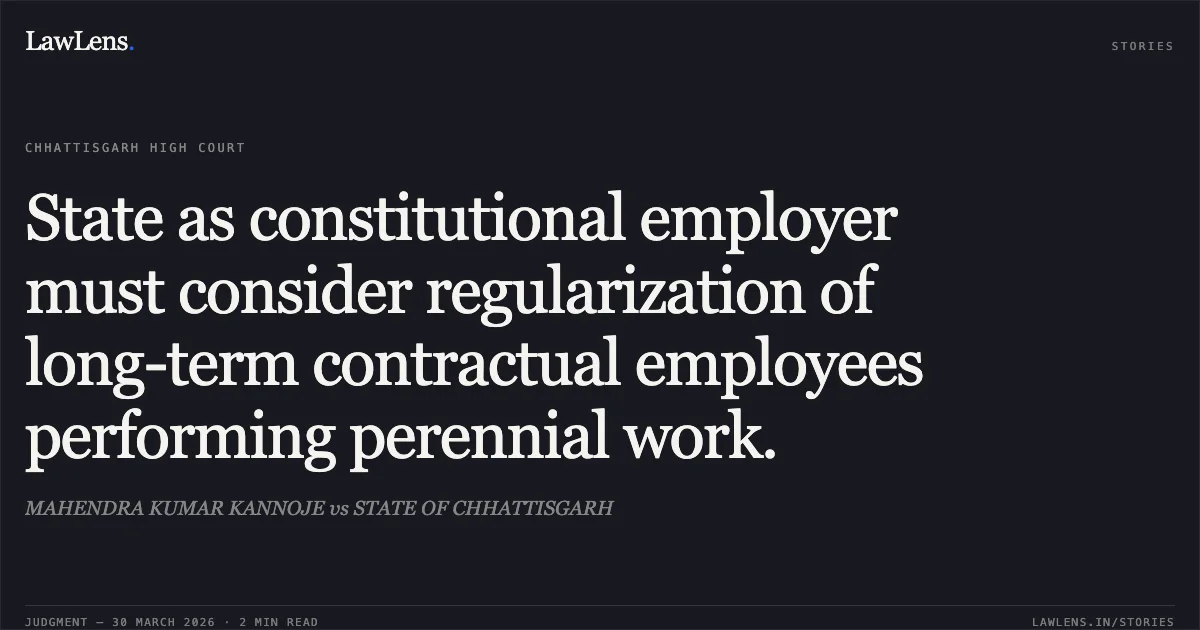
MAHENDRA KUMAR KANNOJEvsSTATE OF CHHATTISGARH
Click to open original judgment
Original judgment, available to read, download and summarize on LawLens.in


