Facts
The petitioners are recorded tenure holders of various agricultural plots in Uttar Pradesh
Source reference: para. 3The State authorities issued a notice under Section 10(2) of the U.P. Imposition of Ceiling on Land Holdings Act, 1961, to Respondent No. 4 (Sri Sobaran Singh) and subsequently clubbed the petitioners' land with his holding
Source reference: para. 3Both the petitioners and Respondent No. 4 filed objections, stating the petitioners were independent owners in cultivatory possession
Source reference: para. 3However, the Prescribed Authority declared 33.913 hectares of irrigated land as surplus by clubbing the petitioners' holdings, relying primarily on a Lekhpal's report suggesting Respondent No. 4 was the "real" owner
Source reference: para. 3, 11The Appellate Authority dismissed the appeals on 28.12.1998 but directed the Prescribed Authority to self-verify certain revenue records
Source reference: para. 3The petitioners challenged these orders via a Writ of Certiorari
Source reference: para. 2Issues
1. Whether the burden of proof to establish that a land holding is "ostensible" or "benami" under Section 5 of the Ceiling Act lies upon the State or the tenure holder.
Source reference: para. 15, 212. Whether the mere report/statement of a Lekhpal is sufficient evidence to rebut the presumption of correctness of revenue entries showing independent ownership.
Source reference: para. 19, 233. Whether the Appellate Authority can delegate the task of factual verification and modification of its own judgment back to the Prescribed Authority.
Source reference: para. 24Law Applied
The court primarily applied Section 5 of the U.P. Imposition of Ceiling on Land Holdings Act, 1961, regarding the clubbing of land held ostensibly in the name of another
Source reference: para. 12, 15It relied on Shishu Pal Singh v. Prescribed Authority, establishing that land recorded in a tenure holder's name carries a presumption of correctness and the "heavy onus" to prove a benami/ostensible transaction lies on the State
Source reference: para. 15, 21It further applied Pritam Singh v. State of U.P. and Som Nath Khanna v. State of U.P., which held that the Ceiling Act is expropriatory legislation that must be strictly construed, and findings cannot be based on mere surmises or Lekhpal reports without corroborative evidence
Source reference: para. 15, 20Reasoning
The Court reasoned that since the petitioners were the recorded tenure holders in revenue records, a legal presumption of correctness existed in their favor
Source reference: para. 17The State failed to provide documentary evidence or independent witnesses to substantiate the claim that the holdings were ostensible
Source reference: para. 18The authorities erroneously shifted the burden of proof onto the petitioners to "disprove" the State's allegation once a notice was issued
Source reference: para. 21-22The Court found the reliance on the Lekhpal’s statement—without examining the source of consideration, nature of possession, or conduct of parties—to be legally insufficient to discharge the State's heavy burden
Source reference: para. 19, 23Finally, the Appellate Authority’s direction to the Prescribed Authority to verify and modify its own order was termed an "abdication of appellate jurisdiction" and an "impermissible course"
Source reference: para. 24Holding
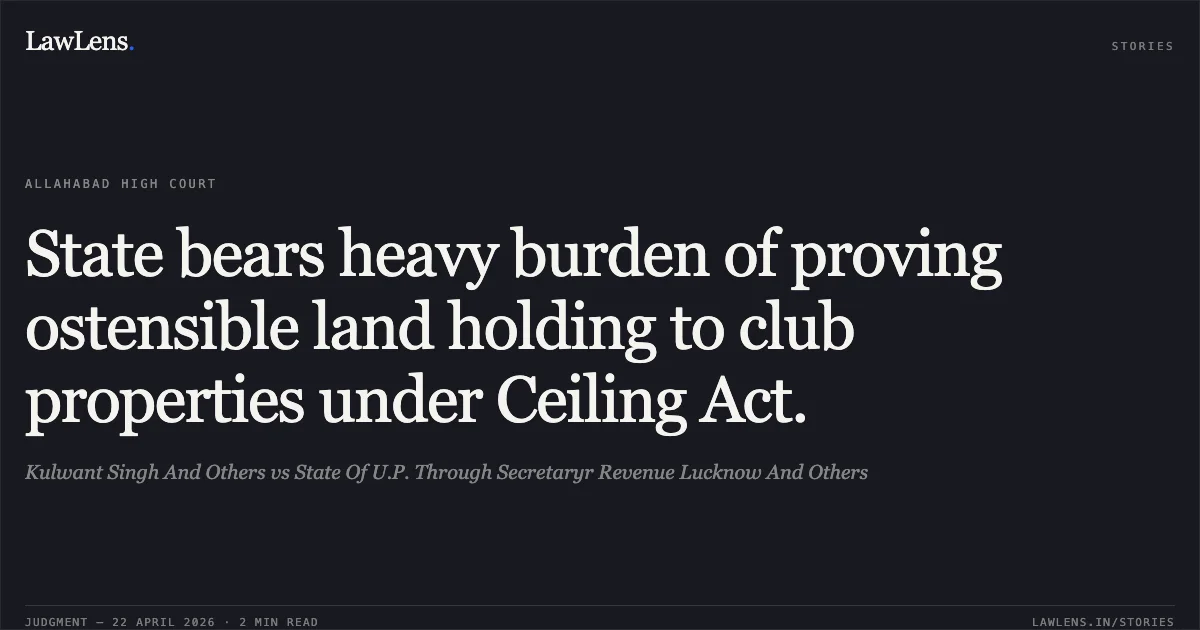
The Court answered the issues in favor of the petitioners, holding that the State failed to discharge its burden of proving that the land was held ostensibly for Respondent No. 4
The findings were deemed perverse and based on inadmissible/insufficient material
Source reference: para. 25Consequently, the High Court allowed the writ petition and set aside the orders dated 21.04.1994 and 28.12.1998
Source reference: para. 26-27No order as to costs was made
Source reference: para. 28Acts & Sections Cited
3 provisions across 1 statute referred to in this judgment. Linked provisions open on LawLens.
U.P. Imposition of Ceiling on Land Holdings Act, 19613
Original Court PDF
Kulwant Singh And OthersvsState Of U.P. Through Secretaryr Revenue Lucknow And Others
Click to open original judgment
Original judgment, available to read, download and summarize on LawLens.in