Facts
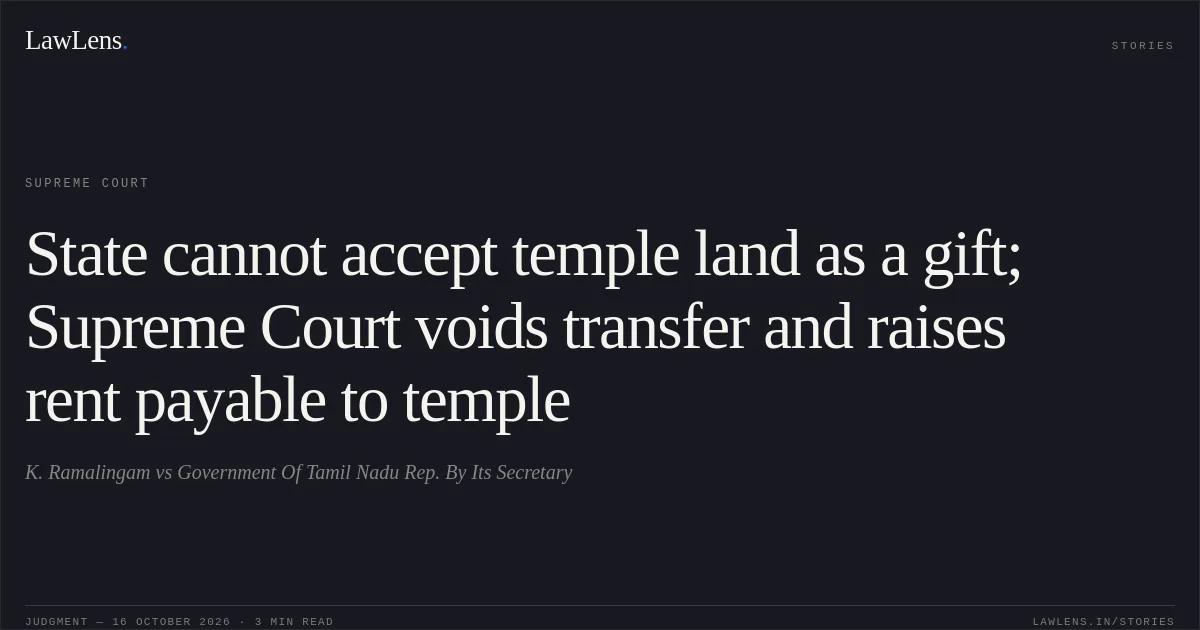
The disputed 1 acre and 10 cents in Kodumudi Village belonged to Nagapalayam Mariamman-Ponnachiamman Temple.
Source reference: no citationOn 30 August 2017, a temporary trustee executed a registered gift deed transferring the land to the State of Tamil Nadu for construction of a Taluk Office.
Source reference: no citationA hereditary trustee challenged the deed, but the High Court dismissed the writ petition, holding that Section 34 of the Tamil Nadu Hindu Religious and Charitable Endowments Act, 1959 (“1959 Act”) did not expressly prohibit gifts and that title was disputed.
Source reference: para. 4–7Devotees appealed.
Source reference: para. 4–7During the appeal, the State acknowledged that the land was an inam granted to the deity and that Section 41 of the 1959 Act applied; it proposed instead that the State hold the land on lease.
Source reference: para. 8–9Issues
Whether the temple’s inam land could validly be gifted to the State by a temporary trustee, and whether the gift and its registration were legally effective
Source reference: para. 2, 28–34Whether the State could continue to occupy the land for the Taluk Office, and what rent and terms should govern that occupation
Source reference: para. 37–39Law Applied
Section 41(1) of the 1959 Act declares an exchange, gift, sale or mortgage of an inam granted for the support or maintenance of a religious institution null and void; unlike other specified transactions, a gift cannot be sanctioned.
Source reference: para. 16–25Section 34(5) excludes inams covered by Section 41 from Section 34, which otherwise requires the Commissioner’s sanction, preceded by prescribed publication and objections and the Government’s prior approval, for specified alienations.
Source reference: para. 16–25Section 22-A of the Registration Act, 1908, as applicable in Tamil Nadu, bars registration of specified transfers of religious-institution property without competent-authority sanction.
Source reference: para. 16–25Sections 23, 27 and 28 of the 1959 Act establish supervisory control and require trustees to obey lawful orders and administer institutional property with ordinary prudence.
Source reference: para. 16–25Section 34-A requires lease rent to be fixed with regard to prevailing market rental value and refixed every three years.
Source reference: para. 16–25The Court also relied on Commissioner, Hindu Religious Endowments, Madras v. Sri Lakshmindra Thirtha Swamiar of Sri Shirur Mutt and A.S. Narayana Deekshitulu v. State of Andhra Pradesh for the distinction between protected religious practice and regulable secular administration of religious property.
Source reference: para. 16–25Reasoning
The State’s affidavit identified the land as an inam granted to the deity, bringing the transaction under Section 41 rather than Section 34.
Source reference: para. 28Section 41 expressly includes gifts among prohibited transactions and permits sanction only for transactions “not being a gift”; the deed was therefore void from the outset and incapable of validation.
Source reference: para. 29–31Registration could not cure that defect, and no competent-authority sanction had preceded it.
Source reference: para. 31The Court added that, even if Section 34 governed, the absence of the required sanction and approvals would invalidate the gift.
Source reference: para. 32The temporary trustee’s authority was constrained by fiduciary duties, and the State, as custodian and regulator, could not accept temple property as a gratuitous transfer.
Source reference: para. 33–36Because a Taluk Office had already been built and served a public need, the Court preserved the State’s occupation through a lease, but recalculated rent using the stated valuation formula and required future rent and renewals to be determined in the temple’s interest.
Source reference: para. 37–39Holding
The Supreme Court allowed the appeals, set aside the High Court’s judgment and declared the land to be inam property vested in the Temple.
It declared the 30 August 2017 gift deed null and void under Section 41(1) of the 1959 Act and its registration of no legal effect under Section 22-A of the Registration Act.
Source reference: para. 41(i)–(ii)The State’s lease was not annulled; rent was fixed at ₹31,000 per month from 8 March 2019, subject to refixation at least every three years and not below that amount, with arrears payable within three months.
Source reference: para. 41(iii)–(iv)The lease’s renewal and terms must be determined in accordance with the 1959 Act, with the Temple’s benefit paramount.
Source reference: para. 41(iii)–(iv)The State was also directed to pay ₹1,00,000 in costs to the Temple and to comply with the statutory procedures governing religious-institution property.
Source reference: para. 40, 41(v)–(vi)Acts & Sections Cited
5 provisions across 1 statute referred to in this judgment. Each provision opens on LawLens.
TAMIL NADU HINDU RELIGIOUS AND CHARITABLE ENDOWMENTS ACT, 19595
Original Court PDF
K. RamalingamvsGovernment Of Tamil Nadu Rep. By Its Secretary
Click to open original judgment
Original judgment, available to read, download and summarize on LawLens.in