Facts
The respondents were engaged as daily rated workers in the Eco Task Force Division of the Forest Department, Jammu, and have continuously served for approximately 25 to 30 years
Source reference: p. 3The Central Administrative Tribunal (CAT), Jammu Bench, vide order dated June 2, 2025, directed the petitioners to regularize the respondents' services under SRO 64 of 1994 and/or the J&K Civil Services (Special Provisions) Act, 2010
Source reference: p. 3The UT of J&K challenged this order, contending that the respondents were hired on "need basis" without sanctioned posts and that all regularization policies (SRO 64 of 1994 and SRO 520 of 2017) were repealed by S.O 514 dated October 6, 2023, leaving no policy in vogue for consideration
Source reference: p. 4Issues
1. Whether the continuous service of employees for three decades can be labeled as "temporary" or "of limited duration" to deny regularization
Source reference: p. 4 / para. 92. Whether the repeal of regularization policies (SRO 64 and SRO 520) retrospectively extinguishes the rights of employees whose claims had already crystallized
Source reference: p. 8 / para. 16Law Applied
The Court relied on the distinction between "illegal" and "irregular" appointments established in State of Karnataka v. Umadevi, asserting that Umadevi cannot shield exploitative engagements persisting for years
Source reference: p. 5It applied the principle from Jaggo v. Union of India (2025) which deprecated the practice of labeling perennial work as contractual to deny job security
Source reference: p. 6Shripal v. Nagar Nigam, Ghaziabad and Bhola Nath v. State of Jharkhand were cited to emphasize that the State, as a "Model Employer," must respect the dignity of labor and cannot rely on mechanical applications of nomenclature to discard long-serving employees
Source reference: p. 5, 7the Court applied the doctrine that rights accrued under a statute cannot be taken away retrospectively by a repeal
Source reference: p. 8Reasoning
The Court reasoned that 25 to 30 years of uninterrupted service, evidenced by muster rolls and duty registers, effectively proves the permanence of the work performed
Source reference: p. 4It rejected the petitioners' "need basis" argument, holding that the State cannot use technical labels like "seasonal labor" to avoid justice after benefiting from decades of labor
Source reference: p. 5The Court observed that the pervasive misuse of temporary contracts mirrors detrimental "gig economy" trends and undermines public trust
Source reference: p. 6-7Regarding the repeal of SRO 64 and SRO 520 via S.O 514, the Court analyzed that since the respondents' rights had already crystallized over three decades, the repeal could not be applied retrospectively to defeat these rights, as doing so would violate Articles 14 and 16 of the Constitution
Source reference: p. 8Holding
The High Court answered that the status of the respondents had acquired "permanence" through the passage of time
Accordingly, the Court dismissed the writ petition, upholding the CAT's direction to regularize the respondents' services, and affirmed that the State cannot resort to a "hire and fire" policy after 30 years of continuous service
Source reference: p. 9Acts & Sections Cited
2 provisions across 2 statutes referred to in this judgment. Linked provisions open on LawLens.
Jammu and Kashmir Civil Services (Special Provisions) Act, 20101
S.O 514 of 20231
Original Court PDF
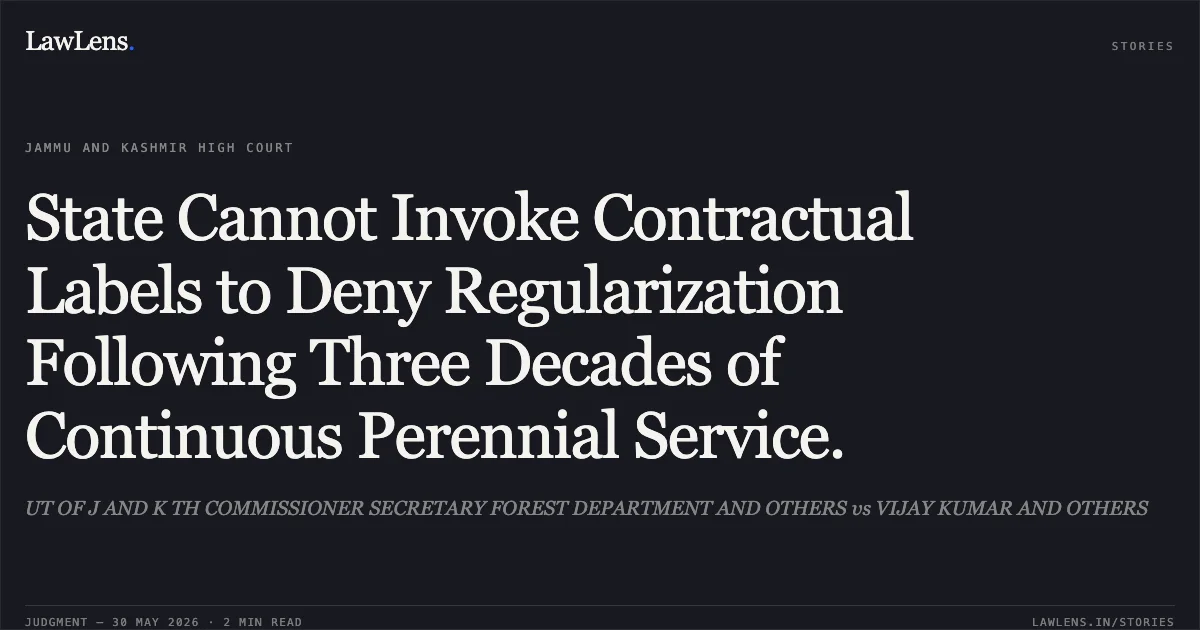
UT OF J AND K TH COMMISSIONER SECRETARY FOREST DEPARTMENT AND OTHERSvsVIJAY KUMAR AND OTHERS
Click to open original judgment
Original judgment, available to read, download and summarize on LawLens.in