Facts
The Appellants, Grade-IV employees, obtained a favorable order from the Andhra Pradesh Administrative Tribunal on 20.07.2012, granting them a minimum regular pay scale.
Source reference: para 3, 4The State did not challenge this order, but failed to implement it.
Source reference: para 4, 8The Appellants’ subsequent contempt and execution petitions before the Tribunal were dismissed on grounds of limitation and non-payment of costs.
Source reference: para 3.1, 7.1In 2017, the Appellants filed Writ Petition No. 32682/2017 before the High Court, which was withdrawn without seeking liberty to file afresh.
Source reference: para 3.1, 7.1Subsequently, they filed Writ Petition No. 44392/2018 seeking implementation of the 2012 order, but suppressed the history of the previous unsuccessful litigations.
Source reference: para 3.1, 7.2The High Court dismissed this petition on grounds of suppression of material facts and the bar on filing a fresh petition without liberty.
Source reference: para 6Issues
1. Whether the filing of a second Writ Petition (W.P. No. 44392/2018) was maintainable in the absence of liberty granted during the withdrawal of the first petition.
Source reference: para 72. Whether the non-disclosure of previous connected litigations amounted to suppression of material facts disentitling the Appellants to relief.
Source reference: para 73. Whether the State, as a model employer, can rely on technicalities and delays to avoid implementing a final judicial order.
Source reference: para 8Law Applied
The Court applied the principle that suppression of a "material fact"—defined as a fact that would significantly influence the decision-making process—disqualifies a litigant from relief, as established in S J S Enterprises (P) Ltd. v. State of Bihar.
Source reference: para 6.1, 7.3Arunima Baruah v. Union of India regarding disclosure in writ petitions.
Source reference: para 7.2Doctrine of Ex injuria sua nemo habere debet (no person can take advantage of their own wrong), referencing Kusheshwar Prasad Singh v. State of Bihar.
Source reference: para 8(ii)"Model Employer" obligation of the State under Article 12 of the Constitution and the principle from Union Territory of Ladakh v. Jammu and Kashmir National Conference that systemic delays should not defeat the cause of justice.
Source reference: para 8(ii), 8(iv)Reasoning
The Court acknowledged that the Appellants failed in their duty to disclose previous proceedings, noting that litigants cannot unilaterally decide what information is "relevant".
Source reference: para 7.2The Court distinguished this by ruling that such suppression must be material to the merits of the case; here, the underlying 2012 Tribunal order remained valid and unchallenged.
Source reference: para 7.3, 8(i)The Court observed that because the salary/increment grievance arises monthly, it constitutes a continuing cause of action.
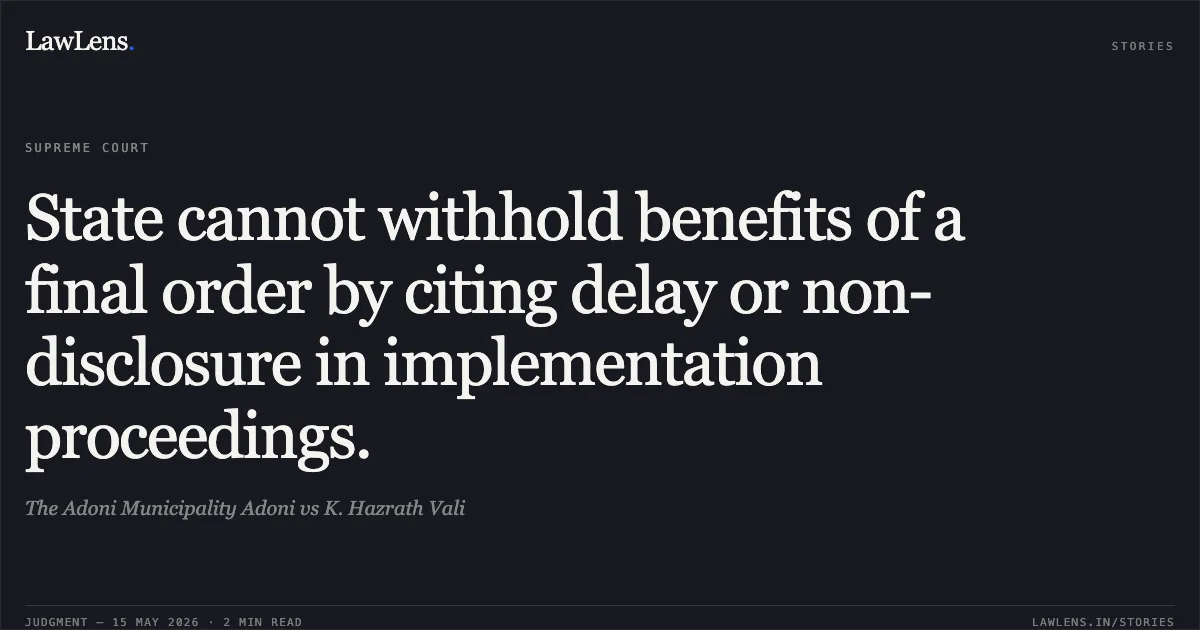
Source reference: para 8(iii)The Court held that the State, acting as a model employer, is estopped from profiting from its own failure to implement a final judicial order through technical pleas of limitation or procedural lapses by the employees.
Source reference: para 8(ii), 9The lack of liberty to file a fresh petition was deemed insufficient to bar the quest for implementation of a finalized right.
Source reference: para 7.1, 9Holding
The Supreme Court allowed the appeal and set aside the High Court’s judgment.
The Tribunal's 2012 order does not lose force by efflux of time and the State cannot avoid its implementation despite the Appellants' procedural failings.
Source reference: para 9The Court directed the Respondents to comply with the Order dated 20.07.2012 and make all required payments within four months, though it declined to award interest as a "deterrence" for the Appellants' non-disclosures.
Source reference: para 10Acts & Sections Cited
3 provisions across 2 statutes referred to in this judgment. Each provision opens on LawLens.
Administrative Tribunals Act, 19852
Contempt of Courts Act, 19711
Original Court PDF
The Adoni Municipality AdonivsK. Hazrath Vali
Click to open original judgment
Original judgment, available to read, download and summarize on LawLens.in