01Facts
The appellant purchased 37.875 acres at Nallur-Manamai through an e-auction conducted under the SARFAESI Act on an “as is where is” basis.
pp. 3–5, paras 3.1–3.4The property had previously belonged to PRIST Trust, which had received an Essentiality Certificate in 2014 for establishing a medical college with an annual intake of 150 students.
pp. 3–5, paras 3.1–3.4After acquiring the property, the appellant applied to the National Medical Commission for approval to admit 150 students, but the application was rejected because the Essentiality Certificate stood in PRIST Trust’s name.
pp. 3–5, paras 3.1–3.4The State Government required production of an Environmental Clearance Certificate and a Tamil Nadu Pollution Control Board certificate before processing the application.
pp. 3–5, paras 3.1–3.4The learned Single Judge directed the appellant to obtain those certificates before the State considered the Essentiality Certificate, relying, inter alia, on the principle that there could be no equality in illegality.
pp. 6–8, para 3.902Issues
i.1. Whether the State Government could insist upon prior production of an Environmental Clearance Certificate and a Tamil Nadu Pollution Control Board certificate as conditions for processing or granting an Essentiality Certificate under the applicable medical-college regulations.
pp. 8–12, paras 4.2, 9–10ii.2. Whether the learned Single Judge erred by failing to decide the appellant’s contention that the 2014 Essentiality Certificate granted to PRIST Trust continued to operate and passed with the property under Section 13(6) of the SARFAESI Act and the saving provision in Section 60(4) of the National Medical Commission Act, 2019.
pp. 8, 11–12, paras 4.1, 8iii.3. Whether the principle in Medical Council of India v. V.N. Public Health and Educational Trust, (2016) 11 SCC 216, rendered a conditional Essentiality Certificate impermissible in the present circumstances.
pp. 13–15, paras 11–1303Law Applied
Regulation 2(f) of the National Medical Commission’s 2023 Regulations defines an Essentiality Certificate as written permission from the Central or concerned State Government for establishing a new medical institution, while Regulation 9(a) requires a valid Essentiality Certificate to accompany the application.
pp. 16–17, paras 14–15Form 2 under the 1999 Regulations confines the State Government’s inquiry to matters such as medical manpower requirements, doctor-population ratios, public interest, feasibility of the proposed institution, availability of clinical material, land, building-plan approval, and completion or building-use certification.
pp. 17–20, para 16The State must act within the statutory parameters of Form 2 and cannot impose additional conditions unrelated to those prescribed criteria.
p. 20, para 17Environmental clearances and pollution-control approvals may be mandatory under separate environmental statutes before construction or commissioning, but they are not qualifying criteria for the grant of an Essentiality Certificate.
p. 20, para 18Medical Council of India v. V.N. Public Health and Educational Trust, (2016) 11 SCC 216, establishes that a certificate made conditional upon compliance with a mandatory Form 2 requirement may be treated as no certificate under the Regulations; it does not create a general prohibition against every form of conditional certificate.
pp. 13–15, paras 11–1204Reasoning
The Division Bench held that the learned Single Judge had failed to adjudicate two live issues: whether the earlier Essentiality Certificate survived the SARFAESI sale and whether environmental approvals were legally relevant at the Essentiality Certificate stage.
pp. 11–13, paras 8–10The Bench further found that the Single Judge had incorrectly treated Medical Council of India v. V.N. Public Health and Educational Trust, (2016) 11 SCC 216, as establishing a blanket rule invalidating all conditional Essentiality Certificates.
pp. 13–15, paras 11–12That precedent concerned a condition relating to clinical material, which Form 2 expressly requires to exist at the application stage; it did not address environmental approvals falling outside Form 2.
pp. 13–15, paras 11–12Applying Form 2, the Court concluded that the State’s statutory role was limited to assessing medical need, public interest, feasibility, land, infrastructure, and clinical material.
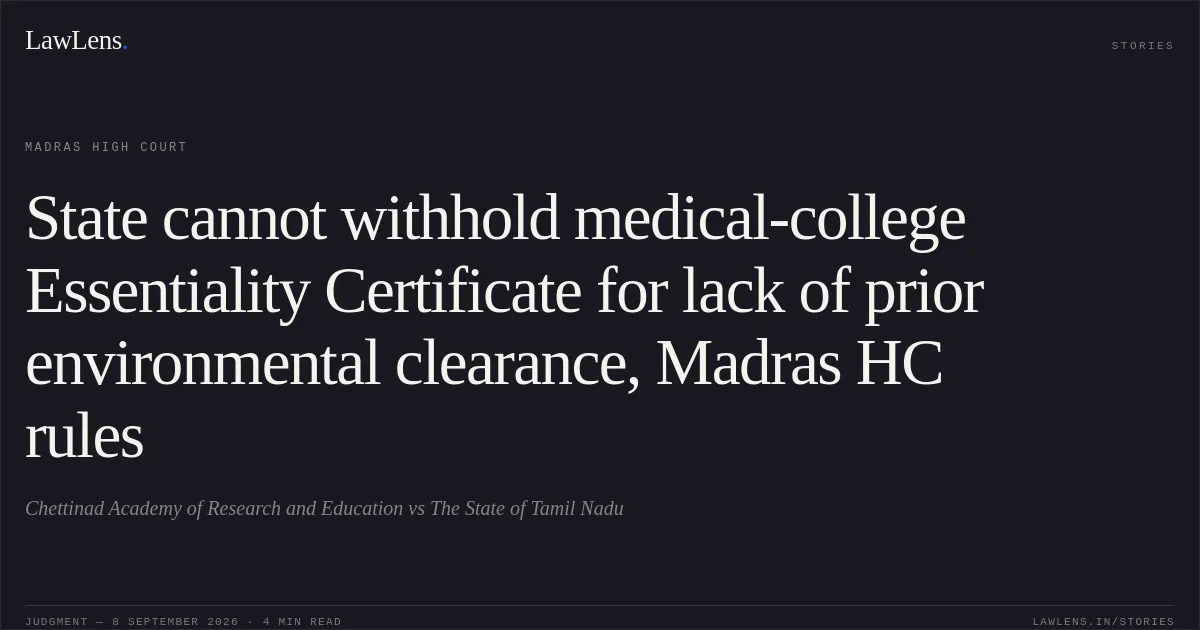
pp. 19–21, paras 17–20Since Environmental Clearance and TNPCB approval were governed by separate statutory regimes and were not prescribed as Essentiality Certificate criteria, the State could not defer consideration of the appellant’s application solely for want of those documents.
pp. 19–21, paras 17–20The Court left the issue concerning the continued validity and transferability of the 2014 certificate open because the environmental-clearance issue independently disposed of the appeal.
p. 21, para 1905Holding
The writ appeal was allowed, and the learned Single Judge’s order dated 03.12.2025 was set aside.
p. 21, para 20The State Government was directed to process and consider the appellant’s application for an Essentiality Certificate strictly in accordance with the criteria in Form 2 of the 1999 Regulations and applicable law, without insisting upon prior production of an Environmental Clearance Certificate or TNPCB approval at that stage.
p. 21, para 20The Court clarified that the appellant was not exempted from obtaining environmental or pollution-control approvals; those requirements could be enforced at the appropriate later stage.
pp. 21, paras 13, 19–20The issue concerning the legal continuity of the 2014 Essentiality Certificate was left open for determination in an appropriate case.
pp. 21, paras 13, 19–20No order as to costs was made, and the connected miscellaneous petitions were closed.
p. 21, para 20Original Court PDF
Chettinad Academy of Research and EducationvsThe State of Tamil Nadu
Click to open original judgment
Original judgment, available to read, download and summarize on LawLens.in