Facts
The Petitioners (a son and his parents) resided in a house in Hamirpur, purchased via sale deeds between 2001 and 2009.
Source reference: para. 4Following the registration of an FIR (Crime No. 20/2026) against the first Petitioner’s cousin for alleged religious conversion and POCSO offenses, the State authorities issued demolition notices for the residential house and sealed the Petitioners' commercial properties (a lodge and a saw mill).
Source reference: para. 5, 6The Petitioners alleged these actions were punitive and lacked due process, while the State contended the saw mill was sealed for Forest Act violations and that no demolition would occur without following legal procedures.
Source reference: para. 7, 14, 15Issues
1. Whether the State's actions constituted a "retributive exercise of executive discretion" by targeting dwelling places immediately following the commission of a crime.
Source reference: para. 92. Whether the "reasonable apprehension" of imminent demolition constitutes a sufficient cause of action for a citizen to approach the High Court under Article 226.
Source reference: para. 93. How to balance the State's statutory authority to remove illegal encroachments against the fundamental right to shelter under Articles 14 and 21.
Source reference: para. 9Law Applied
The Court applied the "Rule of Law" as a safeguard against arbitrary State action and the "Doctrine of Separation of Powers," which vests the power to punish exclusively in the judiciary.
Source reference: para. 18, 19The Court primarily relied on the Supreme Court’s directions in In re: Directions in the Matter of Demolition of Structures (2025) 5 SCC 1 (the "bulldozer case") and Rajendra Kumar Barjatya v. U.P. Avas Evam Vikas Parishad (2024) 37674.
Source reference: para. 2The Court reaffirmed that the "Right to Shelter" is an integral facet of the Right to Life under Article 21, citing Olga Tellis v. Bombay Municipal Corp regarding the nexus between life, livelihood, and shelter.
Source reference: para. 35-37, 23-25The Court further invoked the principle of "Malice in Law" through the newly carved specie of "Retributive Exercise of Executive Discretion".
Source reference: para. 40-41Reasoning
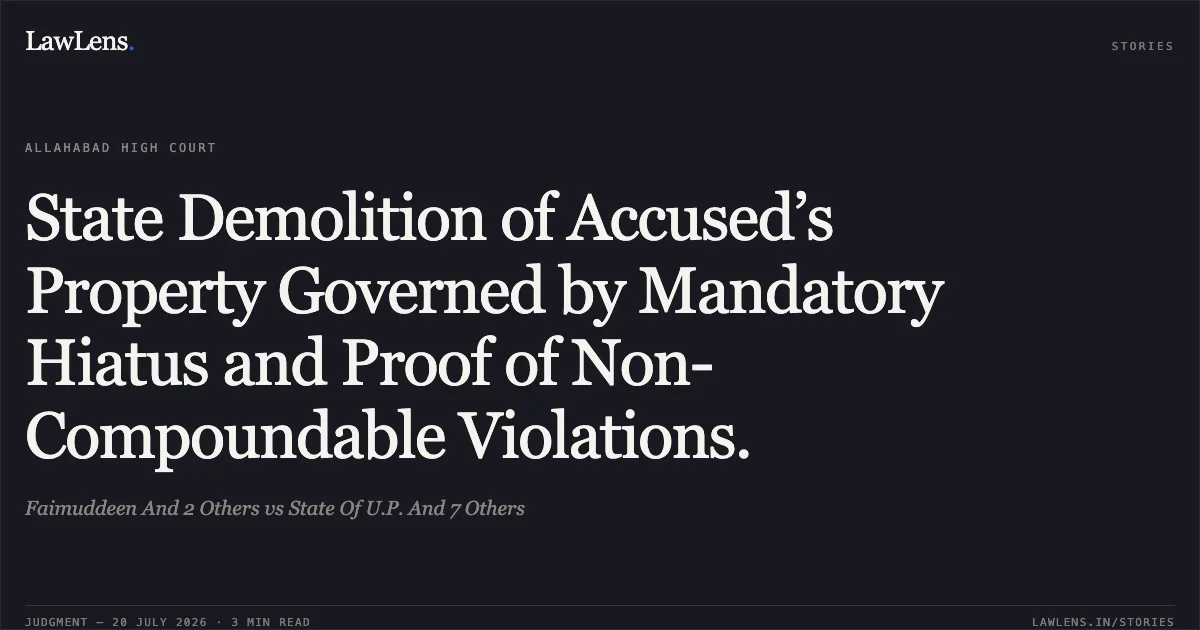
The Court reasoned that while the State has the authority to remove illegal structures, using municipal laws specifically to target persons accused of crimes constitutes a colorable and malicious exercise of power.
Source reference: para. 46It noted that the proximity between the FIR and the demolition notice betrayed a punitive intent rather than a bona fide administrative one.
Source reference: para. 60Drawing on S.M.D. Kiran Pasha, the Court held that a citizen need not wait for their house to be razed; "pre-violation protection" is available under Article 226 when a threat to Article 21 is imminent.
Source reference: para. 57The Court critiqued the State's "selective outrage," observing that choosing one structure for demolition while ignoring surrounding illegalities indicates mala fides.
Source reference: para. 60-61It further emphasized that since the State is often particeps criminis—allowing illegal structures to exist for decades through bureaucratic corruption—it cannot abruptly render citizens homeless without substantial notice.
Source reference: para. 76Holding
The Court disposed of the writ petition by quashing the demolition proceedings against the Petitioners' residence and lodge, finding them to be a "retributive exercise of executive discretion".
It held that no demolition of an accused’s dwelling may occur for two years following an FIR, unless there is a proved public purpose requiring immediate reclamation.
Source reference: para. 74-75The Court mandated a one-year notice period for residents of any illegal structure existing for over three years and ordered that any demolition notice must be accompanied by disciplinary and criminal proceedings against the erring officers who originally permitted the illegal construction.
Source reference: para. 76, 77The proceedings regarding the saw mill under the Forest Act were permitted to continue, and violations of these directions were made subject to contempt of court.
Source reference: para. 80, 82Acts & Sections Cited
10 provisions across 3 statutes referred to in this judgment. Each provision opens on LawLens.
Bharatiya Nyaya Sanhita, 20234
Indian Forest Act, 19274
Original Court PDF
Faimuddeen And 2 OthersvsState Of U.P. And 7 Others
Click to open original judgment
Original judgment, available to read, download and summarize on LawLens.in