Facts
The petitioner, Oil & Natural Gas Corporation (ONGC), was granted a mining lease by the State of Gujarat in 1973 for hydrocarbon exploration in the Mehsana District
Source reference: p. 3The lease was renewed in 2002, effective from 1986. Under Part VII of the Lease Deed, ONGC was liable to pay rents and royalties but was specifically exempted from "demands for land revenue"
Source reference: p. 4Despite this exemption and the lease terms, the Respondent authorities issued a demand notice dated December 17, 2009, and a seizure order dated January 4, 2010, seeking payment of Rs. 77,504.75 as "conversion tax" for the change of land use from agricultural to non-agricultural purposes
Source reference: p. 2-4ONGC challenged these demands as being without jurisdiction and contrary to existing judicial precedents.
Source reference: no citationIssues
1. Whether the State Government is entitled to levy conversion tax or land revenue-related assessments on lands held by ONGC under a mining lease agreement that specifically exempts "land revenue" demands.
Source reference: p. 2 / para. 2(a)2. Whether the demand notice and seizure order issued under the Bombay Land Revenue Code are legally sustainable in light of prior Division Bench judgments of the High Court.
Source reference: p. 2 / para 2(b)Law Applied
The Court applied the provisions of the Bombay Land Revenue Code and the Gujarat Panchayats Act, interpreting them alongside the specific covenants found in the standard Petroleum Mining Lease agreements
Source reference: p. 4The core legal principle relied upon is the doctrine of Stare Decisis, specifically following the Division Bench ruling in ONGC v. Taluka Panchayat, Khambhat (2006 (2) GLR 987), which established that where a contract (lease) with the State Government specifically exempts the payment of land revenue, the State cannot levy such taxes under Section 45 of the Bombay Land Revenue Code
Source reference: p. 7Furthermore, the court referred to the established precedent that ONGC is not liable for Panchayat cess under Sections 191 and 203 of the Panchayats Act, nor for local fund cess, though it remains liable for education cess
Source reference: p. 8Reasoning
The Court analyzed the demand for "conversion tax" through the lens of prior litigations involving the same parties and similar lease terms. It noted that the Division Bench in First Appeal No. 5224 of 2001 and subsequent Special Civil Applications (No. 17304 of 2006) had already adjudicated that ONGC’s leasehold lands are exempt from land revenue assessments under the Bombay Land Revenue Code
Source reference: para. 8-11The Court reasoned that since conversion tax is a nature of assessment under the Land Revenue Code, and the lease agreement specifically excludes "demands for land revenue", the State lacks the statutory authority to impose such a tax on these specific mining leases.
Source reference: para. 6The respondent (State) failed to provide any contrary evidence or superior court judgments to override these precedents. Consequently, because the demand was based on provisions of the Code from which ONGC was contractually and legally shielded, the notice was deemed "wholly illegal"
Source reference: para. 12-16Holding
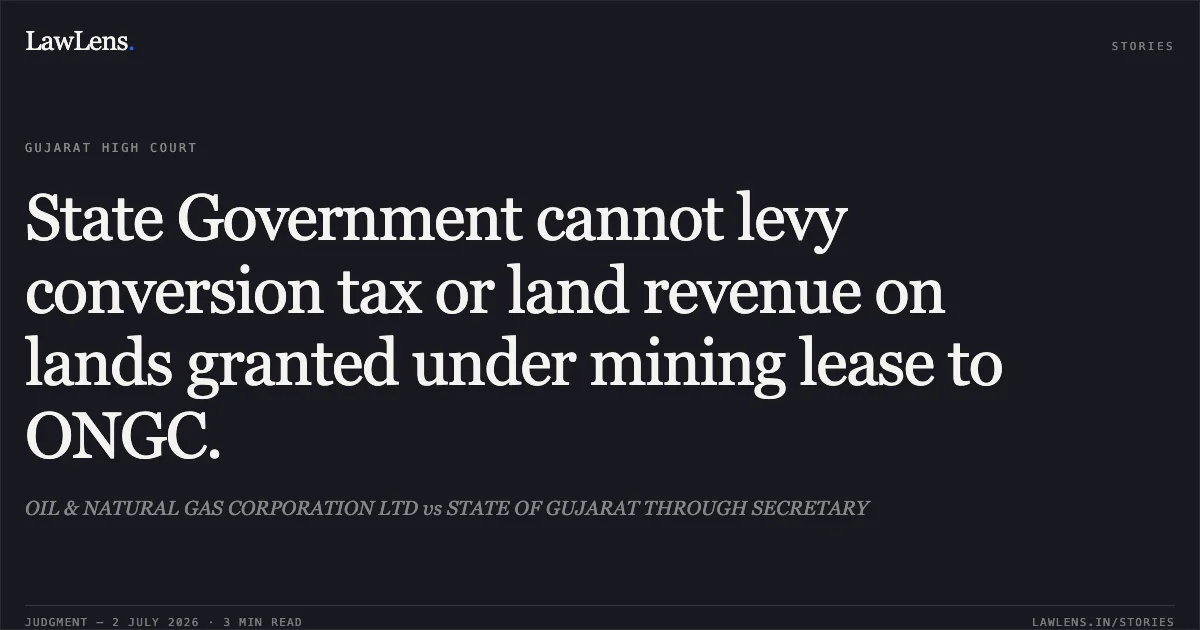
The Court held that the State Government is not entitled in law to raise demands for land revenue, local fund, or Panchayat cess (including conversion tax) on lands occupied by ONGC under these mining lease agreements. The Court answered the issues in the negative for the State.
Consequently, the High Court allowed the petition, quashed and set aside the impugned demand notice dated December 17, 2009, and made the Rule absolute. No order as to costs was made
Source reference: p. 8-9Acts & Sections Cited
3 provisions across 2 statutes referred to in this judgment. Linked provisions open on LawLens.
Oil And Natural Gas Commission Act, 19591
Cess Act, 18802
Original Court PDF
OIL & NATURAL GAS CORPORATION LTDvsSTATE OF GUJARAT THROUGH SECRETARY
Click to open original judgment
Original judgment, available to read, download and summarize on LawLens.in