Facts
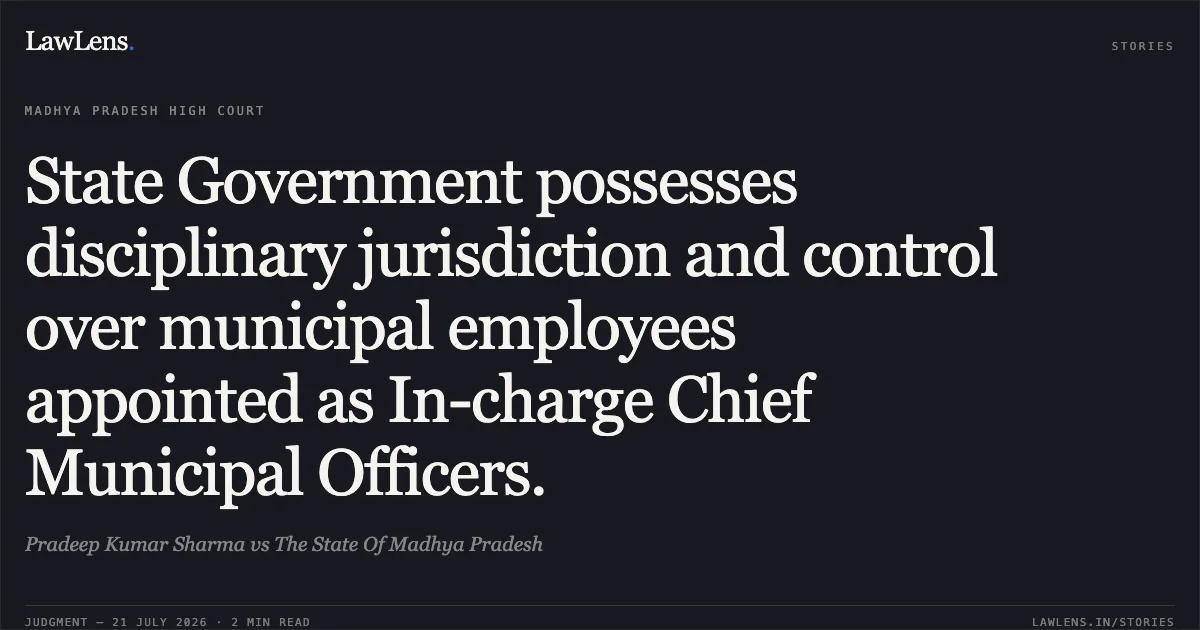
The petitioner, substantively appointed as a Revenue Sub-Inspector under the Madhya Pradesh Municipal Employees (Recruitment and Conditions of Service) Rules, 1968, was serving as the In-charge Chief Municipal Officer (CMO) at Nagar Palika Parishad, Sabalgarh
Source reference: p. 1-2On July 10, 2020, Respondent No. 2 issued a charge-sheet against the petitioner alleging financial embezzlement committed during his tenure as In-charge CMO
Source reference: p. 2The petitioner challenged the charge-sheet (Annexure P/1) and the related communication (Annexure P/2) via this writ petition under Article 226 of the Constitution, contending that the issuing authority lacked jurisdiction as he was not a member of the State Municipal Service
Source reference: p. 1-2Issues
1. Whether the Additional Commissioner/State authorities have the jurisdiction to initiate disciplinary proceedings and issue a charge-sheet to an employee holding the post of In-charge Chief Municipal Officer, despite their substantive post being in the municipal service
Source reference: p. 2, para. 3; p. 11, para. 10Law Applied
The court primarily applied Sections 89 and 90 of the M.P. Municipalities Act, 1961. Specifically, Section 89(1-A) grants the State Government powers of control over persons appointed to act as Chief Municipal Officers.
Source reference: p. 4-5Section 90(4) stipulates that any person appointed to perform the duties of a CMO shall be subject to the same liabilities, restrictions, and conditions as a regular CMO
Source reference: p. 5Interpretation of the term "control" is a broad connotation including disciplinary jurisdiction and the power to suspend as established in Anand Sharma v. State of M.P. (2007) 5 MPHT 85.
Source reference: p. 7-8The principle that "In-charge" officers fall under the State’s disciplinary umbrella as affirmed in Ikrar Ahmed v. State of M.P. (W.P. No. 600/2018) and Mahesh Kumar Wore v. State of M.P. (W.A. No. 1213/2019).
Source reference: p. 2, 12Reasoning
The court reasoned that even if an employee’s substantive appointment is a lower post (e.g., Revenue Inspector), the moment they are appointed as In-charge CMO, they come under the direct administrative and disciplinary "control" of the State Government per Section 89(1-A) of the Act
Source reference: p. 4, 10The court dismissed the petitioner’s argument that his service was governed solely by the 1968 Rules, noting that Section 90(4) explicitly attaches the "liabilities" of a CMO to any person performing those duties
Source reference: p. 5, 10By applying the interpretations from Anand Sharma, the court found that since the State Government has the power to appoint an In-charge CMO, it inherently possesses the "power of control," which includes the authority to issue charge-sheets for financial irregularities
Source reference: p. 10-11Consequently, the Additional Commissioner was held to be a competent authority for the impugned action
Source reference: p. 12Holding
The court answered the issue in the affirmative, holding that the State Government and its authorized officers (Additional Commissioner) have the jurisdiction to take disciplinary action against an In-charge CMO
The court found no merit in the petition, held that no case was made out to warrant interference under Article 226, and dismissed the writ petition
Source reference: p. 13Acts & Sections Cited
1 provisions across 1 statute referred to in this judgment. Each provision opens on LawLens.
Road Transport Corporations Act, 19501
Original Court PDF
Pradeep Kumar SharmavsThe State Of Madhya Pradesh
Click to open original judgment
Original judgment, available to read, download and summarize on LawLens.in