Facts
The appeals arose from judgments of the Bombay High Court and its Aurangabad and Nagpur Benches concerning references made to Labour Courts under Section 17(2) of the Working Journalists and Other Newspaper Employees (Conditions of Service) and Miscellaneous Provisions Act, 1955 (“Working Journalists Act”).
Source reference: paras. 2–6By notification dated 11 May 2016, the Government of Maharashtra delegated to specified Additional and Deputy Commissioners of Labour the power to make references to Labour Courts under Section 17(2).
Source reference: para. 4References were thereafter made by those authorities in disputes concerning amounts allegedly payable by newspaper establishments to employees.
Source reference: no citationThe Aurangabad Bench set aside, inter alia, an award of the Labour Court, while the Nagpur Bench upheld a preliminary objection challenging the competence of the authority that made the reference.
Source reference: paras. 3, 6The Supreme Court consolidated the appeals because they involved the common question whether the State Government could delegate its power of reference under Section 17(2).
Source reference: para. 2Issues
Whether Section 17(2) of the Working Journalists Act empowered the State Government to delegate to another authority its power to refer a dispute concerning the amount due to a newspaper employee to a Labour Court
Source reference: paras. 5, 14, 19–22Whether references and proceedings already initiated pursuant to the Maharashtra Government’s delegation notification should be terminated once that delegation was held invalid
Source reference: paras. 33–39Law Applied
Section 17(1) of the Working Journalists Act permitted the State Government to specify an authority to satisfy itself that an undisputed amount was due and to issue a recovery certificate.
Source reference: paras. 13, 19In contrast, Section 17(2) expressly vested the power to refer a dispute regarding the amount due in the State Government and contained no provision authorising delegation; under the principle expressio unius est exclusio alterius, the express delegation power in sub-section (1) excluded an implied delegation power under sub-section (2).
Source reference: paras. 19–22Section 17(3) further required the Labour Court to forward its decision to the State Government “which made the reference,” confirming that the reference-making power belonged to the State Government.
Source reference: para. 21The Court relied on Samarjit Ghosh v. Bennett Coleman & Co., which treated Section 17 as a sequential and integrated statutory scheme, and on Pradyot Kumar Bose v. Chief Justice of the Calcutta High Court and Sahni Silk Mills (P) Ltd. v. Employees’ State Insurance Corporation for the principle that statutory powers cannot be delegated or sub-delegated without express authority or necessary implication, although officials may collect materials and assist the competent authority.
Source reference: paras. 9–11, 24–28Beneficial legislation cannot be interpreted contrary to clear statutory language.
Source reference: para. 29Reasoning
The Court held that Section 17(1) and Section 17(2) operated as successive stages of one recovery scheme, but the limited delegation authorised under sub-section (1) could not be carried forward into sub-section (2).
Source reference: paras. 11, 28Under sub-section (1), the specified authority could deal with an undisputed claim; once the employer disputed liability or quantum, that authority became functus officio and could only place the relevant materials before the State Government.
Source reference: para. 28The decision whether a genuine dispute existed and whether it warranted adjudication by a Labour Court required satisfaction to be reached by the State Government itself.
Source reference: no citationThe Maharashtra notification did not merely authorise subordinate officers to implement a decision already taken by the State Government; it vested them with the ultimate power to make the reference, thereby removing the statutory responsibility from the State Government.
Source reference: para. 31The Court therefore found the delegation under Section 17(2) invalid.
Source reference: para. 32Nevertheless, because the references had been made pursuant to an operative government notification, numerous proceedings had progressed, and the Working Journalists Act had subsequently been repealed with effect from 21 November 2025, the Court exercised its power under Article 142 to avoid restarting all proceedings from the beginning.
Source reference: paras. 33–38Holding
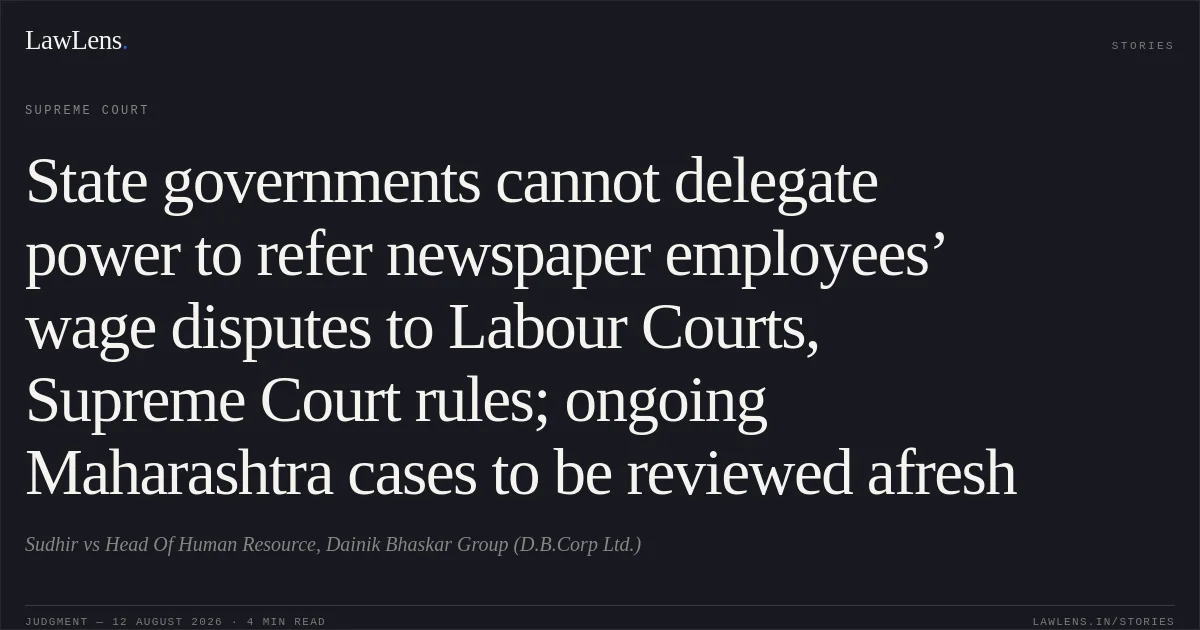
The Supreme Court held that the State Government alone was competent to make a reference under Section 17(2) of the Working Journalists Act, and the Government of Maharashtra could not delegate that power to Additional or Deputy Commissioners of Labour.
The impugned High Court judgments were affirmed in principle, but the pending Labour Court and High Court proceedings were not automatically terminated.
Source reference: para. 37Exercising Article 142, the Court directed the Government of Maharashtra to independently reconsider every reference made by the specified authorities and record fresh satisfaction as to whether a dispute existed that ought to be referred.
Source reference: para. 38Where such satisfaction was reached, the State Government was to make a fresh reference and the proceedings could continue from their existing stage, subject to further evidence where necessary.
Source reference: paras. 38–39Parties in disposed writ petitions could seek restoration where the State Government certified that a valid reference ought to have been made.
Source reference: para. 40If the State Government concluded that no reference should have been made, the employee could pursue other remedies, with limitation running from communication of that decision.
Source reference: para. 41Concluded proceedings whose references had not been challenged before a higher court could not be reopened merely because of this judgment.
Source reference: para. 42The State Government was directed to complete the exercise within six months, and proceedings were stayed pending its decision.
Source reference: para. 44The appeals were accordingly disposed of on these terms.
Source reference: para. 46Acts & Sections Cited
6 provisions across 5 statutes referred to in this judgment. Linked provisions open on LawLens.
Working Journalists And Other Newspaper Employees (Conditions Of Service) And Miscellaneous Provisions Act, 19551
Occupational Safety, Health and Working Conditions Code, 20201
Employees2
Bombay Provincial Municipal Corporations Act, 19491
Major Port Trusts Act, 19631
Original Court PDF
SudhirvsHead Of Human Resource, Dainik Bhaskar Group (D.B.Corp Ltd.)
Click to open original judgment
Original judgment, available to read, download and summarize on LawLens.in