Facts
The State of Uttarakhand enacted "The Uttarakhand Water Tax on Electricity Generation Act, 2012," which levied a tax on the drawal of water for hydroelectric power generation
Source reference: paras 1, 5Multiple power companies challenged the Act’s constitutional validity, arguing the State lacked legislative competence as the tax was effectively on "electricity generation" (a Union subject) and violated prior Implementation Agreements promising tax exemptions
Source reference: paras 6, 7A Division Bench of the High Court delivered a split verdict on 25.10.2023: one judge upheld the Act, while the other struck it down as ultra vires.
Source reference: para. 2Consequently, the matter was referred to a third judge—Justice Alok Kumar Verma—for a majority opinion
Source reference: para. 32Issues
1. Whether the State Legislature has the competence under List II (State List) or Article 288 of the Constitution to impose a tax on the drawal of water specifically for electricity generation
Source reference: paras 30, 512. Whether the Act is invalid due to "excessive delegation" of legislative power to the executive for fixing tax rates
Source reference: para 433. Whether the State is barred by the doctrine of "promissory estoppel" from levying the tax due to contractual exemptions in Implementation Agreements
Source reference: paras 67, 71Law Applied
The court applied the "Doctrine of Pith and Substance" to determine the true nature of the legislation, distinguishing between the subject of a tax and its measure
Source reference: para 33, 41It relied on M.P.V. Sundararamier Co. v. State of A.P. and State of W.B. v. Kesoram Industries Ltd., which establish that "taxing entries" are distinct from "general entries" and power to tax cannot be inferred from a general regulatory head like Entry 17 of List II
Source reference: paras 50, 65The court further applied the principle from Union of India v. H.S. Dhillon regarding the requirements for tax under Entry 49 List II
Source reference: para 59the legislature cannot abdicate "essential legislative functions" (like fixing tax rates) without sufficient policy guidelines
Source reference: para 45promissory estoppel cannot be pleaded against the legislature in the discharge of its functions
Source reference: para 70, 72Reasoning
The Court analyzed the charging provisions (Sections 2, 12, and 17) and concluded that the "taxable event" was not the mere drawal of water, but specifically the drawal for electricity generation; thus, in pith and substance, it was a tax on electricity generation
Source reference: paras 35, 39, 46The Court rejected the State’s reliance on Entry 17 (Water), Entry 45 (Land Revenue), and Entry 49 (Taxes on Lands) of List II, noting that water used for power generation does not constitute "land" for taxing purposes under the Seventh Schedule, nor can a taxing power be derived from Article 288, which is an enabling or exempting provision rather than a source of competence
Source reference: paras 63, 64Regarding Section 17, the Court found "excessive delegation" because the Act provided no minimum/maximum limits or guidelines for fixing tax rates, granting the executive unfettered power
Source reference: para 45, 46the Court sided with the State on promissory estoppel, reasoning that a government’s contractual promise cannot tie the hands of the sovereign legislature
Source reference: paras 69, 73Holding
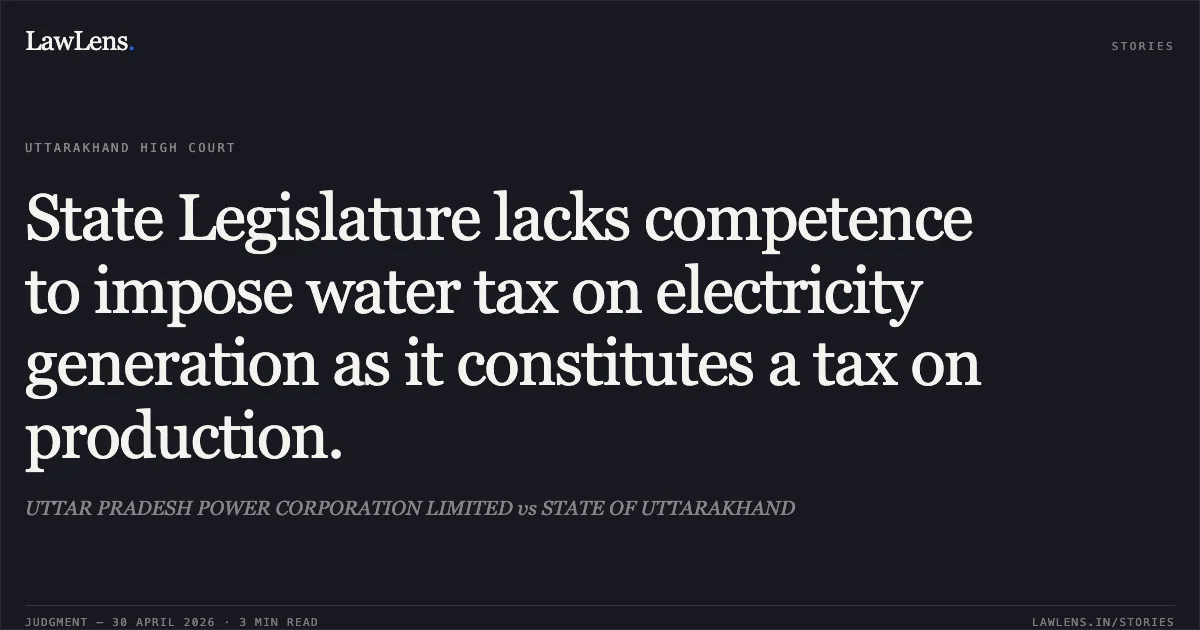
The Court held that the Uttarakhand Water Tax on Electricity Generation Act, 2012, is ultra vires the Constitution as the State Legislature lacks the competence to tax electricity generation
The Court further held that Section 17 of the Act suffers from unconstitutional excessive delegation
Source reference: para 46the plea of promissory estoppel was rejected as it does not apply against legislative action
Source reference: para 73The reference was answered in favor of striking down the Act, concurring with the view of Justice Ravindra Maithani
Source reference: para 46, 74Acts & Sections Cited
20 provisions across 1 statute referred to in this judgment. Each provision opens on LawLens.
Uttarakhand water tax and electricity Generation Act
Original Court PDF
UTTAR PRADESH POWER CORPORATION LIMITEDvsSTATE OF UTTARAKHAND
Click to open original judgment
Original judgment, available to read, download and summarize on LawLens.in