Facts
Several hydroelectric power companies challenged the constitutional validity of "The Uttarakhand Water Tax on Electricity Generation Act, 2012," which imposed a tax on water drawn for power production.
Source reference: para. 1A Coordinate Bench of the High Court initially dismissed the writ petitions in 2021.
Source reference: para. 1On appeal, a Division Bench delivered a split verdict on 25.10.2023: the Chief Justice upheld the Act, while the companion judge struck it down as ultra vires.
Source reference: para. 2The matter was referred to a third judge (Alok Kumar Verma, J.) to resolve the deadlock.
Source reference: para. 2The appellants argued that the State lacked legislative competence to tax electricity generation and that the tax violated prior "Implementation Agreements" exempting them from such levies.
Source reference: paras. 7-15Issues
1. Whether the true nature (pith and substance) of the tax under the Act is a tax on "drawal of water" or a tax on the "generation of electricity"
Source reference: para. 302. Whether the State Legislature possesses the competence to enact such a law under Entries 17, 18, 45, 49, or 50 of List II or Article 288 of the Constitution
Source reference: paras. 3-4, 513. Whether Section 17 of the Act suffers from the vice of excessive delegation by allowing the Government to fix tax rates without legislative guidelines
Source reference: para. 434. Whether the State is barred by the doctrine of promissory estoppel from imposing the tax due to existing agreements with the power companies
Source reference: para. 67Law Applied
The Court applied the Doctrine of Pith and Substance to determine the true character of the levy, noting that nomenclature is not conclusive.
Source reference: para. 33Taxation is a distinct matter and the power to tax cannot be derived from a general (non-taxing) legislative entry, as established in M.P.V. Sundararamier and Co. v. State of A.P. and State of W.B. v. Kesoram Industries Ltd.
Source reference: paras. 7, 13, 65Requirements of Entry 49 List II (Taxes on lands/buildings) as per Union of India v. H.S. Dhillon.
Source reference: para. 59While fixing rates can be delegated, the legislature must provide policy guidelines to avoid "naked delegation".
Source reference: paras. 45-46There is no promissory estoppel against the legislature in the exercise of its legislative functions, as per M/s Hero Motocorp Ltd. v. Union of India.
Source reference: para. 70Reasoning
The Court analyzed the Act’s charging section and definitions, observing that water is only taxed if drawn specifically for "generation of electricity".
Source reference: paras. 35, 39It determined that the "taxable event" is tied to electricity production rather than mere water usage, thus the tax is in pith and substance on electricity generation.
Source reference: para. 46The Court rejected the State's reliance on Entry 49 (Land) and Entry 50 (Mineral rights), holding that water used in this context does not constitute a "unit of land" nor a "mineral" in the universal sense.
Source reference: paras. 59, 61Section 17 of the Act provided no maximum limits or policy guidelines for the executive to fix tax rates, amounting to an unconstitutional abdication of essential legislative functions.
Source reference: para. 45-46While the Court found the Act unconstitutional for lack of competence, it disagreed with the appellants on promissory estoppel, noting that contractual promises by the Executive cannot override the Sovereign Legislature’s power to tax.
Source reference: paras. 69, 73Holding
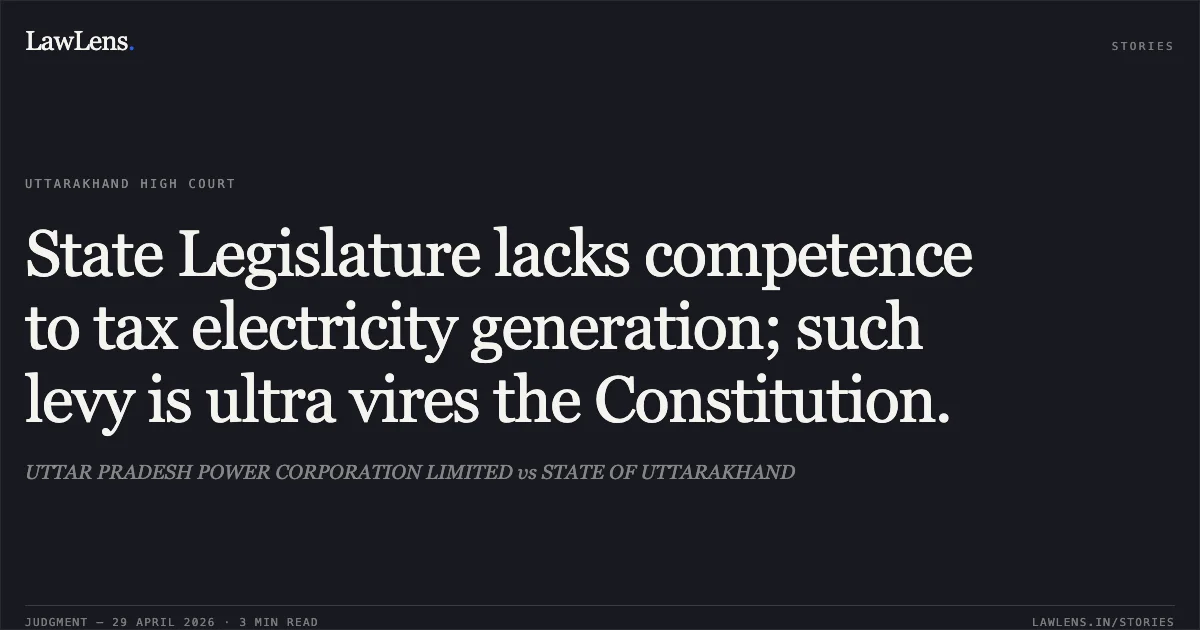
The Court answered the reference by concurring with the opinion of Ravindra Maithani, J. and holding that the Act is ultra vires the Constitution.
The tax is on the "generation of electricity," a field for which the State Legislature lacks competence under List II.
Source reference: para. 66Section 17 of the Act is void due to excessive delegation.
Source reference: para. 46The plea of promissory estoppel is not maintainable against the exercise of legislative power.
Source reference: para. 73The reference was answered in favour of the appellants, effectively striking down the Act.
Source reference: para. 74Acts & Sections Cited
20 provisions across 1 statute referred to in this judgment. Each provision opens on LawLens.
Uttarakhand water tax and electricity Generation Act
Original Court PDF
UTTAR PRADESH POWER CORPORATION LIMITEDvsSTATE OF UTTARAKHAND
Click to open original judgment
Original judgment, available to read, download and summarize on LawLens.in